Recall the end of week 1
A finite system must discard most of its world, and the discarding is not reported. We found one instance with a card.
The question we left open
Is that a fact about eyes, or about any system that has to sense at all?
Where this week sits
| Now | Part | Weeks | What it does |
|---|---|---|---|
| → | Premise | weeks 1–2 | the constraint, and what a sense organ is for |
| Interior models | weeks 3–7 | trace, association, map, prediction, self | |
| Control group | weeks 8–10 | other minds, as the only outside vantage | |
| The human case, and its limits | weeks 11–12 | the catalogue, and the blind spot |
The third part is not a tour. It is the only place a bound is visible from outside, which is what the fourth part needs.
What a sense organ is for
SLOP3233 · Week 2 · Rosalind Achebe
Part 1 — sensing with nothing held
A bacterium solves this with one number
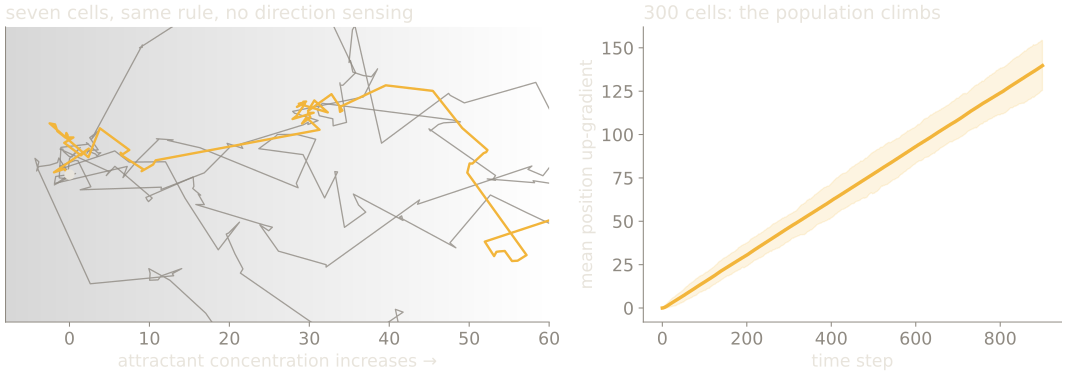
The entire decision rule: if things are improving, keep going; otherwise turn at random.
What is and is not in that rule
| Not present | Present |
|---|---|
| a direction to the food | receptor occupancy now |
| a representation of the target | occupancy a few seconds ago |
| a map, a plan, a goal | two motor states |
It climbs a gradient with no ability to sense which way the gradient points.
It does not know where the food is. It knows whether things are getting better.
Watch your verbs
| You want to write | It licenses | What is actually held |
|---|---|---|
| “seeks”, “searches for” | a goal | — |
| “senses the gradient” | a spatial quantity | — |
| “compares” | two stored values | one recent value, and a sign of change |
Where the memory actually is
The comparison needs a stored past, and in E. coli it is receptor methylation.
Ligand binding drives a fast response; methylation state adapts on a slower timescale, restoring the baseline. The difference between the two timescales is the memory — a few seconds of it.
So “is it getting better?” is implemented as “does current occupancy exceed what the methylation state has adapted to?”
Which is worth dwelling on
The memory is not a record. It is an adaptation offset, a moving baseline that the current signal is compared against.
Nothing stores a value. Nothing is retrieved. And it is enough.
Macnab & Koshland, PNAS 69(9), 2509–2512 (1972); Berg, E. coli in Motion (2004).
The numbers, because they constrain the story
| Quantity | Value |
|---|---|
| Swimming speed | ~20–30 body lengths per second |
| Run duration | ~1 second |
| Tumble duration | ~0.1 second |
| Adaptation timescale | seconds |
| Detectable change in occupancy | a few percent |
A cell that reorients every second cannot be using a spatial comparison across its own body — it is far too small and too fast. Temporal comparison is the only option its physics leaves open.
Von Uexküll’s term for this
The Umwelt: not the environment, but the world as it exists for that organism, built entirely from the distinctions its receptors can make.
His example is a tick, whose world reduces to butyric acid, warmth, and hair. Not an impoverished version of our world. A different one, complete in itself.
A Foray into the Worlds of Animals and Humans (1934).
So the question changes shape
Not “how much of the world does this organism perceive?”
But “which distinctions did it commit to paying for?”
That reframing is what makes the next animal comprehensible rather than absurd.
Now the useful animal
Twelve channels against your three
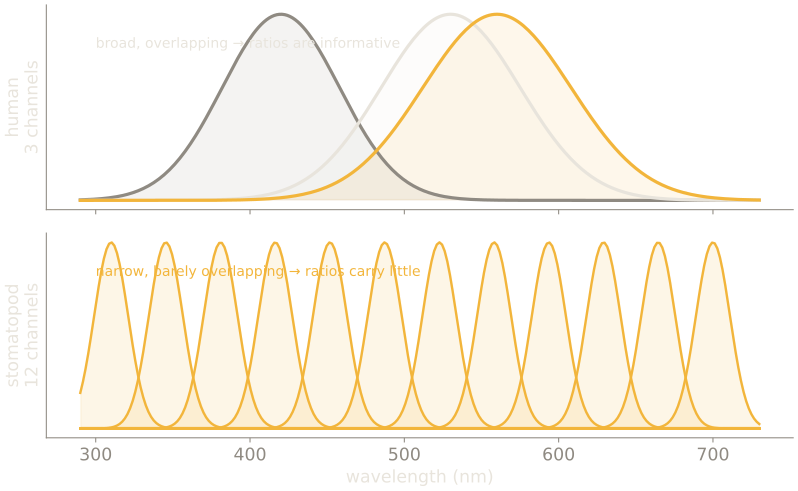
Gaussian approximations at published peak positions — for channel shape and spacing, not digitised microspectrophotometry.
Why channel shape decides what you can resolve
Colour discrimination in us works by comparing across channels. Broad, overlapping sensitivities mean a small wavelength shift changes the ratio between two channels measurably.
Narrow, barely-overlapping channels give you excellent identification of which band a wavelength fell in, and almost no information about where inside the band it fell.
Discrimination, measured
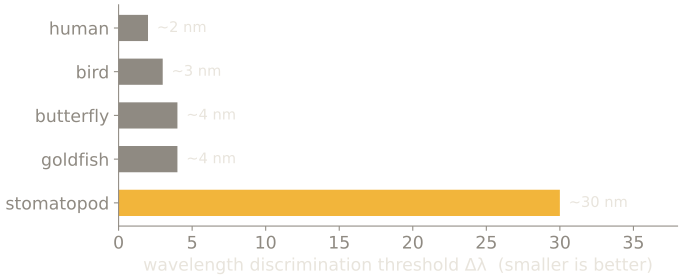
Thoen et al., Science 343(6169), 411–413 (2014). Bars are indicative of the reported ten-fold ratio rather than digitised values.
The hypothesis predicts a number
If the animal reads which bin fired hardest and cannot resolve within a bin, then its discrimination threshold should be about one bin wide.
spectral range covered  =  720 − 300  =  420 nm
receptor classes        =  12
bin width               =  420 / 12   =  35 nm
Check it against the measurement
predicted Δλ (one bin)        ≈  35 nm
measured Δλ (Thoen et al.)    ≈  25–30 nm
comparison animals            ≈   1–4 nm
The prediction lands in the right place, and the comparison animals are an order of magnitude away from both.
That is a great deal better than the hypothesis merely sounding plausible, and it is why this is [C] rather than [S].
The moral
A story about a mechanism becomes a scientific claim when it commits to a number you can be wrong about.
“It scans like a barcode reader” is a metaphor. “Its threshold should be about one bin wide” is a prediction, and the prediction can be checked.
Ask this of every mechanism in the remaining ten weeks.
The popular claim does not overstate the finding. It inverts it.
Two ways to use twelve channels
Why you would build that
Prey or mate, decided before a strike you cannot recall.
That, not which.
Mechanism still unresolved — a 2021 review says so. [C]
The thing they can do that we cannot
Stomatopods are sensitive to polarisation, including circular polarisation, the only animals known to be.
Which is the same story from the other side: the channels they built are excellent for a distinction we cannot make at all, and poor for one we make easily.
Neither system is better. They are priced differently.
A case where nobody knows the answer
Magnetoreception. Many animals demonstrably use the geomagnetic field to navigate. Two candidate mechanisms have been argued for decades:
| Mechanism | Idea | Problem |
|---|---|---|
| Radical pair | light-dependent quantum effect in cryptochrome | hard to demonstrate in vivo |
| Magnetite | ferrous particles acting as a compass needle | receptor cells not conclusively identified |
A sense we are certain exists and cannot explain. [C], and a useful reminder that this course’s confidence varies by topic.
What would falsify the barcode account?
Worth asking, because this is the first [C] claim you are asked to hold.
- Behavioural discrimination that is fine within a single receptor band would break it — the account predicts you cannot resolve inside a bin
- Neural evidence of opponent comparison between adjacent channels would break it
- A species with the same twelve channels and good discrimination would break it
None of those has been shown either way, which is what [C] means here.
The lesson that carries to week 7
This is a News and Views claim
A popular statement that inverts its source is exactly the shape your week 7 investigation is looking for.
And note the trap in the brief: a popular version that is merely less detailed is not wrong, and a thousand words discovering that journalists simplify has found nothing.
The mantis shrimp is not available, it is the worked example.
Part 3 — what a sensory system commits to
Three Umwelten, priced differently
| Organism | Commits to | Pays with |
|---|---|---|
| Tick | butyric acid, warmth, hair texture | no vision, no navigation, years of waiting |
| E. coli | one scalar, compared over seconds | no spatial sense of anything |
| Stomatopod | twelve spectral bins, polarisation, speed | ~10× worse hue discrimination |
None of the three rows is a deficient version of another. Each is a budget spent.
Which is the question to carry into week 3
Not how much does this organism perceive.
What did it commit to paying for, and what did that purchase cost it?
Every remaining week of the course is a version of that question, including the weeks about you.
Seminar
Does the 2014 result license “the mantis shrimp has poor colour vision”?
Not quite. Work out why.