Week 1 Seminar: A world too large
The constraint the whole course runs on, and the grading scheme you will use every week after this one.
Bring a plain white card and a pen. That is the whole equipment list for the semester.
The constraint#
We start with something that is not a fact about brains but a fact about systems. A finite thing embedded in a world larger than itself cannot represent that world; it can only represent some compression of it, and every compression throws information away. Ashby put the formal version in 1956 — a regulator needs at least as much variety as the disturbances it has to counter — and Shannon had already given us the mathematics of what it costs to throw things away on purpose.
This is worth getting straight before any biology arrives, because it means the interesting question is never “how much intelligence does this animal have”. It is “what did this system decide not to represent, and what did that buy it”.
The card#
Twenty minutes of the seminar goes on the oldest demonstration in the course. You will map the blind spot in your own eye, the patch of retina where the optic nerve leaves and there are no photoreceptors at all. It is roughly the size of nine full moons. You have had it your entire life and have never once seen a hole.
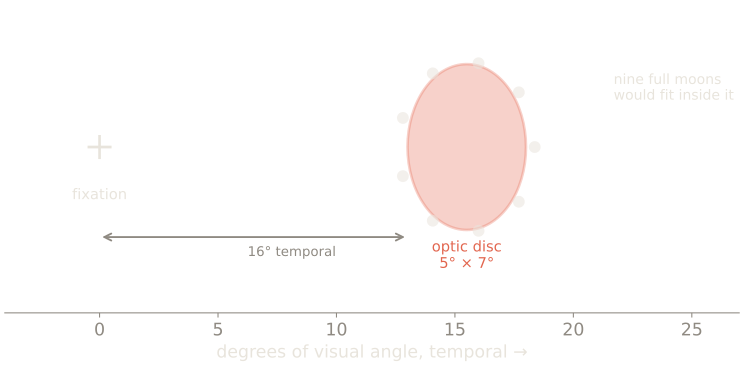
The optic disc, to scale. Nine full moons fit inside it, about fifteen degrees off fixation in each eye.
What you are looking at when the dot disappears is not the gap. It’s the filling — your visual system has been generating plausible content across that region continuously, without flagging it, and you had no way to know. Hold onto the structure of that, because in week 12 we come back to it with a harder version: the blind spot you can’t find with a card.
The grading scheme#
The rest of the session sets up the notation you will use all semester. Every substantive claim on this site carries one of three grades — [E] for established, [C] for contested, [S] for speculative — and by week 3 you will be assigning them yourself.
We practise on four claims, two of which are wrong in ways that took the field a long time to notice. Nobody gets all four right, and the point of doing it in week 1 rather than week 10 is that you find out early that “sounds right” and “is supported” are different properties of a sentence.
What you leave with#
The reading for week 2, and the brief for the position statement due at the end of next week. Write that before you do the reading, not after. It is the only piece of work in this course that is better for being uninformed.
Reading#
The paper this seminar is built around:
- Shannon (1948). A mathematical theory of communication. Bell System Technical Journal.
The rest of the week’s reading:
- Conant and Ashby (1970). Every good regulator of a system must be a model of that system. International Journal of Systems Science.
- Ramachandran and Gregory (1991). Perceptual filling in of artificially induced scotomas in human vision. Nature — the experimental version of the card you used in the seminar, and the reason “you see the filling, not the gap” is a finding rather than a turn of phrase.
- Ashby (1956). An Introduction to Cybernetics. Chapman & Hall — the law of requisite variety. No DOI; the full text is freely available.
- von Uexküll (1934/2010). A Foray into the Worlds of Animals and Humans. University of Minnesota Press — where the Umwelt comes from.
- Godfrey-Smith (2016). Other Minds, chapters 1–2. Farrar, Straus and Giroux.
Grades are not attached to papers here, because a grade belongs to a claim rather than to the paper it appears in — see evidence grades. Several of these papers contain claims at two different grades.
The spec
What you bring to the session. Written so a reader can tell whether it has been met without asking you.
- you can state the constraint any finite system faces, in one sentence, without using the word intelligence
- you have found your own retinal blind spot and can say why you had never noticed it
- you can assign an evidence grade to a claim and defend the grade rather than the claim
Teaching team
- Halvard Emms — convenor