Where this week sits
| Now | Part | Weeks | What it does |
|---|---|---|---|
| → | Premise | weeks 1–2 | the constraint, and what a sense organ is for |
| Interior models | weeks 3–7 | trace, association, map, prediction, self | |
| Control group | weeks 8–10 | other minds, as the only outside vantage | |
| The human case, and its limits | weeks 11–12 | the catalogue, and the blind spot |
The third part is not a tour. It is the only place a bound is visible from outside, which is what the fourth part needs.
How and Why You’re Dumb
SLOP3233 · Week 1 · Halvard Emms
You are a finite thing inside a world that is not.
Part 1 — the constraint, before any biology
A system smaller than its world must throw things away
Ashby, 1956: you cannot regulate what you cannot represent
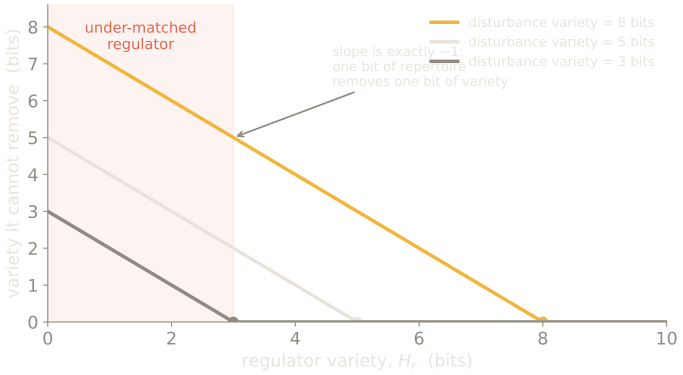
Requisite variety: the number of distinct responses a regulator can make. Ashby’s law puts a floor on what it cannot absorb:
H(outcome) ≥ H(disturbance) − H(regulator)
The slope is −1 by construction
One bit of repertoire removes one bit of variety, and not a fraction more.
Worked, with numbers
A thermostat that can only switch a heater on or off has H(regulator) = log₂ 2 = 1 bit.
Suppose the disturbances it must counter — outdoor temperature, occupancy, sunlight, draughts, door openings — jointly take 32 distinguishable states, so H(disturbance) = log₂ 32 = 5 bits.
H(outcome) ≥ 5 − 1 = 4 bits of variation it cannot removeSanity check: buy a regulator with 32 settings and the floor drops to 5 − 5 = 0. Buy one with 64 and it stays at 0 — extra repertoire past the disturbance variety buys nothing.
The moral
Ashby’s law is not advice about thermostats.
It says the shape of what a system cannot control is fixed by its own repertoire, and no cleverness in how the repertoire is deployed changes the floor.
Every organism in this course is somewhere on that inequality.
Read the left-hand region
A regulator with fewer distinguishable responses than the world has distinguishable disturbances leaves the remainder standing —
however cleverly it is organised.
No amount of architecture substitutes for repertoire. That is what makes it a law rather than a design guideline.
Conant & Ashby, 1970: so the model is not optional
Any successful regulator contains a model of what it regulates.
So only its accuracy is negotiable.
Shannon gave us the price list
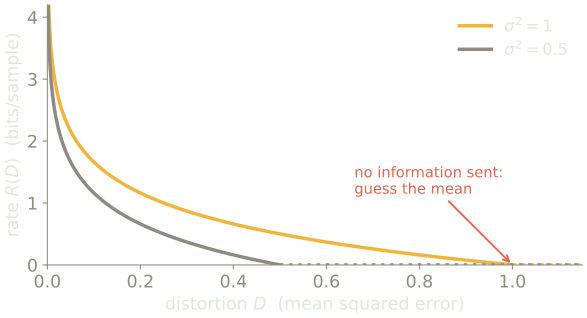
The exact closed form, not a sketch: R(D) = ½·log₂(σ²/D).
Past D = σ² the rate is zero — you send nothing and guess the mean.
Three results, one claim
| Year | Result | What it forbids |
|---|---|---|
| 1948 | Rate–distortion (Shannon) | fidelity beyond your channel capacity |
| 1956 | Requisite variety (Ashby) | regulating variety you cannot represent |
| 1970 | Good regulator (Conant & Ashby) | regulating without a model at all |
None of the three is about biology. All three constrain it.
Why start here rather than with an animal
Because the alternative is circular.
If you begin by asking “how intelligent is this organism”, you have already assumed intelligence is a quantity on a single scale, which is the assumption week 8 destroys and week 12 turns on us.
Beginning with the constraint means the question becomes: what did this system decide not to represent, and what did that buy?
That question has an answer for a bacterium and for you.
Take out your card
The optic disc: no photoreceptors, no report
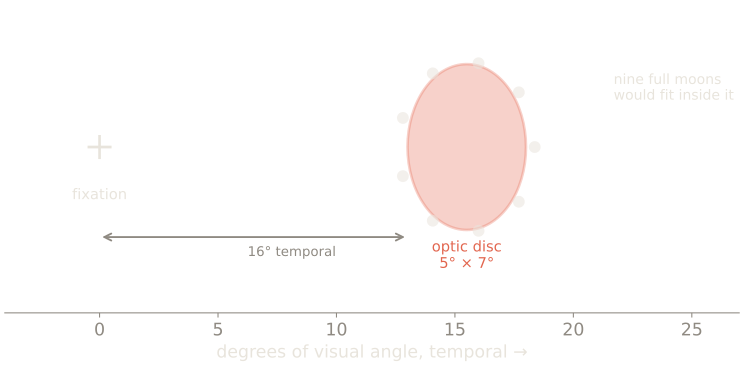
Roughly 15° temporal, about 5° × 7°. The full moon subtends half a degree.
Which is to say
Nine full moons of nothing, in each eye, about fifteen degrees out from wherever you are looking.
Present since birth. Never once reported.
What you are about to watch is not the gap
Not the gap. The filling.
But be careful what you conclude from it
There is a real dispute here, and it is a good first taste of what this course does with disputes.
Ramachandran and others describe the visual system as actively filling in — generating plausible content across the gap, like an interpolation.
Dennett argues nothing is filled in. The system simply does not represent the absence, and there is no need to paint anything, because nobody is looking at an internal canvas.
The two accounts predict differently
| Question | Filling-in | Not-representing-absence |
|---|---|---|
| Is content generated? | yes | no |
| What would you find in cortex? | activity coding the interpolated pattern | nothing where the gap is |
| Why no hole is seen | the hole was painted over | there is no mechanism that reports holes |
Some V1 studies do find responses consistent with interpolation, which pushes toward the first. Grade [C] — and notice that both accounts explain your experience equally well, which is exactly why the experience cannot settle it.
Part 3 — the instrument you use all semester
The notation you will use every week
Where [C] actually sits
| Grade | Not this | But this |
|---|---|---|
| [E] | “true” | replicated, or nobody is arguing |
| [C] | “we don’t know yet” | the disagreement is the content |
| [S] | “guessing” | reasoned past the evidence, and labelled |
Grade these before I tell you
- Octopuses have eight independent brains.
- Ego depletion: self-control is a limited resource that runs down with use.
- The mantis shrimp sees millions more colours than humans.
- Slime moulds can navigate a maze.
Write [E], [C] or [S] beside each. Two minutes.
The answers, and why they are uncomfortable
| Claim | Grade | Why |
|---|---|---|
| 1 · eight brains | [S] | arms hold most neurons and act locally, but “brains” imports more than the evidence |
| 2 · ego depletion | [C] | 23 labs, N = 2,141, no effect — and still argued over |
| 3 · mantis shrimp colours | [E] that it is false | discrimination measured ~10× worse than a goldfish |
| 4 · slime mould maze | [E] | replicated, and the mechanism was identified by removing the cue |
What that exercise was for
Three of those four are things you had probably heard. One of them is confidently repeated and inverts its source.
“Sounds right” and “is supported” are different properties of a sentence, and you cannot tell them apart by introspection — which is the first appearance of week 12’s problem, in week 1, about you.
Four claims. Two are wrong.
Before next week, in this order
What this course is not
- Not a survey of clever animals. Weeks 8–10 are a control group, and they exist to test whether the account generalises.
- Not a ladder. There is no scale with bacteria at one end and us at the other. Scala naturae is what evolutionary biology spent a century dismantling.
- Not a list of your cognitive biases. Week 11 is largely about why that literature is less secure than its popularity suggests.
What is assessed, and when
| Piece | Weight | Due |
|---|---|---|
| Position statement | hurdle, 0% | end of week 3 |
| News and Views investigation | 25% | week 7 |
| Revision and memo | 20% | week 11 |
| Calibrated quizzes | 15% | weekly, best 8 of 10 |
| Cognitive profile | 40% | week 12 |
Two of those are unusual enough to explain now.
The quizzes will make your score look bad
They use certainty-based marking: you declare how sure you are, and a confident error costs six marks where a hedged one costs nothing.
Students at 80% accuracy typically collect about half the available marks.
That gap is not a scoring quirk. It is the subject of week 12, arriving in week 2 and in your own results.
The quiz scoring, worked
| Declared certainty | If correct | If wrong |
|---|---|---|
| low | +1 | 0 |
| mid | +2 | −2 |
| high | +3 | −6 |
Let p be your true probability of being correct. Expected score is linear in p:
E[low]  = 1p + 0(1−p) =      p
E[mid]  = 2p − 2(1−p) = 4p − 2
E[high] = 3p − 6(1−p) = 9p − 6
Where the advice changes
Set the lines equal:
low = mid    →   p = 4p − 2    →   p = 2/3  ≈ 0.667
mid = high   →   4p − 2 = 9p − 6   →   p = 4/5 = 0.800
Sanity check: those are the 67% and 80% thresholds the scheme publishes. They were not chosen by anyone. They fall out of the payoff table.
Which is what “proper” means
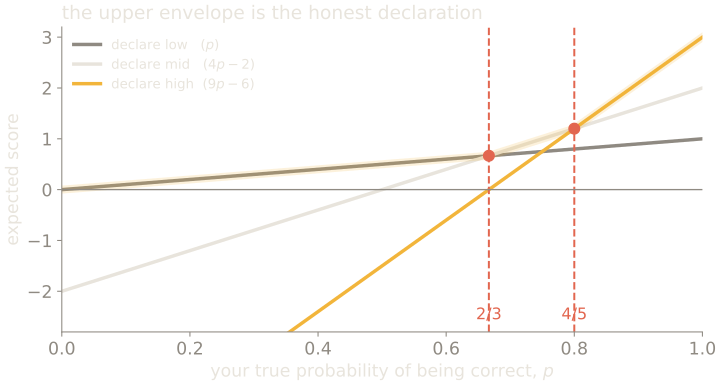
The highest line at your actual p is always the one that reports your actual p. No misreport beats honesty.
The moral
You cannot improve your score by managing how confident you look.
The only lever is being better calibrated — which is the one thing the course is trying to teach, and the reason the scheme was chosen over ordinary negative marking.
And the position statement is deliberately uninformed
~500 words, before you do any reading, on what you currently think intelligence is and where it starts.
Not marked. Submitting it is a hurdle. It cannot be extended past week 3, because a statement written in week 8 has already been contaminated by the thing it is meant to predate.
In week 11 you revise it, and the memo explaining what moved is what earns the marks.
Week 12 asks this again
The card found a gap your visual system never reported.
The last week asks what else is shaped like that, and has no card.