Recall the end of week 7
The self-model is necessarily a summary, and introspection reads the summary rather than the process.
The question we left open
Seven weeks built one account. Does any of it describe minds that are not vertebrates?
Where this week sits
| Now | Part | Weeks | What it does |
|---|---|---|---|
| Premise | weeks 1–2 | the constraint, and what a sense organ is for | |
| Interior models | weeks 3–7 | trace, association, map, prediction, self | |
| → | Control group | weeks 8–10 | other minds, as the only outside vantage |
| The human case, and its limits | weeks 11–12 | the catalogue, and the blind spot |
The third part is not a tour. It is the only place a bound is visible from outside, which is what the fourth part needs.
A million neurons is plenty
SLOP3233 · Week 8 · Rosalind Achebe
Where we are
Seven weeks built an account. From here to week 10 we stop adding to it and start testing it.
If it only describes vertebrates, it was never an account of intelligence.
Part 1 — the puzzle
Darwin already had it, 1871
“The brain of an ant is one of the most marvellous atoms of matter in the world, perhaps more so than the brain of man.”
And the intuition it cuts against
| System | Mass | Neurons |
|---|---|---|
| Blue whale | up to 9 kg | >200 billion |
| Human | 1250–1450 g | ~85 billion |
| Honeybee | ~1 mm³ | fewer than 10⁶ |
Corvids and parrots perform comparably to great apes on some tasks.
Bees learn abstract rules.
A million-fold shortfall in hardware, and not a million-fold shortfall in behaviour.
Counts from Chittka & Niven, Current Biology 19(21), 2009.
An old and bad answer
1850 — Dujardin proposes the mushroom bodies are the “organs of intelligence” in arthropods, partly because they are enlarged in social insects.
1929 — Pandazis notes the largest mushroom bodies belong to horseshoe crabs.
Pandazis’s own resolution
Size doesn’t matter; wiring does.
Insect mushroom bodies contain cells with extensive dendritic ramifications and connections to all major brain centres — as a centre of higher-order integration requires. Limulus mushroom bodies do not.
That is the move this whole lecture makes, repeatedly.
Part 2 — open the bee
Where a bee’s neurons actually go
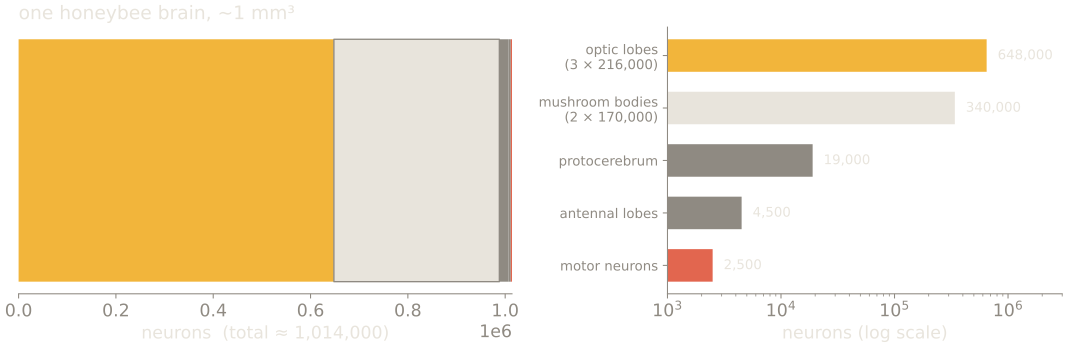
Counts from Chittka & Niven 2009, Fig. 1.
Do the arithmetic
optic lobes      3 × 216,000  =  648,000
mushroom bodies  2 × 170,000  =  340,000
protocerebrum                 =   19,000
antennal lobes                =    4,500
motor neurons                 =    2,500
                                ---------
                                  1,014,000
Sanity check: Chittka & Niven give “fewer than a million neurons” for a ~1 mm³ brain. The parts add to about that, so we have the whole budget and not a subset of it.
Read the first line again
648,000 / 1,014,000 = 0.6464% of the budget is optic lobes.
Lamina, medulla and lobula: ~216,000 cells each.
Two-thirds of the brain is spent before any integration happens at all.
What is left to think with
| Region | Neurons | Job |
|---|---|---|
| Mushroom bodies | ~170,000 × 2 | learning and memory |
| Protocerebrum remainder | ~19,000 | integration, projections to pre-motor |
| Antennal lobes | ~4,500 in ~160 glomeruli | olfaction |
| Deutocerebrum | ~2,500 | motor output |
Nineteen thousand neurons, for everything the mushroom bodies don’t do.
And it runs 59 distinct behaviours
Chittka and Niven enumerate them. A sample:
aggressive flight · alarm fanning · antennation · attend dance · beg food · brief piping · brood incubation · build comb · buzz run · cap brood · colony fission · corpse removal · dorsoventral abdominal vibration · expulsion of drones · guarding · lateral shake · robbing other hives · scouting for food · sickle dance · sterzeln · tremble dance · waggle dance · worker policing
Part 3 — so what does a big brain buy?
Mostly: more of the same
Visual sampling
| Eye | Sampling units |
|---|---|
| Fruit fly eye | 700 ommatidia |
| Large dragonfly | 30,000 |
| Human fovea alone | 60,000 cones |
| Human retina | ~400,000 “pixels” |
Olfactory sampling
| Species | Glomeruli |
|---|---|
| Fruit fly | 43 |
| Honeybee | ~160 |
| Human | ~350 |
| Mouse | ~1000 |
Finer resolution, higher sensitivity, more precision. Not new operations.
The same pattern centrally
Primary visual cortex area:
mouse 4.5 mm² → macaque 1200 mm² → human 3000 mm²
A ~670-fold increase, largely engaged in low-level feature extraction, without necessarily increasing the diversity of ways information is processed.
Convergence worth noticing
Insects and vertebrates arrived at the same architecture independently: retinotopic maps built from local circuits — “cartridges” or columns — repeated hundreds or thousands of times.
Same solution, and no common ancestor that had it.
Part 4 — and the motor system isn’t simpler
Skeletal muscle counts
| Animal | Muscles |
|---|---|
| Weasel | 322 |
| Primates | 316 |
| Migratory locust | 296 |
| Rat, hare | ~215 |
| Opossum | 159 |
An insect sits inside the mammalian range. Chittka & Niven 2009, Fig. 3.
With strikingly few neurons controlling them
Desert locust flight:
- 72 motor neurons innervating 34 muscles
- the flight central pattern generator is 3 neurons
Vertebrate limb muscles are typically innervated by tens of motor neurons; highly innervated insect muscles have fewer than fifteen.
Why that matters for the account
Novel behaviour does not require novel hardware.
It can come from few neurons recruiting existing motor circuits in a different order — which is cheap, and which is why repertoire size does not track brain size.
Part 5 — the comparison that settles it
Repertoire against brain mass
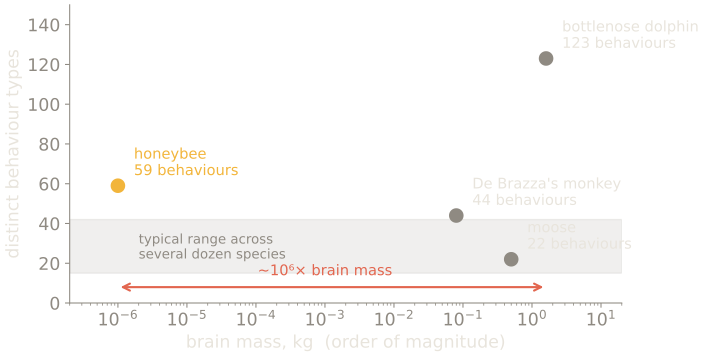
The number to remember
A million-fold increase in brain mass buys a mammal two to three times the number of behaviour types.
Not a million times. Two to three.
Part 6 — but is it cognition?
Delayed matching-to-sample, in a bee
Train: see pattern A, then choose between A and B. A is rewarded.
Then: bees generalise to “choose the same one” with entirely different stimuli — pattern C, then C and D — having never seen them.
They transfer the sameness rule across modalities, from olfactory entrainment to visual test. And they learn the inverse: choose the odd one.
Two objections you must be able to state
Horridge
Bees may extract only low-level cues, edge orientation, contour length, spectral content — and never represent “sameness” at all.
Dennett’s Sphex
The digger wasp, its provisioning interrupted, repeats the whole routine indefinitely. Complex behaviour, no comprehension.
Grade the sameness-concept claim [C] and say what would move it.
Srinivasan’s inversion
The interesting possibility isn’t that bees manage rules despite small brains.
It’s that rule learning, concept formation and categorisation may be adaptive because of miniaturisation, combining objects under one category economises on memory, rather than storing each instance.
Constraint as the cause of abstraction. Keep that for week 12.
Part 7 — count the right thing
Olkowicz et al., 2016
28 avian species, isotropic fractionator.
- Parrot and songbird brains hold roughly twice the neurons of primate brains of equal mass
- A higher proportion sits in the pallial telencephalon
- So large parrots and corvids match or exceed monkeys with far larger brains on forebrain neuron count
PNAS 113(26), 7255–7260.
They were never small in the currency that matters.
Which is what this part is for
Our intuitions about which minds are capable were tracking the wrong quantity for decades.
We found that out by measuring a lineage from outside it. Nobody discovered it by introspecting about brains.
And the same argument, pointed at us
Herculano-Houzel — a co-author on that paper — on the human brain:
an ordinary primate brain scaled up, with no special encephalisation.
What is unusual is the absolute cortical neuron count, and the metabolic budget required to run it.
Part 8 — the ant
Two quantities, two mechanisms
Cataglyphis fortis, Saharan salt-pan forager. No pheromone trail — too hot, too volatile.
| Quantity | Source |
|---|---|
| Direction | celestial compass, polarised skylight |
| Distance | a stride integrator |
The second one is the claim that needed proving.
The design is the argument

Wittlinger, Wehner & Wolf, Science 312, 1965–1967 (2006).
Work the stilts
Say an ant walks 10 m out with a natural stride of 10 mm. Its integrator therefore holds:
strides counted = 10.0 m / 0.010 m = 1,000Glue on stilts so the stride becomes 13 mm, then let it run home. It runs until the count is repaid:
distance covered  =  1,000 × 0.013 m  =  13.0 m
overshoot         =  13.0 − 10.0      =   3.0 m
And the stumps
Trim the legs so the stride becomes 7 mm:
distance covered  =  1,000 × 0.007 m  =   7.0 m
undershoot        =  10.0 − 7.0       =   3.0 m
Sanity check: the error is proportional to the stride change, and to the outbound distance. A longer foraging trip makes the same manipulation worse in absolute terms — which is what the experiments found.
The moral
The ant is not measuring distance. It is counting a proxy and multiplying by an assumed constant.
Change the constant after the count and the arithmetic is still perfect. The answer is simply wrong, and nothing inside the calculation can notice.
Why the control is the clever part
Manipulating before the outbound run leaves navigation intact.
The ant counts the same stride length in both directions, so the error cancels.
That single condition rules out optic flow, energy expenditure and elapsed time in one move.
Robust in ways that are informative
The distance estimate survives:
- carrying heavy prey
- walking backwards
- losing one or two legs
It’s a stride integrator that compensates for stride length and walking speed, not a naive step counter. Follow-up: J Exp Biol 210(2), 198–207 (2007).
And bees do it completely differently
Walking insects integrate strides. Flying insects use optic flow.
Same computational problem, two unrelated solutions, chosen by what the body makes available.
What is stored is a vector
Not a route
A route would let you retrace, cross-check, and recognise where you had been.
A vector is a bearing and a distance, continuously updated.
So the ant always knows where home is —
and never knows how it got where it is.
Which has a consequence you can compute
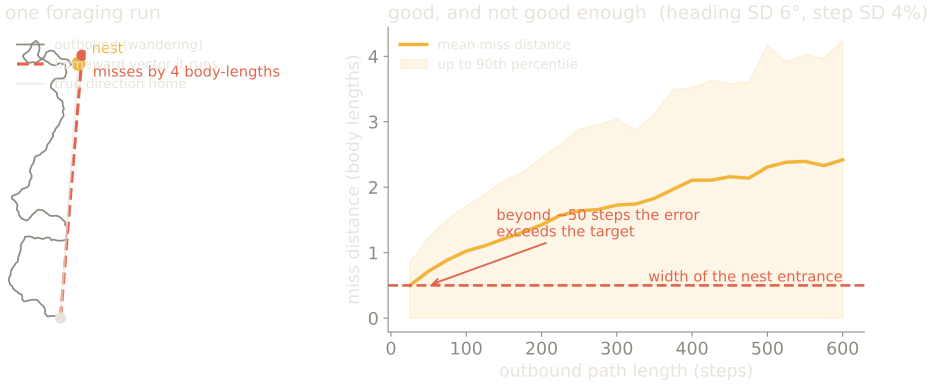
Simulation: per-step heading error SD 6°, step-length error SD 4%, seeded.
The result is not what you would guess
The integrator is good. Errors partly cancel on a wandering path, so the miss grows roughly as √n and stays within a few body lengths.
It is still not good enough — because the target is a hole.
Past ~50 steps the expected error exceeds the nest entrance.
So the spiral is not a failure
Arriving in the right place stops being the same as finding it.
The systematic search at the end of the homeward run is the only available remedy for an accumulator with no external reference.
An ant that is lost behaves exactly like an ant that is not.
Take that sentence to week 12
No independent reference means no error signal.
No error signal means the failure is invisible from inside, and no amount of better engineering within that design removes it.
You can see the ant’s bound because you are outside it.
The ant is also a worked example
Because that was a cognitive profile
Everything in Part 8 maps onto the sections of the assessment you are writing. Deliberately, so you have seen one done before you attempt one.
The mapping, section by section
| Profile section | The ant, from this lecture |
|---|---|
| 1 · the organism, and why | Cataglyphis fortis — decisive experiments, clean limits |
| 2 · sensory channels | polarised skylight; no pheromone trail, too volatile |
| 3 · what it computes, and what it stores | integrates stride count and bearing; stores a vector, not a route |
| 4 · what it does better than us | maintains a homeward bearing over 100 m of wandering, unaided |
| 5 · what it cannot represent | the outbound path itself |
And the sections where marks concentrate
| Profile section | The ant |
|---|---|
| 6 · demonstrated failures | stilts overshoot, stumps undershoot (Wittlinger 2006) |
| 7 · failures with no fix | accumulator has no independent reference — no internal remedy exists |
| 8 · what it cannot detect about itself | its own accumulated error |
| 9 · comparison with people | same structure as our confidence miscalibration: the checker is the checked |
| 10 · sources and grades | 2006 Science paper [E]; play and REM claims [C] |
Read section 3 again
stores a vector, not a route
That is a claim about what is held in the animal. Not about what it does.
“It navigates accurately” would be a behavioural claim, and it is the single most common way this section is failed.
And read section 7 again
the accumulator has no independent reference
Not “the ant sometimes gets lost”. A structural limit: no better engineering inside that design removes it, because the checking would have to come from outside the thing being checked.
Section 7 is where weak profiles collapse, and that sentence is the standard.
Part 9 — two things with no obvious function
Bumblebees roll balls
Galpayage Dona et al., Animal Behaviour 194, 239–251 (2022).
- 45 tagged bees; individuals rolled between 1 and 117 times
- they detoured into a ball chamber past a clear path to food
- a second experiment (42 bees) showed colour-chamber preference for balls
- younger bees rolled more; males rolled for longer
No proboscis extension, no biting — so not food-directed. Frequency rose then fell, matching play rather than exploration.
Jumping spiders may dream
Rößler et al., PNAS 119(33), e2204754119 (2022).
The method is the finding: salticids cannot move their lenses, but they can move their retinal tubes, and newly emerged spiderlings are unpigmented enough to watch it happen.
34 spiders showed regular bouts of retinal movement with limb and spinneret twitching, lengthening through the night.
Grade both honestly
[C] and [C].
Note the asymmetry even here. We can state precisely what evidence would settle the question for a bee.
For the same question about ourselves, we cannot say what would count.
Neither tells us what we want it to. “Play” and “REM” are both defined by criteria developed on mammals, and the question of whether those criteria travel is exactly the question.
Seminar: what evidence would move either?
What this week established
Four things
- A small brain is not a scaled-down large one — it is differently apportioned, and mostly it is sensors.
- Scaling buys resolution, not new operations, more glomeruli, more ommatidia, more cortex doing low-level extraction.
- Counting neurons rather than grams dissolves the corvid puzzle — and makes our own brain unnotable for its lineage.
- A system with no external reference cannot detect its own error, the ant, stated once, and the whole of week 12.
Next week
An animal whose nervous system is mostly not in its brain.
And a famous question that may be the wrong shape.