Solitaire
01The deal, and the cast
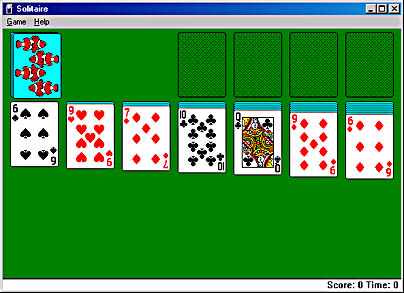
Fifty-two cards, dealt into seven columns: one card in the first, two in the second, and so on to seven, with only the top card of each column face up. What remains becomes the stock, face down, to be turned through when the board runs out of moves. Four empty spaces wait above for the foundations.
The cast is worth naming, because somebody drew every one of them. The deck was designed by Susan Kare, the artist behind the original Macintosh icons — so the visual language of the Mac shipped inside Windows, on the one screen everybody in the office looked at. Several of the card backs were drawn by Leslie Kooy, who described her contributions as the weirder ones: the rainbow shell, the haunted castle, the beach scene, the robot, the hidden ace.
The character you are waiting for is a King. Nothing else can be moved into an empty column, so an early King is a door and a late King is a wall. That is the whole drama of the game and it is entirely outside your control.
02Object of the game
Move all fifty-two cards to the four foundations, each foundation a single suit running ace to king. To free them, build the columns downward in alternating colours — a red six onto a black seven — and turn the stock when there is nothing left to move.
You will not always win. Some deals cannot be won at all, no matter how well they are played, and the game never tells you which one you are looking at. That is an unusual arrangement for something bundled with an operating system: the failure state is often not your fault, and it is never explained.
03Controls
| Drag | Press on a card, hold, move it across the screen, release it in a new place. This is the only gesture the game requires. |
|---|---|
| Click the deck | Turns the stock — one card, or three. |
| Game → Deck… | Chooses the card back. |
| Game → Options… | Sets the draw, the scoring, whether the game is timed, and whether the status bar shows at all. |
| Help → About | Version 3.10, © Microsoft Corp. 1991–1992, developed for Microsoft by Wes Cherry. |
Press, hold, move, release. In 1990 that was the whole syllabus, and this was the classroom.
04Scoring
Three scoring options, and almost nobody changed them from the default. They are more punitive than the game's reputation for gentleness suggests.
Standard
Points for moves that help and deductions for moves that don't. The passes through the deck are where it bites: on Draw One you get one free pass and then lose 100 points for every further one. On Draw Three you get three free passes, then lose 20 points each.
Vegas
You are buying the deck. Draw Three allows three passes and Draw One allows exactly one — and when the passes are used up the game is simply over, solved or not.
Timed
Two points lost every ten seconds, against an end-of-game bonus of 700,000 divided by the number of seconds taken, for any game lasting longer than thirty. Play well and the clock pays; dawdle and it charges you rent.
None
No score at all. Worth naming because it is the setting that admits what the game is actually for.
05The author, and the mouse lesson
Solitaire was written over a summer by Wes Cherry, then a Microsoft intern, and he was paid no royalties for it. It shipped with Windows 3.0 and every consumer version of Windows for decades, which makes it plausibly the most widely distributed piece of work by an unpaid junior in the industry's history.
Read the controls section again and notice what the game is teaching. In 1990 the mouse was not obvious. Plenty of people sitting down at a Windows PC had never dragged anything anywhere, and being told to practise would have been both humiliating and useless. So the required gesture of the game is exactly the motor skill the whole operating system depended on. People practised for hours, voluntarily, and believed they were slacking off.
One feature did not survive. Cherry built a boss key: press it and the game flipped to a fake Microsoft Excel spreadsheet, so anyone walking past your desk saw work. Microsoft asked for it to be removed before release. It is hard to name a cut feature that better understood its own audience.
Checked facts
- Options dialog offers Draw One / Draw Three, scoring Standard / Vegas / None, and a Timed game checkbox; the Game menu holds Deck…, Options… and Exit.
- Standard: one free deck pass on Draw One then −100 per pass; three free passes on Draw Three then −20. Vegas: three passes on Draw Three, one on Draw One.
- Timed play costs 2 points per 10 seconds, with a bonus of 700,000 ÷ seconds for games over 30 seconds.
- About box: Version 3.10, © Microsoft Corp. 1991–1992, “developed for Microsoft by Wes Cherry”.
- Deck art by Susan Kare; several card backs by Leslie Kooy; the boss key was built and cut before release.
Sources: peterc.org's faithful browser recreation of Windows 3.1 Solitaire (menus, Options dialog, About box); Microsoft's own Solitaire documentation as reproduced in Running Microsoft Windows; The Cutting Room Floor (Solitaire, Windows, 1990) for the cut boss key.