Chip's Challenge
01Chip
Chip McCallahan wants to join a computer club. That is the premise, and the game means it. The Bit Busters do not take applications; Melinda the Mental Marvel has built a clubhouse full of lethal rooms, and the membership test is to walk through all of them collecting computer chips.
One hundred and forty-eight puzzle rooms, in service of joining a computer club. It is either the lowest stakes in the medium or the most honest, and either way it explains the tone: nothing in this game is angry at you. It simply has rules, and it applies them.
02Object of the game
Collect the chips the level requires. Carry them into the socket, which will not open until the last one is accounted for. Then reach the exit. Do all of it before the clock in the Information window runs out.
Everything else — the water, the fire, the ice, the monsters walking their fixed patrol routes — exists between you and that sequence.
03Controls
| Arrow keys | Move Chip one square, on the numeric keypad in the Windows version. |
|---|---|
| Mouse | Click the square you want Chip to walk to, however near or far. |
| Information window | To the right of the maze, and it has four displays: the Level, the Time remaining, Chips Left to collect, and an inventory that doubles as the Hint Box. |
| Hints | Stand on a hint tile and the Hint Box tells you what the room wants. This is the only instruction the game volunteers. |
04The tiles, and the boots that survive them
Four hazards, four pairs of boots, one rule each. Every tile below is drawn here in CSS rather than pasted in, because a tile in this game is not a picture — it is a rule with an appearance.
- Water — flippers With flippers you swim. Without them you drown, and the level starts again.
- Fire — fire boots Fire boots let you walk across fire. They do not protect you from a fireball that happens to be travelling through it.
- Ice — ice skates Ice has no friction: without skates you slide until something stops you. With them you walk across it as though it were floor.
- Force floor — suction boots A force floor moves you whether or not you asked. Suction boots let you walk it normally.
- Computer chip The collectible. The Chips Left display counts down as you take them.
- Socket Opens only when the level's chip requirement is met. It is a locked door that counts.
- Exit The end of the room. Step on it and the next one starts.
The boots were not always called that. On the original Atari Lynx the flippers were a water shield and the fire boots a heat shield; the Lynx and the sequel call the skates ice cleats. The rules are identical. Which manual you had depended on which machine you met the game on, which is a small, precise example of why this shelf writes the rules down.
05Reading the board
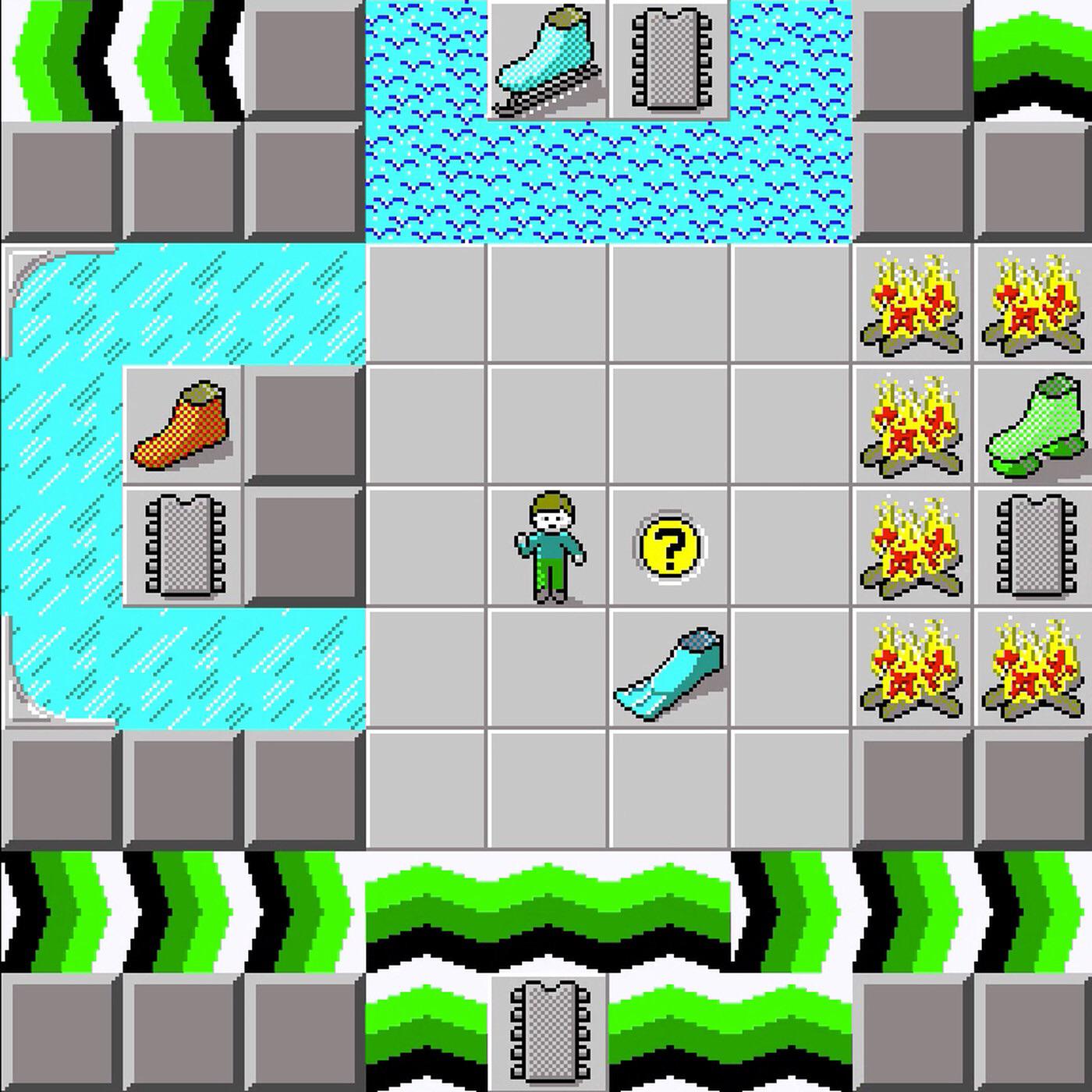
Here is a room. It is not from the game — it is nine tiles by five, assembled from the legend above, and it is readable before you take a single step. That readability is the entire skill the game teaches.
Three chips, and only one route that collects all of them: the force floors run one way, the water needs flippers this room does not contain, and the fire is optional if you take the long way round.
None of this is explained in the moment. Every rule in the game is learned the same way — you walk into it, you die, and now you know. The manual described all of it and nobody read the manual first, which means the real teaching mechanism was consequence. What it trains, room after room, is the habit of surveying before acting.
06Where the rooms end
The Lynx original has 148 levels and ends on one called Fireflies. The Microsoft Entertainment Pack version added a 149th, named simply Special, so the two versions people argue about do not have the same ending. The Windows port also rewrote several hints to match its redesigned boots and different controls, and converted every hint out of the Lynx's all-capitals sprite font into sentence case — a typographic decision inside a puzzle game that quietly changed how the clubhouse speaks to you.
Checked facts
- Designed by Chuck Sommerville, published by Epyx in 1989 as an Atari Lynx launch title.
- The four items besides keys and chips are flippers, fire boots, ice skates and suction boots; fire boots do not protect against fireballs.
- Lynx naming: water shield, heat shield, ice cleats.
- The Information window shows Level, Time, Chips Left and an inventory / Hint Box; Chip moves by keypad arrows or by clicking a destination square.
- 148 levels ending on Fireflies; a 149th, Special, was added for the Microsoft version, which also converted hints from capitals to sentence case.
Sources: the Chip's Challenge Wiki at bitbusters.club (Item; Microsoft's version of Chip's Challenge); Microsoft Knowledge Base Q98909, “Description of Chip's Challenge”; Wikipedia (Chip's Challenge).