Bow and Arrow
01The archer
You are an archer of local reputation. The manual is careful about that word: locally renowned, in an age of myth and legend, which is to say known in one valley and nowhere else. Somewhere beyond the edge of the field is the Black Archer, the greatest bowman in the land, and the entire game is the distance between those two facts.
Speed, accuracy and cunning are all required, in that order of increasing surprise. The archer does not level up, collect anything, or learn a second ability. He has a bow, an unlimited patience for standing at the left-hand edge of a green field, and a number of hits he can take before the search ends.
02Object of the game
Burst the balloons. Shoot the targets and the enemies. Advance through the levels, and eventually face the Black Archer himself.
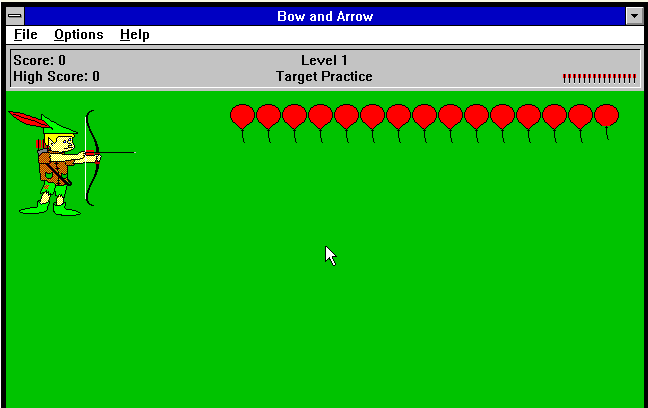
Level one is called Target Practice and it is the only honest moment in the game: fourteen red balloons, in a row, at a fixed height, not moving. Every balloon after level one moves. The row is not a tutorial so much as a promise the game does not intend to keep.
03Controls
| Right mouse button | Draws the bow. Release to loose the arrow. |
|---|---|
| Left mouse button | Moves the archer up and down the left-hand edge. |
| Playing-field size | Chosen from the options: three fixed sizes, or maximised to the screen. The larger the field, the harder the game — maximised on a large monitor it is close to impossible. |
| Saving | Three save slots in version 1.0, five in 1.1. Save often: some levels cannot be completed unless something was done in a previous one. |
Note which button does which job, because it is the wrong way round by every convention that came afterwards. The button modern software reserves for menus is the one that fires. This is what an interface looks like before anybody had agreed what a mouse was for.
04The enemies, and what they cost you
- Balloons. Harmless. They are the score, and after level one they are moving.
- Enemies that attack. Some of what walks onto the field attacks indiscriminately, whether or not you have provoked it.
- Enemies that don't. Others are harmless unless you shoot them by accident — which makes a missed arrow expensive in a way most games of this vintage never bothered with.
- The feathers. A row of feathers records how many more times you can be hit. When they are gone, so is the search.
05Registering
The version that reached you was the Abridged one: the first twelve of the game's twenty-two levels, free, permanently, with nothing disabled and nothing expiring. It had no sound effects. That was the only thing held back.
For the remaining ten levels you registered the Unabridged version for US$12 — later US$15 with version 1.1, which added two bonus programs. You paid a person, by post, after you already had the game. There was no licence server, no account, and no way for the author to know whether you had paid. The enforcement mechanism was a paragraph in a text file, and a substantial part of the software industry ran on that paragraph for most of a decade.
Checked facts
- Written by John Di Troia, 1992, full title In Search of the Greatest Archer; runs on Windows 3.1, 95 and 98.
- Right mouse button draws the bow; left moves the archer up and down.
- 22 levels, of which the shareware Abridged release has the first 12 and no sound effects. Registration US$12, rising to US$15 with 1.1 and two bonus programs.
- Three save slots in 1.0, five in 1.1; three playing-field sizes plus maximise, and the game gets harder as the field grows.
- Feathers indicate hit points. The documented description places them in a corner of the status area; in the level-one capture above that strip sits at the right, so the position may vary by version or level.
Sources: RGB Classic Games (Bow and Arrow — In Search of the Greatest Archer); Internet Archive (Bow and Arrow for Windows, versions 1.0 and 1.0/2.0).