Week 7: From frame to performance
Turning a controlled anchor frame into motion — directing image-to-video prompts at performance, timing and camera movement, not decoration
12 April 2027
An anchor frame is a locked starting point, generated straight from the bible so it matches everything already decided. What happens next is where directing actually starts: not what’s in the frame, but what changes inside it over the next few seconds.
What you’ll be able to do#
- Generate an anchor image from a locked bible reference, rather than a fresh description that risks drifting from it.
- Write a “moment before” for a beat — the concrete circumstance just before it — and use it to direct a motion take’s timing, not just its content.
- Name what changed between two motion takes in the language of performance (timing, a look, a gesture), not prompt syntax.
The lecture runs 90 minutes: recap 5, outcomes 5, technique and worked takes 45, comparison 15, judgement practice 15, synthesis 5.
The anchor frame is a locked starting point, not a fresh guess#
Generate the anchor image straight from the character and location bible entries in your locked pre-production package — Assignment 1’s, or your pivot plan’s if you’ve since switched stories — the same references a shot’s storyboard frame already points to — rather than writing a new description of the scene from memory. A fresh description drifts; a generation built from the locked reference has something to be checked against. The anchor is generated from whichever bible reference(s) that shot needs; where one is still pending — today, only the kitchen’s full production approval — generating an anchor tied to it still has to wait.
Once the anchor exists, directing hasn’t started yet — it’s the same discipline as picking a starting mark for an actor before rehearsing the scene. What you actually direct is what changes across the next few seconds of motion: a held breath, a delayed reach, a look that arrives a beat late.
The moment before: a concrete antecedent, not a mood word#
Judith Weston’s technique for directing a beat is the moment before: invent the specific, playable circumstance that happened immediately before the scripted action, rather than relying on a script’s own parenthetical — “(pause),” “(beat)” — which describes a gap, not something an actor or a model can play. A moment-before note answers a concrete question: what just happened, a second ago, that makes this beat happen the way it does?
For the closing beat of “Before It Stops,” the written action is: on the final ring, she accepts the call, lifts the phone to her ear, and says “Hey.” That line names the outcome. It doesn’t yet direct how the lift happens. For this demonstration, the shared moment-before is that she has just finished packing her mother’s kitchen and her estranged brother’s call has interrupted that final task. It supports the resistance to contact without adding earlier missed calls to the story. Direct the playable difference through when her right hand begins moving, keeping the outcome fixed.
The real starting frame and planned comparison#
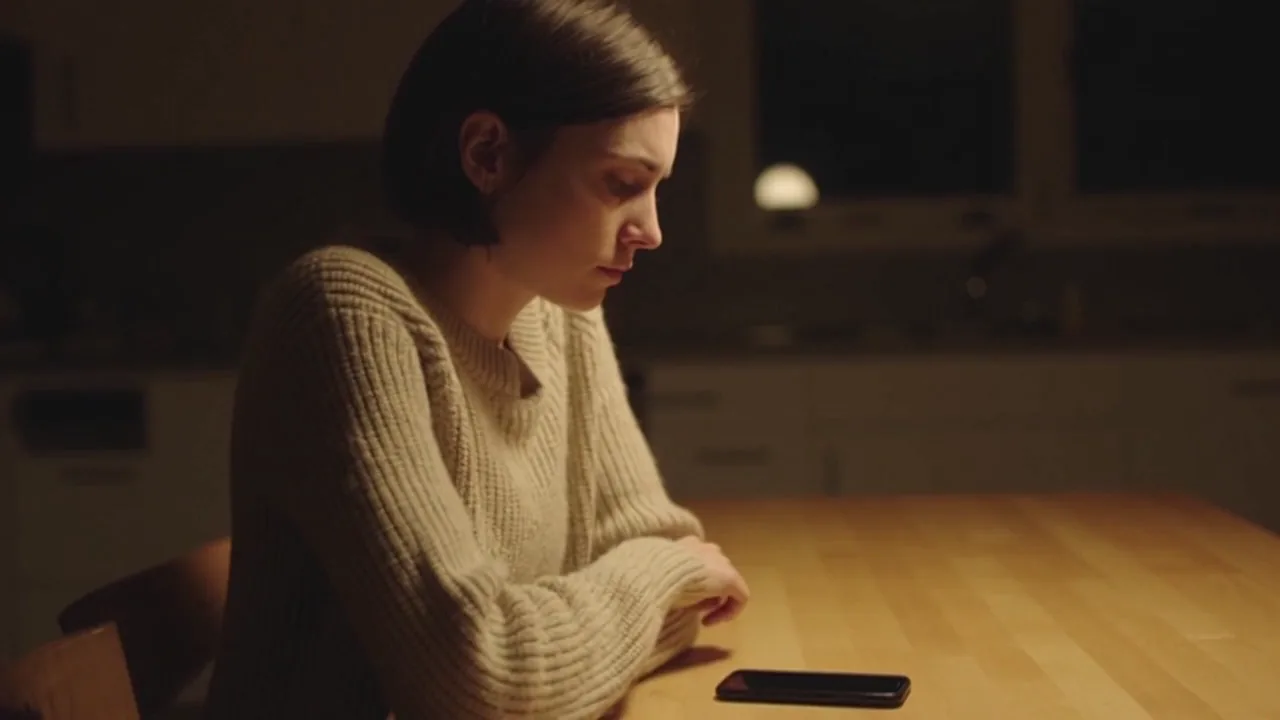
This existing frame was extracted from Week 1 Take B and reused as the input to the motion requests. It is not a newly generated Week 7 image. Keeping Nadia visible gives the generation a pictured identity to preserve.
Shot: fixed medium framing; the screen lights, she looks down, reaches and stops before touching the phone. This demonstrates hesitation, not the later acceptance. The film still ends with her accepting, lifting the phone and saying “Hey.” The shared moment-before is that the call interrupts her final packing task in her mother’s kitchen.
Take A — delayed reach#
Owner-generated Jimeng file 2448: visible reaching begins at approximately
4.5 seconds, then the hand stops and holds short of the phone in the sampled
frames. The direction was to wait until 4 seconds before reaching.
Take B — earlier, quicker reach#
Owner-generated Jimeng file 3477: the screen is lit by approximately
0.5 seconds, but visible reaching begins around 2.5–3 seconds. The hand
stops by approximately 3.5 seconds and stays hovering in the later sampled
frames. The revised direction asked for an immediate reach when the phone
lights up; the result still delays that response.
Comparison: A sustains stillness before reaching; B reaches earlier and more quickly, then holds. Both provide real footage for judging performance, but they are candidates rather than a verified comparison differing in exactly one variable: phone-screen appearance and final hand pose also differ.
Verification limits: the review used 0.5-second samples, closer samples of the reach, and an enlarged late frame. This is not a full frame-by-frame review or peer screening. Audio streams exist but have not been listened to; a continuous ringtone and the planned phone/face inserts remain unverified. The reused anchor also does not demonstrate generating a new image from the locked bible, as required in the workshop.
Earlier Sora attempt: A was moderation-blocked and produced no video; B completed but contacted the phone and was rejected. That original rejected clip remains in the Week 8 lecture. The Jimeng candidates above are separate owner-generated files, not successful Sora retries.
Misconception contrast#
| Directing the frame’s contents | Directing the moment before |
|---|---|
| “Make the kitchen feel colder” — aimed at the room | “She has just finished packing; delay the reach before stopping short” — aimed at the action |
| A note with nowhere to land in the performance | A note the timing of the reach can visibly play |
| Judged by whether the shot looks good | Judged by whether the antecedent is legible in the take |
| Two takes differing in lighting or camera speed for no stated reason | Two takes differing in exactly the directed beat, and nothing else |
Guided judgement: what’s the note actually directing?#
A student’s note reads: “Make her hesitation more dramatic.” Identify what’s wrong with it as a moment-before, and propose a concrete antecedent that would fix it.
Compare your diagnosis
“More dramatic” describes a mood, not a circumstance — it gives the take nothing specific to play, the same failure as a script’s bare “(beat).” A working antecedent names a fact: she sealed the last box from her mother’s kitchen only seconds before the phone lit up. That circumstance gives a performer, or a model directed toward performance, something concrete to carry into the reach — a longer stillness motivated by the specific task just interrupted, not a vaguer instruction to seem more torn.
For the workshop, apply the same test to your own note before generating: does it name a circumstance, or a mood? Only a circumstance is directable.
What you take to the workshop#
Bring your approved shot list and bible from Assignment 1, and pick one shot to animate. Write a moment-before for its central beat before you generate anything.
You leave with an anchor image and two takes that differ by exactly one directed choice, timed against a concrete antecedent — the same discipline from week 1, now with motion attached.
Teaching team
- Marisol Quaye — convenor