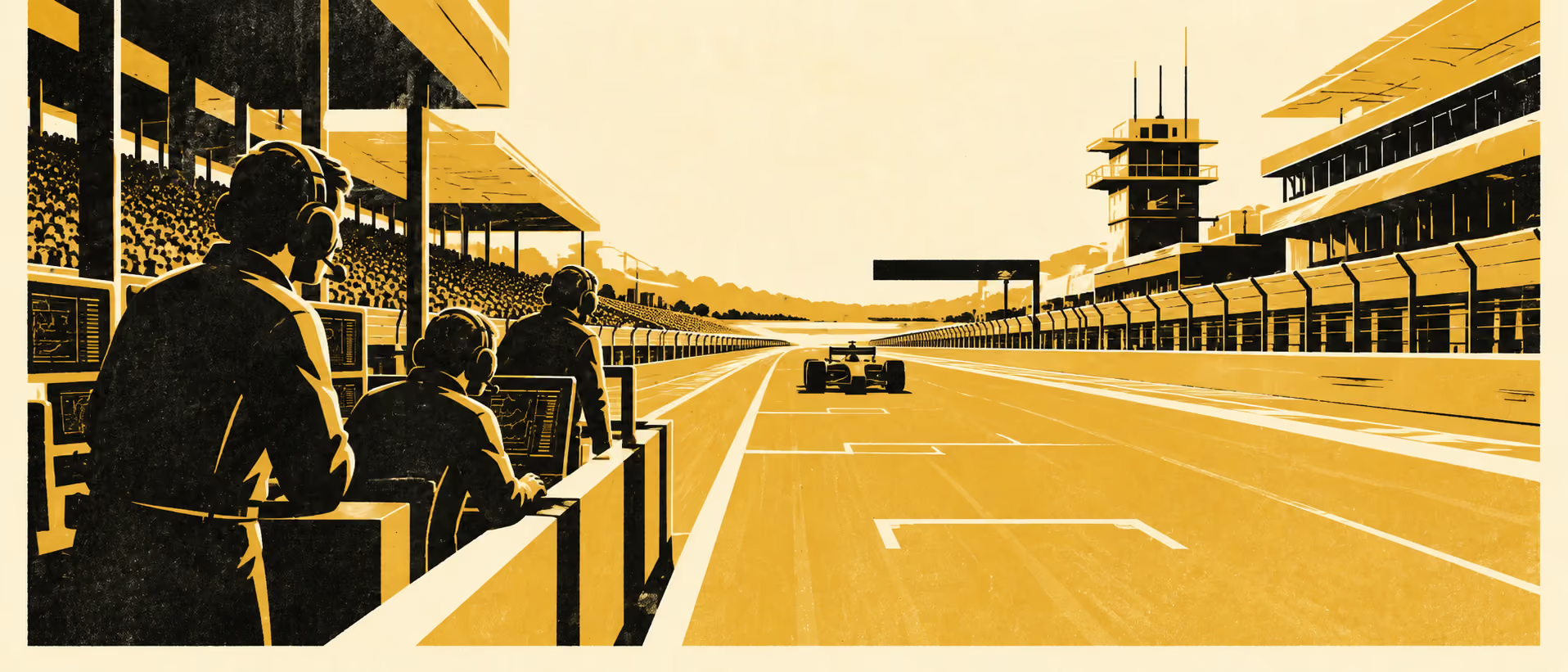
Twelve weeks on one question: what do you tell the driver, and can you defend it afterwards? Students build a race simulator, race it live against the cohort on a shared draw, and are marked on the calls they made rather than on where they finished.
Build the best race simulator you can, then trust it. A good call is one you can still defend after it loses.
Who it is for
Senior undergraduates who can write Python and have done one introductory probability and statistics course. No knowledge of Formula 1 is assumed, and none is rewarded. The course teaches the domain facts it needs, in the sentence that needs them. Interest is assumed; knowledge is taught.
What you will do
Twelve weeks on one question: what do you tell the driver, and can you defend it afterwards? Each week isolates one thing that makes a race hard to predict — what a lap time is made of, what a stop costs, a rival who moves when you do, an interruption nobody scheduled, a forecast you have to commit against — and hands you a codebase with that part left to implement. You finish it in the room.
Labs run on the Faculty's pit wall: forty seats, the same screens for everyone, so what differs between two students is what they chose to put on them. Every scenario is generated by the Faculty rather than recorded from a real season, and the cohort's luck is drawn once, in advance, so nobody meets a safety car another student never saw.
By the end you have built an instrument — your own race simulator and the display you read it through — raced it live against the rest of the grid, and written a defence of the calls you made knowing how they turned out. The instrument brief and its model-to-wall interface are available from the start; integration is advised after week 4, not imposed as another lab or submission.
How the course runs
Twelve weeks, each with a two-hour lecture and a two-hour lab, and about six hours of your own around them. The lecture adds one factor that makes a race harder to predict than the week before. The lab takes that factor on its own, hands you a codebase with the part that does it missing, and you finish it in the room.
The assignments are where the factors stop being separate. Assignment 1 audits a strategy the team bought and never checked; the final project — the instrument, the race, the defence — is all of it at once, built, raced and then argued for. Week 1 is orientation and carries no lab. The eleven weeks after it run in four acts, and each act keeps everything the one before it added, which is why the run below rises instead of repeating. The two-week teaching break falls between the second act and the third, and it is Assignment 1's working time.
- Assignment 1: the audit30 April 202725%
- The labs24 May 202720%
- Final project: the instrument28 May 202725%
- Final project: the race11 June 202710%
- Final project: the defence18 June 202720%
What you will be able to do
A graduate can build a race simulator they are willing to trust, say when it should not be trusted, act on it inside the time a real decision allows, and defend the call to someone who already knows it lost.
- Measure what drives a race from timing data, and state how uncertain the measurement is
- Build a race model whose assumptions you can name, whose omissions you can price, and whose hard constraints come from the regulations rather than from taste
- Treat interruption and weather as hazards rather than events, and propagate them to a distribution over finishing positions
- Treat a rival's strategy as a best response rather than a fixture, and track position as a resource you may not be able to overtake your way out of
- Test whether your own stated probabilities occur at their stated rate, and say when your instrument should not be believed
- Design the information surface that makes a call possible in the seconds available
- Justify a decision against the distribution it faced rather than the result it got
- State what you are optimising for, and whose interest it serves
Your finishing position is worth nothing
Position at the chequered flag does not contribute to your mark. The Faculty is aware this is unusual. It is also aware that a student who boxed on lap 31 against a 62% recommendation and finished second has demonstrated nothing except that the safety car came out.
The wall records each call, its timestamp, and the recommendation standing at that timestamp. Marks follow the agreement between them. A departure is supported only when the student declared an actionable limit before the race and recorded the evidence available at the call showing that its clear, observable condition applied. General limitations still belong in an honest domain, but do not license a live departure without such a condition.
An unsupported departure can lose race conduct marks. The later defence can still reward an honest, rigorous analysis of it; that analysis does not retrospectively justify the departure.
Where to go next
Lectures
The twelve weeks, the factor each one adds, and the deck that teaches it.
Labs
Eleven assessed labs, weeks 2 to 12: what to prepare, and what leaves the room.
Assessment
Five pieces of work, what each is worth, and why the race is marked on conduct alone.
People
One convenor and three tutors, and which of them to ask about what.
Policies
No late work, AI use declared, and the rules an assessment page points at.
Resources
How the weeks fit together, the room they run in, and where the data comes from.