Week 6: Stop, Follow & Draw
Using vertical spin on purpose — stop, follow and draw shots, built on last week's tangent-line reference.
29 March 2027
Learning objectives
- Identify stop, follow and draw shots.
- Understand how cue-ball contact height affects spin.
- Select stop, follow or draw for a simple position problem.
- Recognise the difference between initial tangent-line movement and the later effect of spin.
- Execute basic versions of each shot.
- Learn
Week 5 established a natural reference — the tangent line. This week is about intentionally changing that natural outcome using vertical spin: stop (near-centre contact), follow (above centre) and draw (below centre). Speed and spin interact, so avoid treating "hit higher" or "hit lower" as a guaranteed distance.
- See
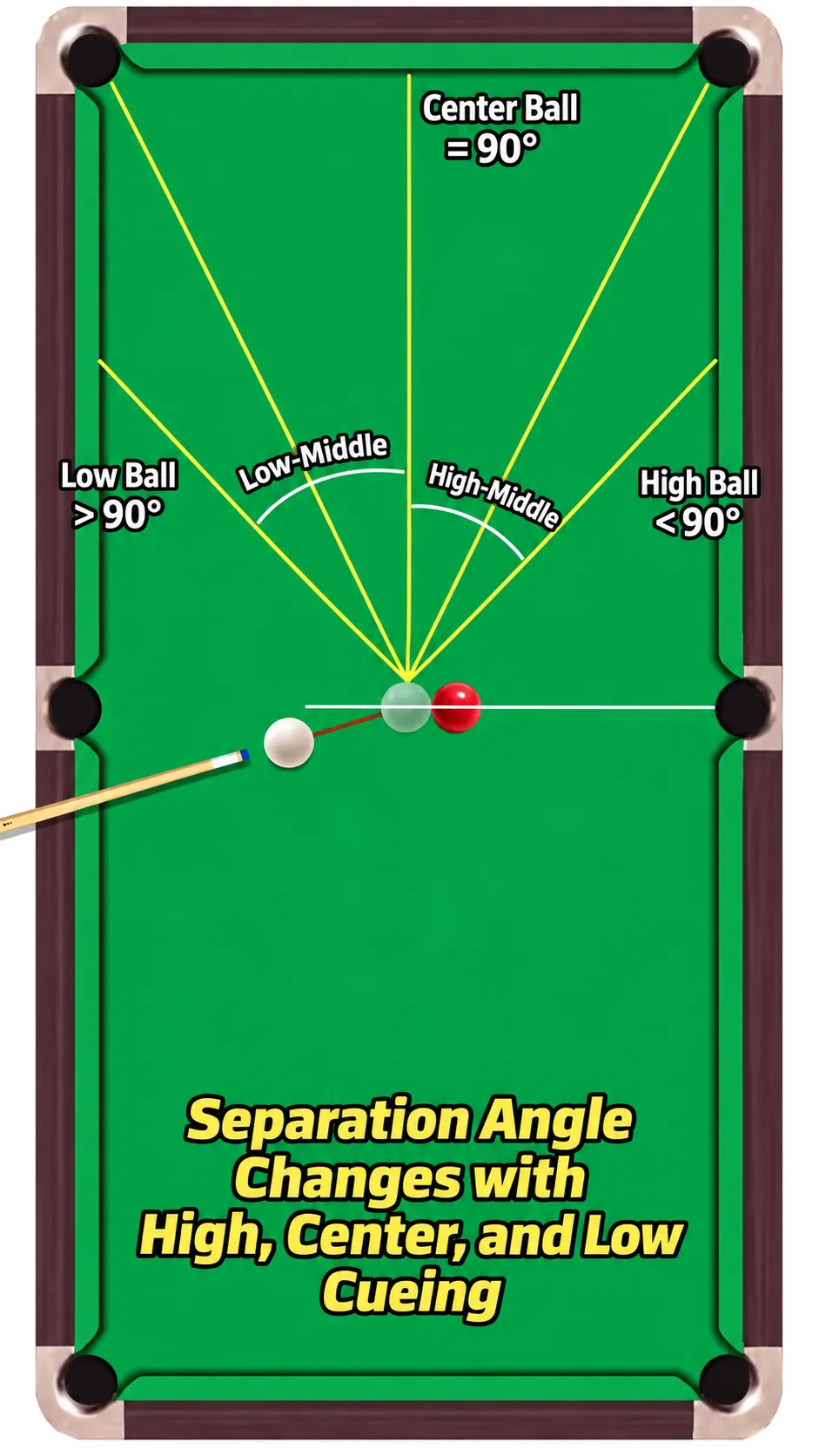
A diagram compares the stun/90-degree reference against a follow path bending forward and a draw path bending backward.
- Think
Given a desired cue-ball finishing area, decide: stop, follow or draw? Given a path, ask which cue action most likely produced it.
- Play
A three-shot control drill on the same or a similar simple layout: one stop, one follow, one draw — so the outcomes can be compared directly.
- Table check
Complete one basic stop, one follow and one draw task.
Stop / stun#
Centre or near-centre contact, with the cue ball reaching the object ball in a sliding (stun) state. On a suitable straight shot, the cue ball can stop close to the point of impact — there’s no separation angle to reason about, since the shot is in-line. On an angled stun shot, the tangent line from Week 5 becomes the important reference again.
Follow#
Striking above centre creates forward rotation. On a straight shot, the cue ball continues forward past the point of impact. On an angled shot, after the cue ball contacts the object ball, the remaining forward spin makes it continue or bend forward — so the final separation angle is generally less than the stun’s 90-degree reference.
Draw#
Striking below centre creates backspin. On a straight shot, the cue ball returns back toward where it came from. On an angled shot, after contact, the remaining backspin makes the cue ball bend backward — so the final separation angle is generally greater than the stun’s 90-degree reference.
Strong spin, short delay#
A firm follow or draw shot can still travel close to the tangent-line direction for a short distance immediately after impact, before the remaining spin produces a stronger forward or backward curve. Use this as a visual reasoning idea rather than a number to memorise.
Speed still matters#
Cue speed and spin interact. “Hit higher, it always goes farther forward” and “hit lower, it always draws farther” are both oversimplifications — the same spin at a different speed behaves differently.
Weekly quiz
Complete this week's graded quiz.