Week 5: Cue Ball Direction & the Tangent Line
A new question after potting: where will the cue ball go after contact? This week introduces contact thickness and the tangent line.
22 March 2027
Learning objectives
- Distinguish full, thick, half-ball and thin contact.
- Predict the approximate first direction of the cue ball after contact.
- Understand the tangent line as a reference for cue-ball separation.
- Recognise that cue-ball path depends on the state of the cue ball at impact.
- Make a prediction before playing a shot.
- Learn
Potting the object ball is only half the shot — the cue ball has to go somewhere too. This week introduces contact thickness (full, thick, half-ball, thin) and the tangent line: a useful 90-degree reference for where a sliding cue ball separates from the object ball, not a fixed law.
- See
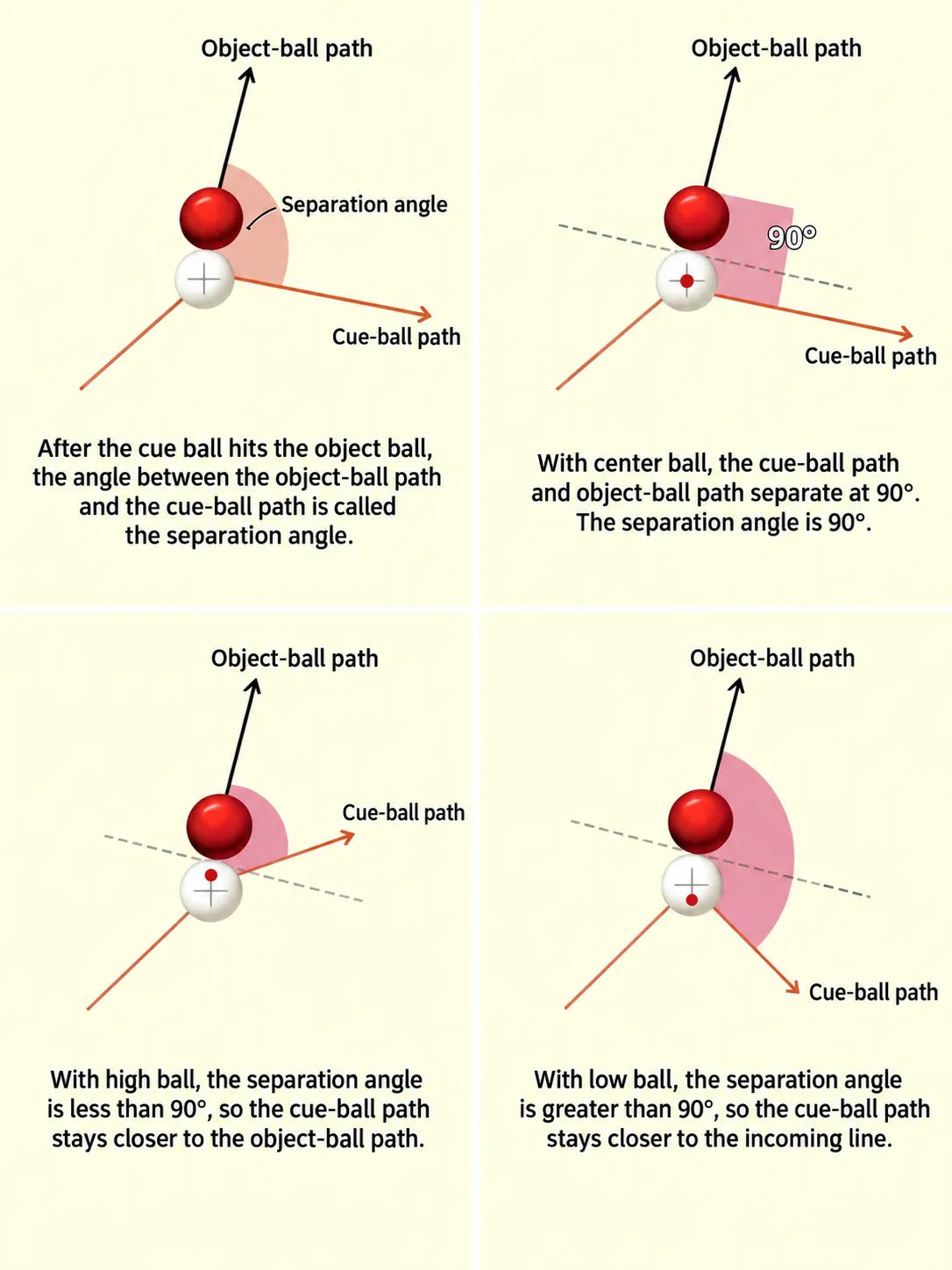
A diagram compares the separation angle produced by centre-ball, high-ball and low-ball contact after collision.
- Think
Prediction questions: which direction will the cue ball initially leave? Is this hit thick or thin? Which path best matches a stun shot?
- Play
Predict the cue-ball direction out loud or by pointing, before playing — using repeated fixed ball positions with different contact thicknesses.
- Table check
Given several simple layouts, predict the approximate first cue-ball direction before playing each one.
Contact thickness#
Full, thick, half-ball and thin hits change how much of the object ball the cue ball actually touches. That changes how energy and direction are shared between the two balls. This isn’t advanced collision physics — it’s a beginner reference for “how much ball did I hit.”
Two separate paths#
Read the object ball and the cue ball as two separate questions:
- The object ball travels toward the pocket you selected.
- The cue ball leaves the collision along a different path.
Don’t expect one line to describe both.
The tangent line#
When the cue ball reaches the object ball in a roughly stun (sliding) state, it initially separates at approximately 90 degrees to the object-ball path. Treat 90 degrees as a useful starting reference for this one situation — a stun-state cue ball — not a rule that applies to every shot regardless of spin.
Predict before you hit#
The core habit this week introduces isn’t a formula — it’s a habit: before playing the shot, say (out loud or to yourself) where you expect the cue ball to go. Getting the prediction wrong is a normal part of learning to read contact and spin; the value is in comparing the prediction to what actually happens.
A question for next week#
What happens if the cue ball arrives with forward spin or backspin instead? In short: forward spin (follow) tends to pull the final path to less than 90 degrees, and backspin (draw) tends to push it to more than 90 degrees. With a firm follow or draw, the cue ball can still travel close to the tangent line for a short distance right after impact, before the remaining spin bends the path forward or backward. Week 6 picks this up in full — for now, just notice that the tangent line is a starting point, not the whole story.
Weekly quiz
Complete this week's graded quiz.