Induced demand, the one-way-street fix, and the uncomfortable arithmetic of why the lane you add fills up again.
29 March 2027
The argument#
Road capacity does not reduce congestion, it relocates and enlarges the demand that produced it, and the corridor that has been widened has paid its frontage for a level of service it will not keep.
What you will learn#
- Compute the effective capacity of a signalised arterial from its saturation flow and green ratio, and the volume–capacity ratio before and after a widening.
- Apply a demand elasticity to a capacity increase and state the long-run volume, showing the working.
- Decompose an observed traffic increase into route, mode, departure-time and land-use components, and match each to the view in the model that shows it.
- Distinguish a street’s vehicular capacity from its environmental capacity, and name what the second cost when the first was raised.
Theory into practice#
- Anthony Downs, “The Law of Peak-Hour Expressway Congestion,” Traffic Quarterly 16(3), 1962; triple convergence developed in Stuck in Traffic (1992). Peak congestion rises to meet the capacity provided, because drivers converge on an improved facility from other routes, other departure times and other modes.
- Gilles Duranton and Matthew A. Turner, “The Fundamental Law of Road Congestion: Evidence from US Cities,” American Economic Review 101(6), 2011. The elasticity of vehicle-kilometres travelled with respect to lane-kilometres is close to one.
- J. Michael Thomson, Great Cities and Their Traffic (1977), and Martin J. H. Mogridge, Travel in Towns: Jam Yesterday, Jam Today and Jam Tomorrow? (1990). The Downs–Thomson and Lewis–Mogridge position: on a corridor with a competing public transport service, the equilibrium speed of car travel is set by the door-to-door speed of that service.
- Dietrich Braess, “Über ein Paradoxon aus der Verkehrsplanung,” Unternehmensforschung 12, 1968, with J. G. Wardrop, “Some theoretical aspects of road traffic research,” Proceedings of the Institution of Civil Engineers (1952) as its equilibrium assumption. Adding a link to a network can make every user’s journey longer.
- Colin Buchanan, Traffic in Towns (HMSO, 1963). A street has an environmental capacity — a traffic volume above which its other functions fail — and it is reached well before its vehicular capacity.
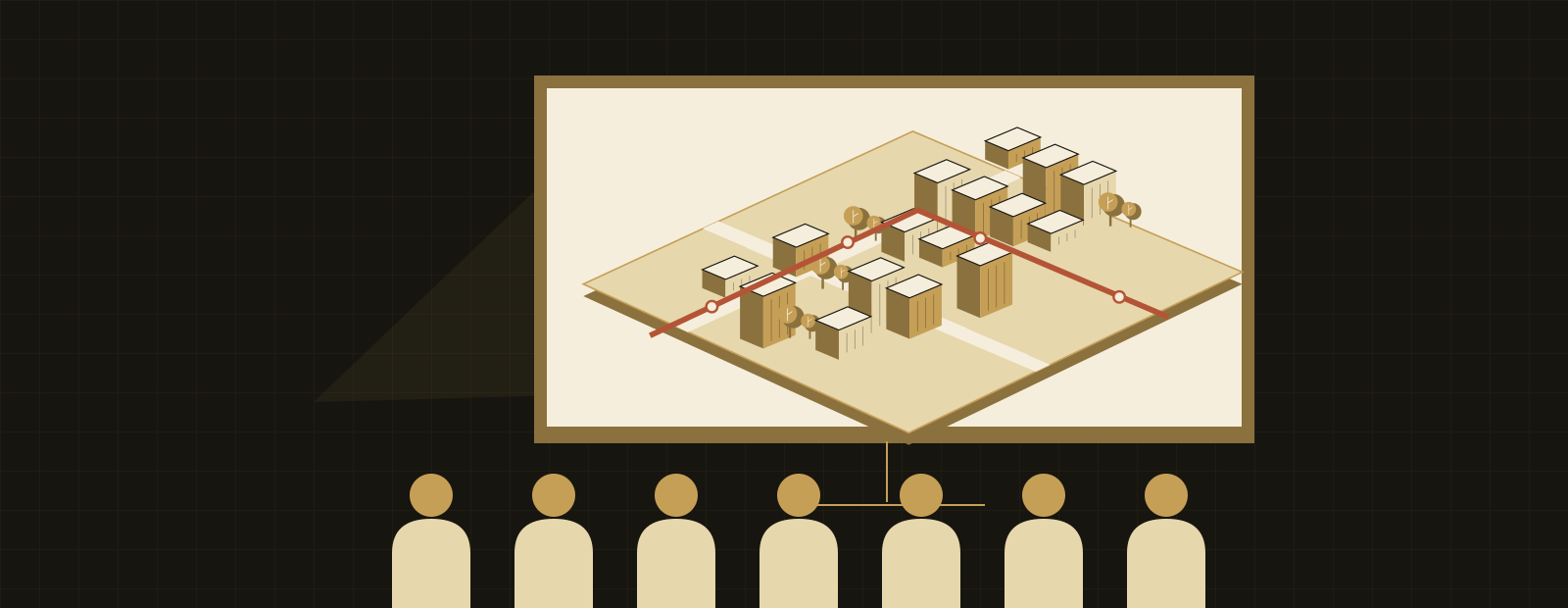
The deck walks through where each of these lands, slide by slide, against the Kerrow widening.
Simulation mapping#
| Theory move | Cities: Skylines II mechanic | What students should watch happen |
|---|---|---|
| Wardrop’s user equilibrium | The traffic AI’s pathfinding: every agent takes the least-cost route available and re-chooses when costs change | The Ashgrove back streets emptying within about three simulated days of the Kerrow widening opening |
| Downs’s spatial convergence | The traffic volume layer of the Traffic info view, read on the parallel routes rather than the widened one | Volume falling on the back streets and rising by more than that on Kerrow |
| Downs’s modal convergence | The Transportation Overview passenger count on the Week 5 bus line | Ridership dropping on the line the widening now competes with, and the line’s revenue dropping with it |
| Downs’s temporal convergence | Citizen daily schedules under the day/night cycle | The shoulder of the peak thinning as the corridor gets quick enough to leave at 08:00 again |
| Braess’s link addition | The road tool, and the new connector at the Wickstead junction | Average district-wide travel time after adding a link that was locally an improvement |
| Buchanan’s environmental capacity | The noise pollution overlay and the Land Value info view along the Pelling Street frontage | Land value falling on the widened frontage, and ground-floor commercial failing to hold its level |
| Marchetti’s time budget, from Week 4 | Housing demand and the residential demand bars at the outer edge of the district | Households taking up sites further out at Denton Hill once the commute cost falls |
Evidence standard. Named interface fields are direct readouts. Calculations shown from those fields are derived measures. Every fixed scenario value on this page is a worked hypothetical, not a captured run. See resources and evidence for access arrangements and worksheets.
The decision this week#
Mobility performance against livability, tested by widening Wickstead from two to four lanes this week: a real capacity gain on day one, against a frontage cost that grows over the following year. The deck works the full before-and-after figures. The mobility gain does not survive the year; the livability loss does.
Into the studio#
Bring the unchanged Week 5 transit save on Monday. Widen Wickstead from two to four lanes in this session and compare the issued before, three-week and six-week checkpoints; keep personal and reference branches distinct. The deck’s three-lanes-each-way example is a separate hypothetical, not the studio intervention. Complete the position statement, save and evidence sheet and upload by 21:00. No weighted assessment is due. Follow the studio brief.
Assessment connection#
No assessment is submitted this week. The stress-test evidence builds toward Assessment 2 — Public Realm and Infrastructure Plan (Week 9, 25%), which takes the frontage question as a starting point, and toward Assessment 3 — Comprehensive City Plan (Week 12, 50%), where the corridor decisions made this week are load-bearing.
Teaching team
- Idris Fenn — tutor