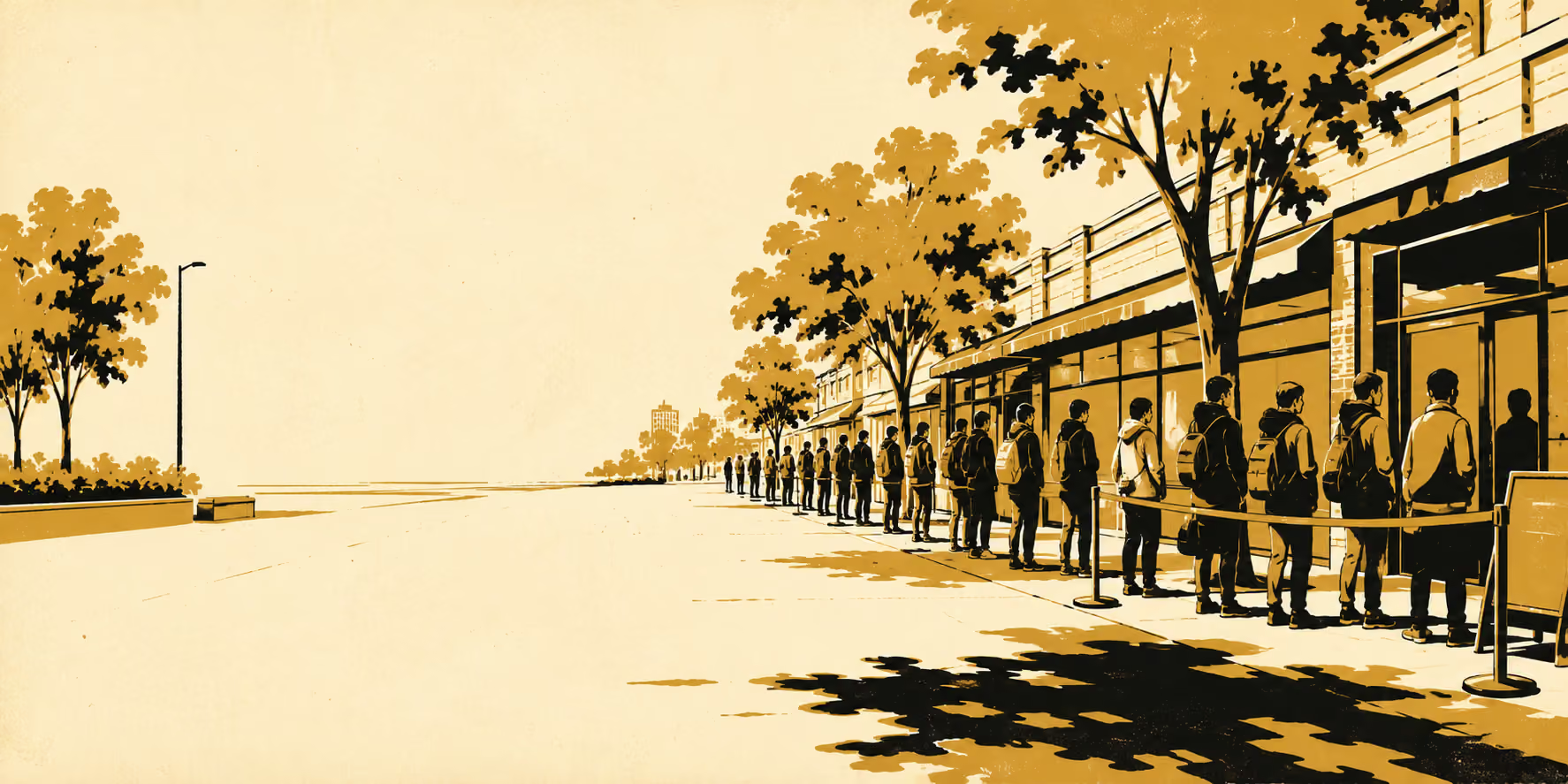
A queue is a machine for handing out waiting, and every queue is a decision about whose time counts for less. Twelve weeks measuring real lines, from supermarket tills to transplant lists to the scheduler in your laptop, and one queue you redesign and defend.
Every queue you have ever stood in was designed by somebody, and almost none of them bothered to tell you how it was done. That is more or less the whole problem, and it is what we spend the semester on. In week 1 you will pick a queue of your own, and you will keep that same one all the way through to week 12.
- 12teaching weeks
- one lecture and one field session each
- 36contact hours
- two thirds of them outdoors
- 4pieces of assessment
- 100% between them, no exam
- 1queue
- chosen in week 1, kept until week 12
What you will do
In week 1 you will pick a queue to work on. It can be almost anything you like, whether that is a till, a counter, a platform or a help desk, as long as it is somewhere you can realistically stand next to twice a week without it becoming a chore. Do take a bit of care over the choice, because whatever you settle on is yours for the rest of the semester and swapping later is more painful than it sounds.
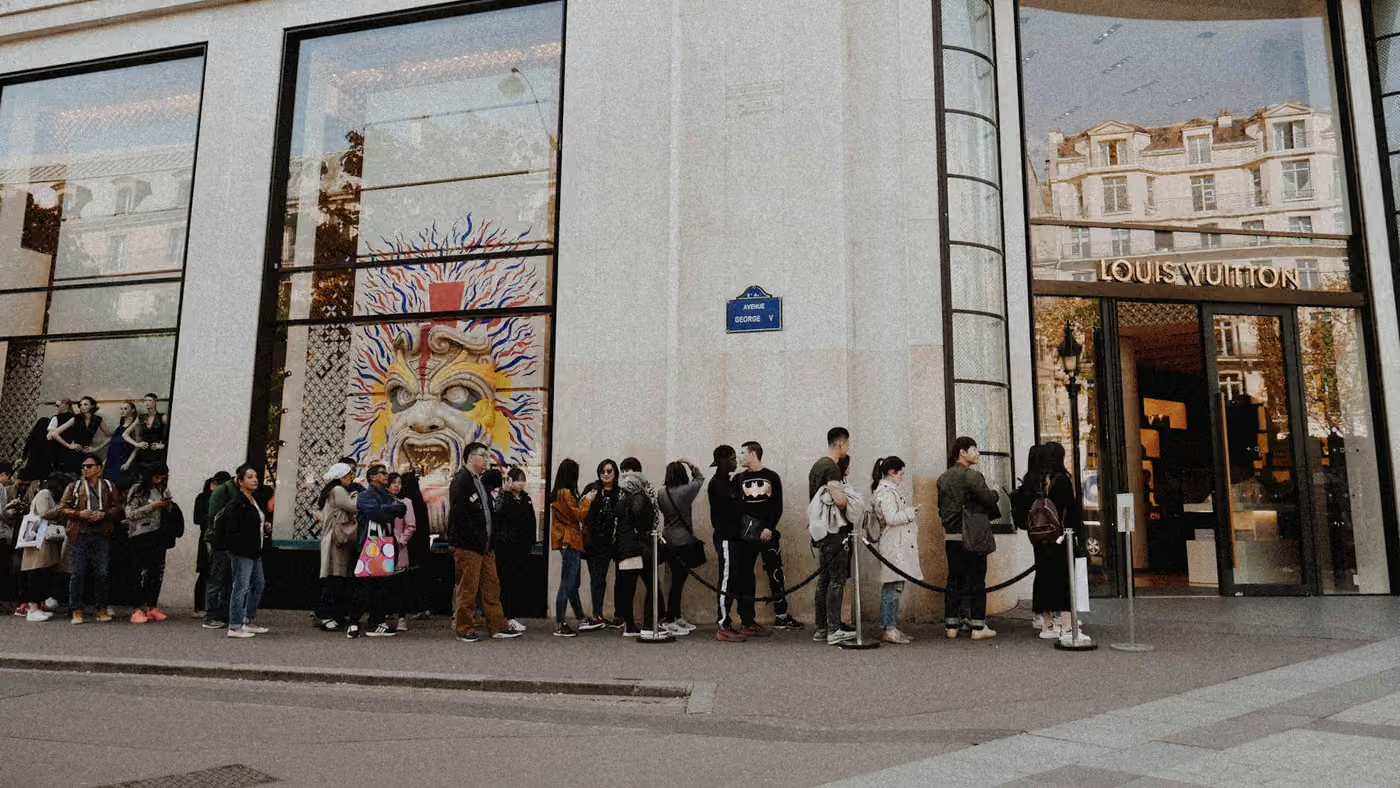
For the first fortnight you will be measuring the queue and its times by hand, with a pen, and we fully expect everyone to measure it badly to begin with. Please do not worry about that. Everybody gets better at it quite quickly, and the early mess is genuinely part of the process rather than a sign that you have picked the wrong site. By around week 4 most people can work out their queue's arrival rate, the rough shape of its service times, and how much of the wait is really the tax the queue pays for being unpredictable rather than simply busy. Alongside all of that you will keep a record of every time somebody gets served out of order, and of what that cost the people standing behind them. The last step is the one the marking cares about most. You write down what it would take to change the queue, you predict the effect before anybody tells you the answer, and then you name whoever ends up waiting longer once your change is in. Somebody always does, and saying so plainly is most of what we are looking for.
Then in week 12 you defend that change in front of the room. If you manage to persuade the room, and a fair few of you do, the obvious next step is to take it to whoever actually runs the queue.
Work out a wait without timing anybody
It takes two counts and one division. The whole thing costs you a minute, you never have to follow a single person through the line, and it works on any queue that is not growing without bound. Try it on the next queue you stand in.
Just heads, including whoever is being served right now. No stopwatch.
Only the ones who actually join. Somebody who looks at the line and walks away does not count.
Divide the first by the second. That is the wait.
12people in the line
divided by4joining each minute
equals
That is how long each person in that line is waiting.
That is Little's Law. It holds for any queue that is neither growing without bound nor draining, whatever order it serves people in and however many counters are open. Week 2 is the hour on the three ways it goes wrong. The numbers behind the buttons are illustrative rather than measured; measuring your own is the week 2 field session.
What the course thinks
Honestly, we think the arithmetic is the easy half. There are only four results in the whole course, and between them they are more than enough to embarrass most of the people who design queues for a living. Little's Law will tell you how long a line has been waiting without you timing a single person in it, which still feels like a trick the first time you do it. Kingman will tell you why a counter got noticeably worse in the month after somebody made it more efficient, which is the kind of thing that is very satisfying to be able to explain.
Spare capacity is not waste. It is what you are bought instead of a queue.
The hard half is the question that none of those equations will answer for you, and it is the one most people find genuinely uncomfortable. A queue discipline is a ranking of people, and nearly every one you will come across was set without anybody quite admitting that is what it is. Emergency triage is the honourable exception here, because it ranks people openly and says why, and that is exactly why we give a whole week to it. The week after that goes to the opposite case, which is the queues that publish nothing at all.
What students did with it
I came in wanting to prove the bus interchange was badly run. It is not. It is running at ninety-four percent and nobody has told the people who set the timetable what that costs.
The redesign studio in week 11 is where my proposal fell apart. Three people found the group my change would have made worse inside four minutes, which is far better than finding it in the marking.
I measured the main entrance at the gardens where I work weekends. The change I proposed in week 11 is the one they trialled in October, and the queue at opening is about four minutes shorter.
What you can do by week 12
There are six of them in the end, and between them they are the reason the weeks run in the order they do rather than in some other order.
- Put a number on a wait you never timed. It really is just two counts and one division, and once you have the knack you can do it from thirty metres away on more or less any queue at all.
- Say why a place got worse after it got busier. Waiting does not rise neatly in step with demand, it accelerates, and you will be able to show somebody where the cliff is using their own numbers rather than an argument.
- Choose between one line and many, and defend it. Pooling wins on the arithmetic every single time, and yet there are five perfectly real reasons why your supermarket still does not do it.
- Name who a queue is charging. Every order of service is a ranking of people whether anybody says so or not, and you will be able to work out what that ranking costs the person at the back, in minutes.
- Measure a queue that publishes nothing. Waiting lists, backlogs and referral pathways all behave like queues underneath, so with a bit of work you can estimate the length of a line that nobody is willing to tell you the length of.
- Change one and predict the result in advance. You write the prediction down, along with the arithmetic that produced it, before anybody tells you whether you are right. That last part is harder than it sounds and it is the whole point.
Who it is for
If you are ever going to have a say in how people wait, then this is probably the course for you.
Quite a lot of the people who wait are waiting in a place that somebody drew on purpose. That might be a park with one gate and four paths leading to it, or a ride with a switchback built to hold ninety minutes of people, or a festival laid out with six bars at one end and the toilet block at the other. Station concourses, stadium exits and museum entrances on a wet Sunday all belong on the same list. The point is that if you are going to design public space at all, then you are going to design a queue as well, and the drawing tends to settle it whether or not anybody in the room ever says the word out loud.
Plenty of others are waiting at a counter of some kind, whether that is a till, a help desk, a pharmacy window, passport control, triage in an emergency department, or a phone line that only answers between nine and four. Others again are waiting in a list they cannot see at all, such as a housing register, a visa subclass, a specialist referral or an insurance claim. Those are easily the hardest queues in the course, mostly because nothing about them is on display and you have to work out how to measure them anyway. And some of what waits is not a person at all, which is why we get a good number of students who write schedulers, rate limiters and request queues.
The course is open to third-year students in any degree at all. You need to be reasonably comfortable with algebra, averages and a spreadsheet, and that really is the whole prerequisite, since there is no calculus anywhere in the course and no proof anywhere in the assessment. What you do need, and we would rather say this up front, is a willingness to stand outside a shop for an hour with a clipboard, in the cold, while people look at you and wonder what you are doing.
What it is not
It is worth being clear that this is not a queueing theory course. A proper queueing theory course would spend the whole semester on Markov chains and never once send you outside. Only four results appear here, and each of them earns its place because you genuinely need it to say something true about a real line. There is also no exam, in case you were wondering.
Where to go next
Timetable
The whole semester sits on one page, with the two busy stretches marked so you can plan around them.

Lectures
Twelve weeks, and each one makes a claim you could reasonably argue with.
Field sessions
Two hours a week, spent mostly outdoors and usually with a stopwatch in your hand.
Assessment
Four pieces, all of them about the same queue.

People
Who teaches it, which weeks, and when they are free.
Needing more time is ordinary and asking early is free.Ask for an extension, or read thepolicies before you need them.