Week 3: Scale, Data, and Optimisation Under Fixed Compute
Power-law intuition, Kaplan- and Chinchilla-style compute allocation, data quality versus data quantity, and reading a training pilot honestly
8 March 2027
Stage: Build language ability · Project 1 drop-in clinic
Summary#
Scaling research asks how loss changes with model parameters (N), training tokens (D), and compute (C). Project 1 asks a smaller but structurally similar question: with a fixed parameter boundary and compute allowance, which model, data mixture, and training schedule deserve the budget? This lecture develops power-law intuition, contrasts the conclusions of Kaplan-style and Chinchilla-style studies, and treats both as empirical evidence rather than universal recipes. It then moves from papers to controllable decisions: data quality and duplication, token budget, batch and gradient accumulation, learning rate, warm-up, decay, clipping, regularisation, checkpoint intervals, and stop rules. Short pilots are framed as measurements used to select a plan, not miniature leaderboard searches.
Learning outcomes#
After this lecture, you should be able to:
- distinguish model scale, data scale, and training compute and explain why improving only one produces diminishing returns;
- interpret a power-law relationship and identify the small-data, useful-scaling, and irreducible-error regions;
- compare Kaplan- and Chinchilla-style compute allocation without treating either fitted law as a guaranteed 32M recipe;
- translate a T4-equivalent/FLOP budget into a token, step, and pilot plan; and
- use loss curves, gradient signals, runtime, and sample evidence to decide whether to continue, revise, or stop a run.
1. The three quantities: N, D, and C#
Model parameters bound representational capacity, data tokens provide learning opportunities, and compute measures the work used to connect them. Increasing a model without enough data undertrains capacity; repeatedly cycling a small or duplicated corpus may spend compute without adding information. A one-GPU thought experiment makes the allocation problem concrete before any equations are introduced.
2. What scaling laws do and do not say#
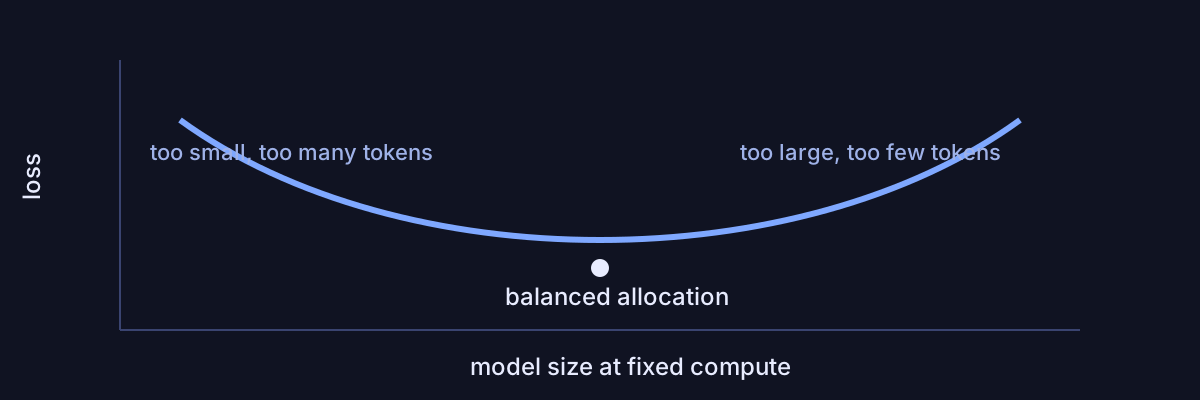
In a power-law region, test loss often decreases predictably but with diminishing returns as scale increases. Kaplan et al. reported smooth relationships across model size, data, and compute and argued that large models can be sample efficient and need not train to convergence. Hoffmann et al. revisited compute-optimal allocation and found that model size and tokens should grow more evenly. These results were fitted at much larger scales than this course; students use their logic to form hypotheses, then validate locally.
3. Data quantity is not data value#
Source diversity, document quality, formatting noise, duplication, and domain match change what one token contributes. TinyStories and the Phi work illustrate that carefully structured data can make small models surprisingly capable, but synthetic or aggressively filtered text also imports generator bias, narrower diversity, and provenance obligations. Project 1 decisions must report both token counts and source-level evidence.
4. From compute ceiling to training schedule#
We connect tokens per step, effective batch size, gradient accumulation, sequence length, steps, and approximate FLOPs. Warm-up protects early optimisation; learning-rate decay changes how aggressively later updates move the model; clipping helps contain unstable gradients; weight decay and dropout trade fit for regularisation. The correct values are not memorised constants. A pilot should isolate one uncertainty, run long enough to expose a trend, and stop according to a rule chosen before the result is known.
5. Reading a pilot honestly#
Training loss alone cannot select a plan. Students compare training and validation curves, gradient norms, throughput, memory, sample quality, and run-to-run comparability. An unstable run, a widening validation gap, or a runtime estimate that exceeds the budget is useful evidence if it changes the plan and is recorded. Failed optimisation is not transformed into success by hiding it.
Required reading#
- Jared Kaplan et al., Scaling Laws for Neural Language Models, abstract and Sections 1–2.
- Jordan Hoffmann et al., Training Compute-Optimal Large Language Models, abstract and Sections 1–3.
Optional reading#
- Suriya Gunasekar et al., Textbooks Are All You Need, Sections 1–2.
- Ronen Eldan and Yuanzhi Li, TinyStories, Sections 3–4.
This week’s action#
Bring a legal configuration, a token/runtime estimate, a curve, a trace, or a concrete failure to the drop-in clinic, and freeze the principal run plan before Week 4: hypothesis, control, maximum spend, stop rule, and intended checkpoint-selection evidence.
Teaching team
- Dr Yiwei Easton — convenor