Week 2: Inside a Decoder-Only Transformer
Encoder, encoder-decoder, and causal decoder-only attention; tracing tensor shapes through a decoder block; architecture as a 32M parameter allocation
1 March 2027
Stage: Build language ability · Formal Lab 1
Summary#
Project 1 is small enough that every architectural choice is visible in the budget. This lecture traces one token through a decoder-only Transformer and connects the computation to learned-parameter count, memory, context length, and generation cost. Encoder and encoder–decoder systems are introduced to clarify why the course uses a causal decoder, not because other architectures are obsolete. Students then examine causal masking, multi-head self-attention, feed-forward blocks, residual paths, pre-normalisation, embeddings, and the output head. The aim is to make architecture a testable allocation of capacity: depth, width, heads, context, and vocabulary must fit together rather than being selected as independent fashionable settings.
Learning outcomes#
After this lecture, you should be able to:
- distinguish encoder, encoder–decoder, and causal decoder-only attention patterns;
- trace tensor shapes through embeddings, attention, the MLP, residual connections, normalisation, and the output head;
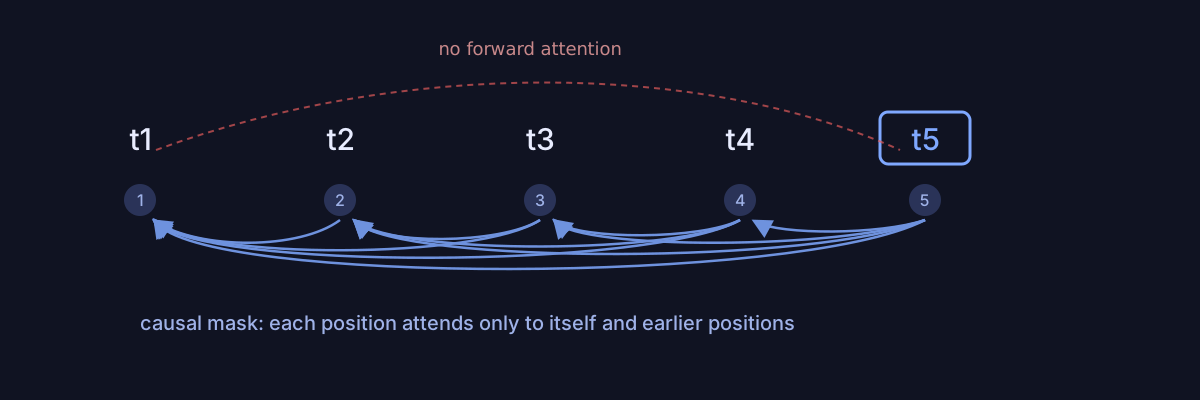
- explain how a causal mask prevents future-token leakage;
- identify which configuration choices dominate parameter count and activation memory; and
- propose two legal architectures whose differences support a controlled Project 1 comparison.
1. Three Transformer families#
Bidirectional encoders build representations using both left and right context. Encoder–decoder models combine source-side representation with autoregressive target generation. A decoder-only language model uses causal self-attention and expresses both prompts and outputs as one continuation. The course uses this form because its training objective matches Project 1 generation and because the starter is intentionally compact.
2. One decoder block#
Token and position representations enter a repeated block. Normalisation stabilises the input to attention and the feed-forward network; residual connections preserve an information and gradient path around each transformation. Attention mixes information across allowed earlier positions, while the position-wise MLP performs most of the block’s feature transformation and often contains most of its learned parameters.
3. Causal attention and heads#
Queries select information from keys and combine values. The triangular causal mask makes every prediction depend only on tokens already available at that position. Multiple heads can represent different relations, but increasing head count does not create capacity for free: head dimension, model width, and implementation constraints must remain coherent. We distinguish learned parameters from sequence-dependent activations.
4. Architecture as a 32M allocation#
Students use the repository preflight rather than estimating compliance by file size. Vocabulary and embedding choices, model width, layer count, and FFN width all affect the learned-parameter total; context length mainly changes activation and attention cost. KV caching is introduced as an inference optimisation: cached past keys and values avoid recomputing unchanged states during autoregressive generation, but it does not change how Project 1 is trained.
Required reading#
- Ashish Vaswani et al., Attention Is All You Need, Sections 3.1–3.2.
- Thomas Wang et al., What Language Model Architecture and Pretraining Objective Work Best for Zero-Shot Generalization?, abstract and Section 2.
Optional reading#
- Andrej Karpathy, nanoGPT,
model.py; focus on the mapping between configuration fields and modules.
This week’s action#
Keep one feasible baseline architecture and one justified alternative from Lab 1; record the preflight output for both before Week 3’s clinic.
Teaching team
- Dr Yiwei Easton — convenor