Week 1: What a Language Model Learns
Probability over text, next-token prediction, maximum likelihood and cross-entropy, n-gram intuition, and perplexity as a first, limited piece of evidence
22 February 2027
Stage: Build language ability · Project 1 begins
Summary#
A language model assigns probabilities to possible continuations. Training turns a text corpus into many next-token prediction problems and adjusts the model to increase the probability of the observed next token. This lecture connects the probability view to the exact tensors students will use in Project 1: token sequences, shifted targets, cross-entropy loss, train/validation/test separation, and perplexity. Historical n-gram models provide useful intuition about context and sparsity, but the practical focus is the neural autoregressive objective. The final question is engineering rather than definitional: what evidence would show that a training run learned a reusable narrative distribution instead of memorising its data or merely reducing one number?
Learning outcomes#
After this lecture, you should be able to:
- express the probability of a token sequence as a product of conditional next-token probabilities;
- construct input and shifted-target sequences for causal language-model training;
- explain maximum likelihood, cross-entropy, negative log-likelihood, and perplexity as connected views of one objective;
- distinguish the roles of training, validation, development, and tutor-evaluation data; and
- state at least two reasons why lower validation loss is insufficient evidence of better story generation.
1. From plausible text to conditional probability#
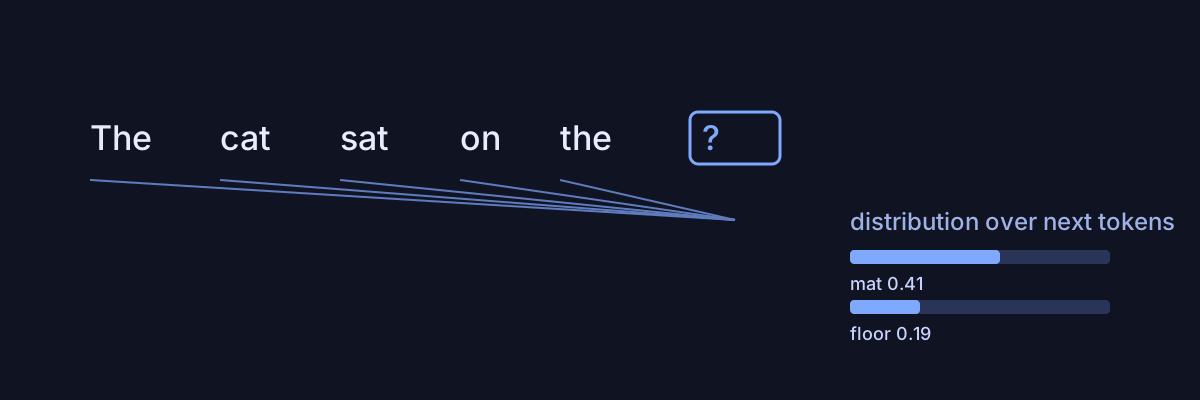
We begin by ranking grammatical, semantically plausible, and stylistically consistent sentences. The exercise reveals that a language model is not a database of complete sentences: it estimates a distribution over the next token given the preceding context. The chain rule converts those local predictions into a probability for a complete sequence. Sampling repeatedly from the changing next-token distribution produces text.
2. What n-grams teach us—and where they fail#
Unigram, bigram, and trigram examples make the context trade-off visible. A short context is easy to count but cannot preserve much structure; a long context is informative but most combinations are unseen. Neural language models replace explicit count tables with a differentiable function that shares statistical strength across contexts. N-grams are used here as conceptual scaffolding, not as an assessed implementation.
3. Turning a corpus into a training objective#
For a token sequence (x_1,\ldots,x_T), the model observes a prefix and predicts the next token. Teacher forcing creates many supervised targets from one document. We derive mean negative log-likelihood and show how the same calculation becomes token-level cross-entropy in code. The loss is differentiable with respect to model parameters, so an optimiser can update those parameters by gradient descent.
4. Splits, perplexity, and evidence#
Perplexity is the exponential of average negative log-likelihood. It is useful for comparing checkpoints evaluated with a common token accounting method, but it does not directly measure coherence, originality, reasoning, or instruction following. Story- or source-level splits must be created before token windows so that near-identical windows from one story cannot appear on both sides of evaluation. Project 1 therefore combines continuation-only reference-token-normalised PPL with blind human review and qualitative failure analysis.
Required reading#
- Ronen Eldan and Yuanzhi Li, TinyStories: How Small Can Language Models Be and Still Speak Coherent English?, Sections 1–2.
- Course page, Evaluation Protocol.
Optional reading#
- Alec Radford et al., Improving Language Understanding by Generative Pre-Training, introduction and Figure 1.
This week’s action#
Run the repository data summary, confirm the document-level split, and write a two-sentence Project 1 target: what the model should continue well and which evidence will test that claim.
Teaching team
- Dr Yiwei Easton — convenor