Week 6: Chimes, dings and voices — the sonic register
What makes a warning sound urgent without becoming alarming, examined through the seatbelt chime's regulatory escalation against Tesla's deliberately sparse chime set
29 March 2027
Last week’s colour grammar assumed the driver is looking at the dashboard. Sound doesn’t, which is exactly why it’s harder to get right. A red telltale only works on someone already looking toward it; a chime reaches someone looking at the road, the mirror, a child arguing in the back seat. That reach is the whole appeal of the sonic register, and its whole risk — a sound that doesn’t need your eyes also doesn’t stop when you’d like it to, and a driver who has learned to tune one out has lost the one channel built to work regardless of where they were looking.
Urgency is not loudness#
The easy mistake is to treat volume as a proxy for importance: louder means more urgent. It doesn’t, reliably. A car can be quiet about something critical (a single low chime for a cracked windscreen sensor fault) and insistent about something merely inconvenient (a door held slightly ajar). Loudness is tuned mainly for audibility over engine and road noise, not for communicating rank among warnings — so something else has to carry urgency.
Four things a designer can actually turn#
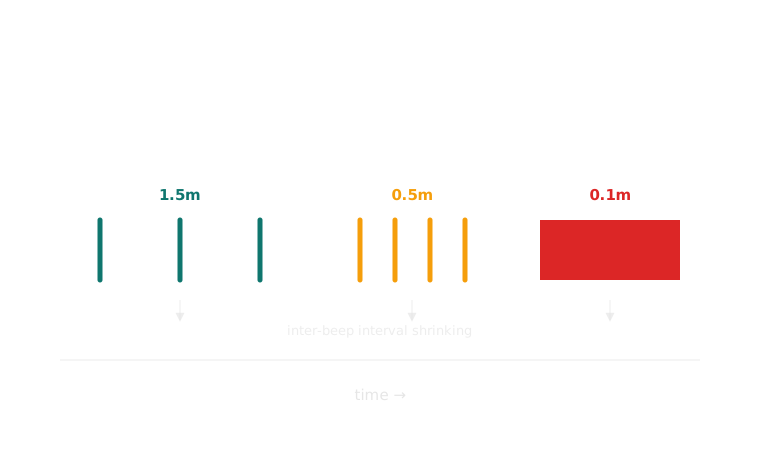
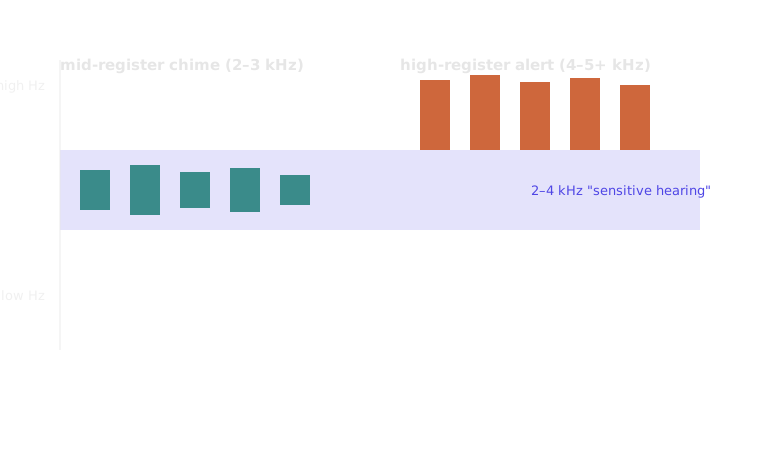
That something else is a small set of independently adjustable variables: pitch (higher reads as more pressing, up to a point where it starts reading as a fault rather than a warning), tempo (a faster repeat rate reads as closer or more immediate — a parking sensor’s beep speeding up as the gap closes is the cleanest example on the dashboard), repetition (does it sound once, reporting an event, or keep returning, reporting a condition that persists), and timbre (a tone, a recorded voice, and a melodic “earcon” carry different weight at matched volume). None of these is fixed by physics. Each is a decision, legible to any driver who has heard enough cars to compare them, even without the words to say why one chime feels more frantic than another at the same volume.
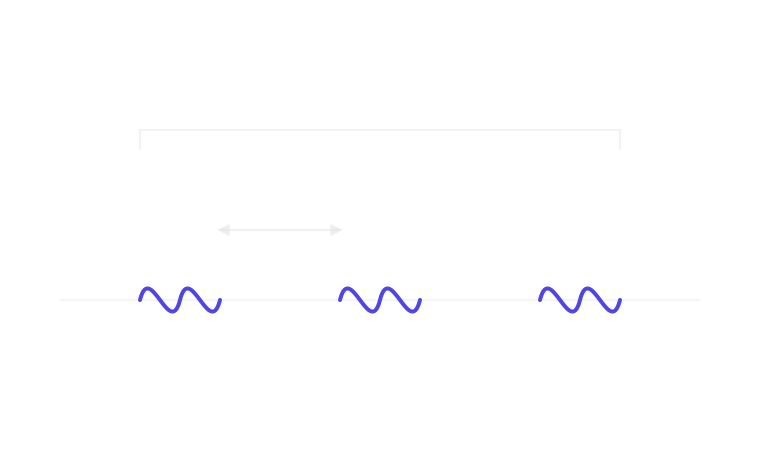 pitch — how dense the wiggle sitstimbre — the curve’s own shapetempo — the gap between repeatsrepetition — how many times it plays
Process: how a warning sound actually gets deployed#
A chime doesn’t just “go off” — it moves through a pipeline, and how far it is allowed to escalate at the last stage is a policy decision, not a technical one.
1. Event detected Sensor reports an unbuckled belt, a closing gap, a lane departure.
2. Tier assigned The event is classified against a severity scale fixed at development.
3. Palette queried The tier maps to a specific sound from the manufacturer’s library.
4. Sound played At the volume, pitch and repetition rate that tier specifies.
5. Response monitored If the condition doesn’t clear, the system may escalate — louder, faster, or an added channel such as haptic seat buzz.
Case study: the seatbelt chime’s escalation, and Tesla’s refusal of it#
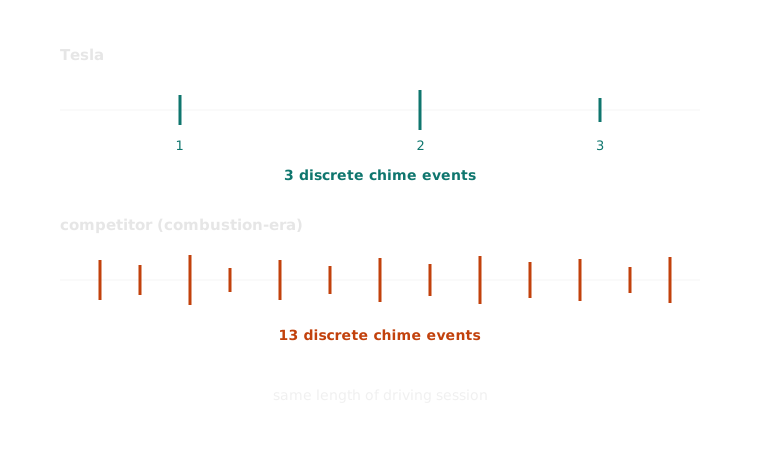
Regulatory testing regimes have spent two decades pushing the seatbelt chime in one direction: louder, more repetitive, harder to ignore. Protocols used by NHTSA’s New Car Assessment Program and Euro NCAP’s Safety Assist criteria award manufacturers credit for reminders that escalate — not a polite ding, but a chime that gets louder and more frequent, paired with a flashing telltale, the longer the belt stays unbuckled while the car moves. The logic is defensible: compliance measurably improves when the nag gets worse, so testing regimes reward designs that make ignoring the belt actively unpleasant. The result is a chime engineered to be annoying by design brief, not by accident.
Tesla takes the opposite bet. The seatbelt chime still exists — it’s federally mandated, not optional — but Tesla generally doesn’t layer the escalating loop many competitors add once that legal minimum has played. Status that would be an ongoing sound elsewhere becomes a persistent but silent icon on the touchscreen instead. Where the escalating chime assumes a driver who needs discomfort to comply, the minimal set assumes a driver who, told once, doesn’t need telling again louder. Neither assumption is obviously wrong; they’re different bets about how much trust a warning system extends to the person it’s warning.
Sound, read against the six-question framework: urgency is the one variable it can express through several independent dials at once — pitch, tempo, repetition — rather than colour’s single hue. Its defining property is visibility: it needs none, reaching a driver whose eyes are anywhere at all. Meaning is a mix — tempo-as-distance is read almost universally, but which chime maps to which fault is still learned. Modality is auditory. Timing is this week’s real axis, from a single reporting chime to an escalating, repeating one. And the required action a sound implies scales with how far a system is allowed to escalate before the driver responds.
Next week leaves sound behind and asks what happens when the dashboard starts writing in sentences instead of playing tones — the shift from acronym to plain language on the multi-info display, and what that costs to translate.
Teaching team
- Idris Fenn — tutor