Week 6
Chimes, dings and voices: the sonic register
Guiding question: What makes a sound urgent without becoming alarming, and who decides where that line sits?
Learning objectives
By the end of this week you should be able to:
- Identify the four independent variables a warning sound designer controls (pitch, tempo, repetition, timbre) in a real dashboard chime
- Explain why volume alone is an unreliable signal of a warning’s actual urgency
- Compare the seatbelt chime’s regulatory escalation against Tesla’s minimal chime philosophy and state what each implies about trusting the driver
- Describe the pipeline that turns a detected event into a played sound, including where driver non-response re-enters the loop
- Distinguish, for a given alert, whether its sound design matches the real stakes of what it signals or over/under-states them
Opening example: the sound you can’t look away from
A red telltale only works on a driver already looking toward the instrument cluster. A chime doesn’t need that. It reaches a driver checking the mirror, glancing at a child in the back seat, eyes fully on the road ahead — anywhere except the dashboard.
That’s the entire appeal of the sonic register: it is the one channel that doesn’t require the driver’s eyes. It is also the entire risk. A sound that reaches you regardless of where you’re looking also doesn’t stop just because you’d like it to — and a driver who has learned to tune a chime out has lost the one warning channel built to work no matter where their attention was.
Opening example, continued: the parking sensor that speeds up
Reversing toward a wall, most cars produce a beep that gets faster as the gap closes — slow ticks at a metre and a half, a near-solid tone at ten centimetres. Nobody has to be told what a faster beep means; the mapping from tempo to distance is learned in seconds, almost certainly the single most intuitive piece of sound design on the entire dashboard.
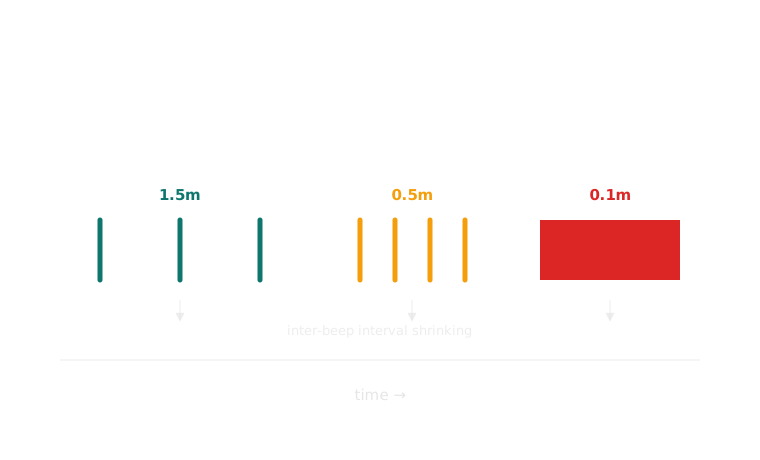
Distance is encoded entirely in tempo — the beep doesn’t get louder, it gets more frequent, until frequency itself becomes a constant tone.
The mistake: treating loudness as a proxy for importance
The easy assumption is that louder means more urgent. It doesn’t, reliably. A car can be quiet about something serious and insistent about something merely inconvenient:
- a single, modest chime for a cracked windscreen sensor fault
- a loud, repeating chime for a door held slightly ajar at low speed
If loudness tracked real stakes, these would be reversed. They aren’t, because loudness is only one of several variables a sound designer sets — and it’s usually tuned for audibility inside a moving cabin, not for communicating rank among warnings.
Four variables, not one dial
A warning sound is not “how loud.” It is at minimum four separate, independently controllable decisions:
| Variable | What it can encode |
|---|---|
| Pitch | perceived pressingness — higher generally reads as more urgent, up to a threshold past which it reads as a system error rather than a warning |
| Tempo | proximity or immediacy — a faster repeat rate reads as “closer,” the same logic as a Geiger counter |
| Repetition | whether the situation is resolved — does it sound once, or does it keep returning until the driver acts |
| Timbre | register — a synthesized tone, a recorded voice, and a two-note consumer-electronics “earcon” all carry different social weight even at matched loudness |
A driver doesn’t need to name these to feel the difference between two chimes of identical volume. Naming them is what lets a designer choose which one to use on purpose.
Pitch: pressing, but only up to a point
Higher pitches are read, cross-culturally, as more attention-demanding — which is why almost every dashboard alert sits well above the frequency range of engine and road noise, typically in the 2–4 kHz band where human hearing is most sensitive. Push pitch too high, though, and a warning stops reading as “urgent” and starts reading as “broken”: a shrill, piercing tone gets dismissed as a fault in the speaker rather than a message about the car. The usable range is narrower than it looks.
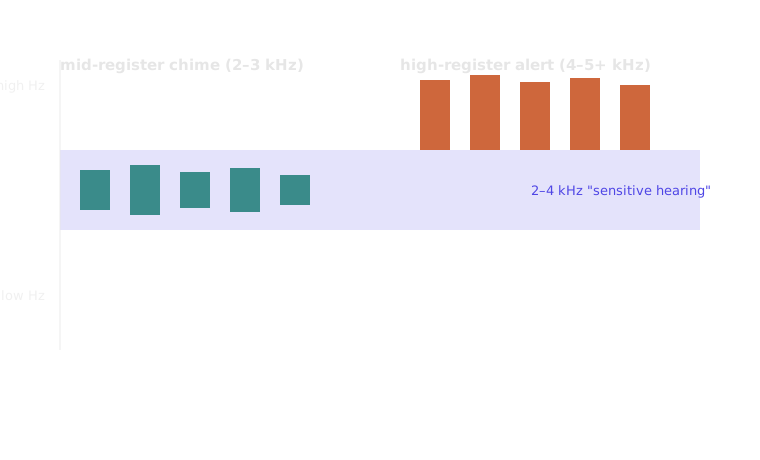
Both tones sit inside the ear’s most sensitive range — the difference in how ‘urgent’ versus ‘broken’ they feel is pitch alone, not loudness.
Tempo and repetition: the difference between “once” and “still”
Tempo (how fast a sound repeats) and repetition (whether it repeats at all) look similar but do different jobs. Tempo encodes proximity or rate of change — the parking sensor again. Repetition encodes state: a chime that sounds once and stops is reporting an event that has passed (a door was opened); a chime that keeps returning is reporting a condition that persists (a door is still open). Conflating the two is a common design failure — a single-shot chime for an ongoing hazard tells the driver something happened, when the car actually needs to say something is still true.
Timbre: tone, earcon, or voice
The same information can be delivered as a synthesized tone, a short melodic “earcon” borrowed from consumer-electronics sound branding, or a recorded/synthesized human voice reading out the fault. These are not interchangeable stylistic choices — they carry different implied relationships between car and driver.
Direct comparison: a tone says “something is true, look at the screen to find out what”; a spoken alert (“Please fasten your seatbelt”) says the same thing without requiring the driver to look at anything at all, at the cost of taking roughly ten times as long to deliver and being far harder to localise in shared attention (a voice competing with passenger conversation is a genuinely different cognitive load than a tone doing the same). Manufacturers that add voice alerts (many premium marques’ navigation and safety-system voices) are trading speed and universality for the ability to be unambiguous about what, not just that.
Real example: Audi, VW, Toyota — convergence without coordination
The tempo-encodes-distance parking-sensor beep described earlier isn’t one manufacturer’s invention — it appears in near-identical form across Audi, Volkswagen, and Toyota reversing systems, among many others, despite no shared regulatory mandate forcing the convergence (unlike week 4’s tyre-pressure icon). It’s a useful case precisely because it shows sonic convergence can happen through user intuition and competitive copying alone, without a standards body — a contrast worth holding against the seatbelt chime case study, which converged under explicit regulatory pressure instead.
Real example: BMW’s Hans Zimmer collaboration (IconicSounds Electric)
BMW commissioned composer Hans Zimmer to design the ambient interior and exterior sound identity for its electric vehicles under the “IconicSounds Electric” programme — not warning tones, but the low-level ambient sound the car makes simply existing and accelerating. It’s useful here because it’s the clearest case of a manufacturer treating cabin sound as brand identity rather than function, which throws the functional chime work of this week into relief: a startup chime is doing marketing; a seatbelt chime is doing compliance; both live in the same interface, and a driver has to be able to tell which is which without being told.
Real example: the regulator-mandated EV pedestrian sound (AVAS)
Electric and hybrid vehicles are quiet enough at low speed to be a pedestrian-safety hazard, so regulators (UN Regulation No. 138 in Europe, NHTSA’s Minimum Sound Requirements for Hybrid and Electric Vehicles in the US, both taking effect around 2019–2020) mandate an Acoustic Vehicle Alerting System: a synthesized sound played below roughly 20 km/h so pedestrians can hear the car coming. It’s useful for this week because it’s a sound engineered for someone outside the car entirely — a reminder that not every sound on this week’s list is designed for the driver, and the same four variables (pitch, tempo, repetition, timbre) still apply to an audience that never sees a dashboard.
Silence is also a decision
A cabin engineered to be very quiet (heavy sound-deadening, no engine note reaching the driver) removes an entire ambient channel of information older drivers relied on without realising it — the sound of the engine labouring was itself a continuous, un-flagged warning about load and gear choice. Removing that ambient sound doesn’t remove the need for the information; it just means something else, usually a discrete chime or a digital gauge, now has to say explicitly what the engine note used to say for free.
Process: how a warning sound actually gets deployed
A chime doesn’t just “go off.” It moves through a pipeline:
- Event detected — sensor reports an unbuckled belt, a closing gap, a lane departure
- Urgency tier assigned — the event is classified against a fixed severity scale set during development, not decided in the moment
- Palette queried — the tier maps to a specific pre-recorded or synthesized sound from the manufacturer’s sound-design library
- Sound played — at the volume, pitch, and repetition rate that tier specifies, not whatever the engineer on duty feels like
- Response monitored — if the triggering condition doesn’t clear (belt still unbuckled, gap still closing), the system may escalate: louder, faster, or paired with an additional channel (haptic seat buzz, flashing telltale)
Step 5 is where this week’s case study lives: how aggressively a system is allowed to escalate at step 5 is a policy decision, not a technical one.
The same pipeline, as a diagram
Case study: the seatbelt chime under regulatory pressure
The seatbelt chime is one of the oldest mandated sounds on the dashboard, and testing regimes have spent two decades pushing it in one direction. Protocols used by NHTSA’s New Car Assessment Program and Euro NCAP’s Safety Assist criteria award manufacturers credit for seatbelt reminder systems that escalate: not a brief courtesy ding, but a chime that gets louder and more frequent, paired with a flashing telltale, the longer the belt stays unbuckled while the vehicle is moving. Some systems extend this to rear seats, and some repeat indefinitely rather than timing out.
Design intent: make ignoring the belt actively unpleasant, because measured compliance improves when the nag gets worse. Strength: it works — escalating reminders measurably increase belt-wearing rates. Weakness: the same design brief that makes it effective on a resistant driver makes it grating for a driver who was always going to buckle up, and grates hardest exactly on the people it doesn’t need to persuade.
Case study: Tesla’s comparatively minimal chime set
The seatbelt chime is federally mandated — Tesla can’t remove it — but Tesla generally doesn’t layer the escalating loop many competitors add once that legal minimum has played. Status that would be an ongoing sound elsewhere (unbuckled belt, open door while parked, various system states) is instead represented as a persistent but silent icon or line of text on the central touchscreen. The chime library as a whole is sparse compared with a typical combustion-era competitor’s, which usually runs to dozens of distinct alert sounds across systems.
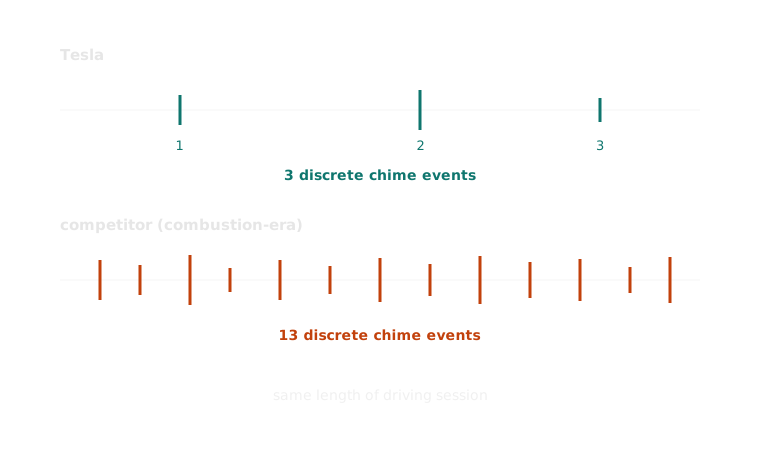
Same length of driving, a fraction of the sound events — the difference isn’t one missing chime, it’s an entire design philosophy about how often the car should speak.
Design intent: treat the driver as someone who, once told, doesn’t need to be told again at increasing volume. Strength: far less chime fatigue — the sounds that do play are more likely to still mean something. Weakness: a system that relies on the driver choosing to look at the screen re-introduces the exact problem sound was supposed to solve — it stops working the moment the driver isn’t looking.
Case study synthesis: neither philosophy is free
The escalating chime buys measurable compliance at the cost of treating every driver as if they need to be worn down. The minimal chime buys respect for the attentive driver at the cost of quietly depending on attention it can’t guarantee. A synthesis worth proposing in class: tier the escalation to behaviour, not just elapsed time — a system that starts minimal (a short, low chime plus a screen icon) and only escalates toward the loud, repetitive, regulator-favoured version if the driver has demonstrably not glanced at or dismissed the alert, rather than escalating on a fixed clock regardless of whether the driver has already noticed.
Comparison: maximally insistent vs minimal
| Dimension | Maximally insistent (regulator-favoured) | Minimal (Tesla-style) |
|---|---|---|
| Repetition rate | Repeats on a fixed cycle regardless of driver behaviour | Sounds once at the mandated minimum, then stops |
| Volume escalation | Increases over time if belt stays unbuckled | None beyond the fixed mandated level |
| Channels used | Audio + flashing telltale, sometimes haptic | Audio once, then screen icon/text only |
| Driver annoyance | High for already-compliant drivers | Low, but only for drivers who check the screen |
| Compliance on resistant drivers | Measurably higher | Untested advantage — depends on screen-glancing |
This week’s channel, against the framework
Urgency is the one variable sound can express through several independent dials at once — pitch, tempo, repetition — rather than colour’s single hue. Its defining property is visibility: it needs none, reaching a driver whose eyes are anywhere at all. Meaning is mixed — tempo-as-distance reads almost universally, but which chime maps to which fault is still learned. Modality is auditory. Timing is this week’s real axis, from a single reporting chime to an escalating, repeating one. The required action scales with how far a system is allowed to escalate before the driver responds.
Common misconception: “louder means more urgent”
It doesn’t, reliably — this deck already showed the counter-example: a single modest chime for a cracked windscreen sensor, a loud repeating one for a door left slightly ajar. If loudness tracked real stakes, those two would be reversed. Loudness is mostly tuned for audibility over cabin noise, not for ranking warnings against each other — pitch, tempo, repetition and timbre are doing that job instead, and a driver who conflates “loud” with “important” is reading the wrong dial.
Exercise: redesign one chime’s escalation policy
Pick one dashboard alert from this week’s studio listening set (seatbelt, low-fuel, lane-departure, or parking-proximity) and design its escalation policy from scratch — not the tone itself, just the rules for when it gets louder, faster, or stops.
Answer, in writing:
- What event triggers the first sound, and how long does that first sound last?
- What condition causes it to escalate — elapsed time, driver non-response, or something else you can detect?
- What does escalation actually change: volume, tempo, repetition, or an added channel?
- What condition makes it stop, and can it stop even if the underlying problem hasn’t been fixed?
Exercise debrief: a model answer
Two answer-shapes tend to cover most redesigns:
- Time-boxed escalation (a good fit for seatbelt-style faults): first sound is short and quiet; if the belt is still unbuckled after a fixed interval, it escalates in volume and repetition; it stops only when the belt is fastened, never on a timer, because the underlying problem isn’t fixed by waiting it out.
- Channel-switch escalation (a good fit for lane-departure, matching what many real systems already do): first response isn’t louder at all — it switches channel entirely, from a chime to steering-wheel haptic feedback, on the logic that a second independent channel is more likely to be noticed than the same channel turned up.
The real constraint being tested: “escalate” doesn’t have to mean “louder” — it can mean faster, more repetitive, or an entirely different channel, and the right lever depends on whether the fault is a one-off event or an ongoing condition.
Mini knowledge check
- Name the four independent variables a chime designer controls, and give an example of a dashboard sound where one of them, not volume, is doing the real work of signalling urgency.
- A single-shot chime is used for a condition that persists (say, a door still ajar). What’s the mismatch, and what should have been used instead?
- Explain, in one sentence each, what the escalating seatbelt chime assumes about the driver, and what Tesla’s minimal chime set assumes instead.
- Give one real example (from this deck or elsewhere) of a sound designed for someone outside the car rather than the driver.
Summary
- Urgency is communicated by at least four independent variables — pitch, tempo, repetition, timbre — not by loudness alone
- Tempo often encodes proximity or rate of change; repetition encodes whether a condition is ongoing, not merely that an event occurred
- A warning sound moves through a real pipeline: event, tier, palette, playback, and — critically — a possible escalation step keyed to driver response
- The seatbelt chime’s regulatory escalation and Tesla’s minimal set are both legible, defensible bets about how much trust to extend to the driver, not one correct design and one wrong one
- Not every sound in a car is designed for the driver — AVAS pedestrian sound and brand-identity ambient sound (BMW/Zimmer) answer to different audiences with the same four variables
Bridge to next week: what a sentence can say that a chime can’t
A chime can tell a driver that something is wrong and roughly how urgently to respond. It is much worse at telling them what, exactly, without training beforehand — which is why multi-info displays increasingly resolve the ambiguity a tone leaves open by simply writing it out: “Low tyre pressure — front left,” not a beep the driver has to already know how to decode. Next week asks what changes when the dashboard stops gesturing at meaning and starts stating it directly in words, and what that plain-language shift costs once it has to be translated into every market the car is sold in.
Same event. Different bet on the driver.
That’s the whole week: a chime, a beep, a voice — each one a decision about how much pressure a car is allowed to put on the person driving it.