The Sandwich Must Hold

Every lunch is a temporary structure.
Study the forces that make it fail.

Enter Week 1

View the semester structure

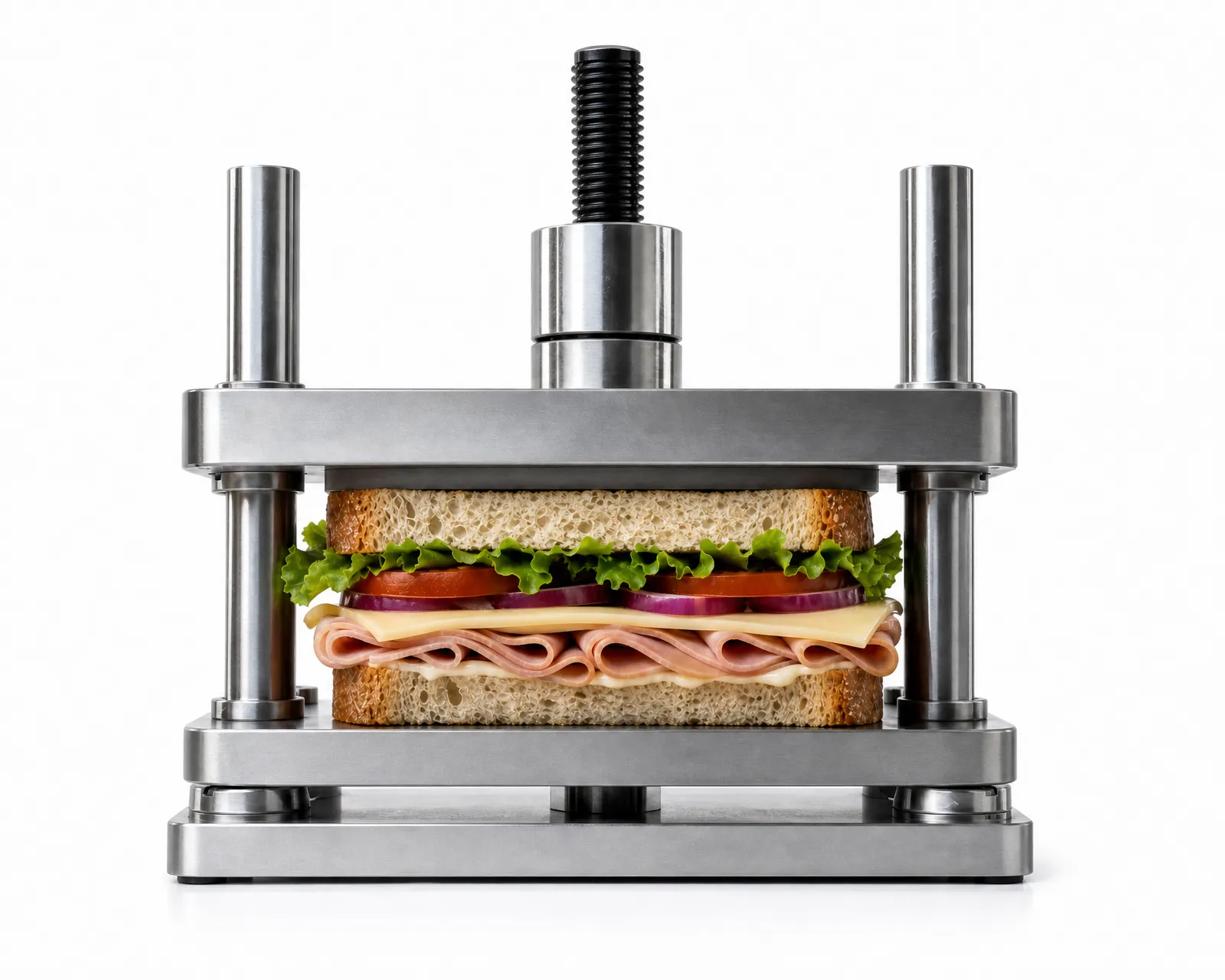
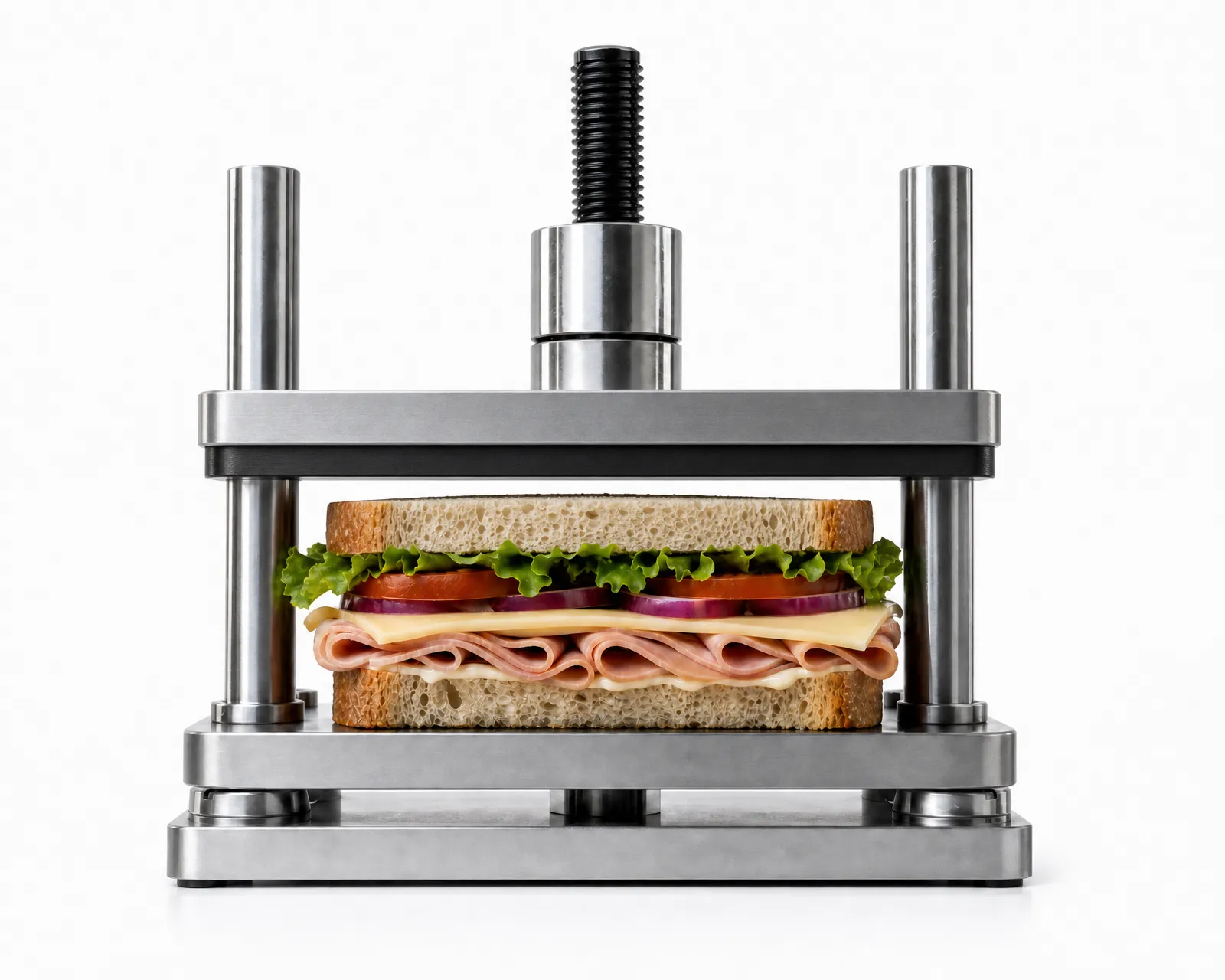
A sandwich of open-crumb bread, ruffled lettuce, tomato, red onion, cheese and folded sliced ham, held between the steel platens of a benchtop compression press. The upper platen is pressing down on the top slice, flattening the crumb where it makes contact.
Specimen001Scale50 mmLoad caseOne-handed holdTest in progress

Lunch is a load case.

A sandwich is a temporary assembly.
Every layer is both a material and an interface.

03

Specimen: grip, friction and slip

Observed failure: lateral slip at the cheese–meat interface, under a shear load applied by one-handed use.

Lateral shear load

  • Bread (top)
  • Cheese
  • Meat — failure interface
  • Bread (bottom)
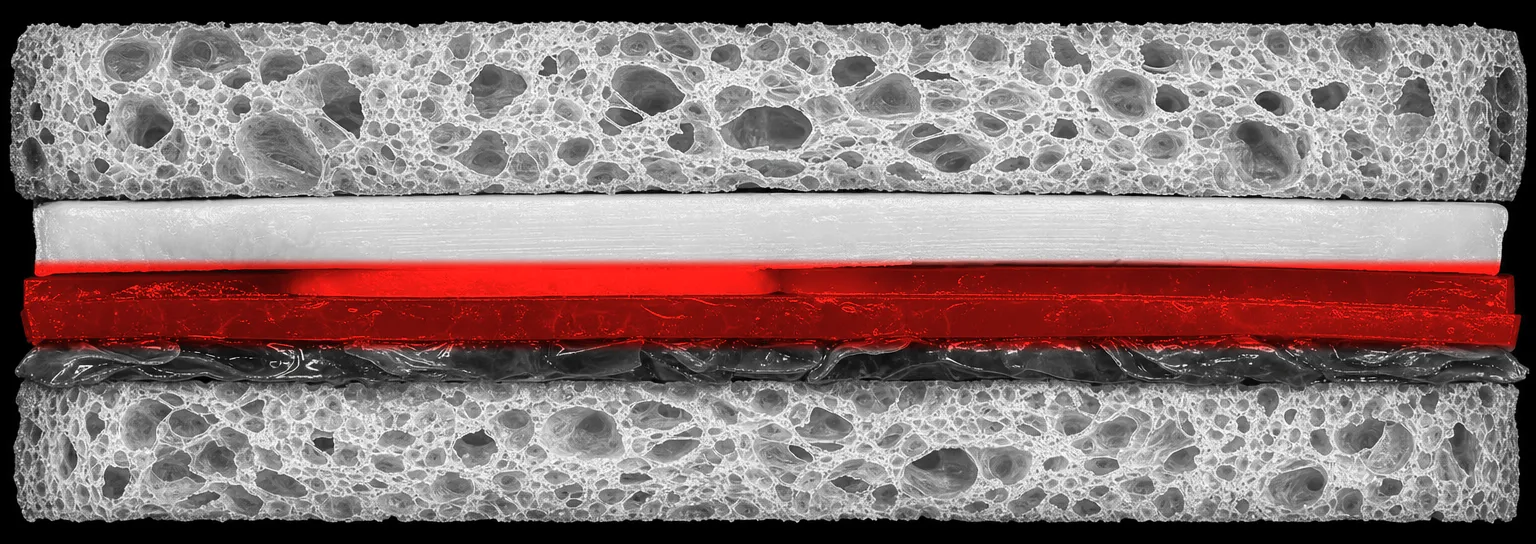
A cut cross-section of a sandwich, photographed as a laboratory specimen scan: two slices of bread with an open, airy crumb enclosing a pale slice of cheese and two layers of folded sliced meat. The specimen is greyscale apart from one meat layer, which is bright red.

≈80 mm

Specimen 003, four layers from the top: bread, cheese, meat — the failure interface — and bread. Specimen height approximately 80 mm.

Four failure families

Course working model — not a professional standard.

  1. 01

    Slip

    Layers move laterally.

    Before load

    Friction holds the interface.

    After load

    Shear overcomes friction. Layers slide.

    Shear overcomes friction. Layers slide.

    Week 3: Grip, Friction and Slip

  2. 02

    Soak

    Moisture advances.

    Before load

    The boundary is dry.

    After load

    The moisture front moves. Strength degrades.

    The moisture front moves. Strength degrades.

    Week 4: Moisture Is a Load

  3. 03

    Crush

    Compression closes gaps.

    Before load

    The stack carries its own height.

    After load

    Load shortens the stack. Gaps collapse.

    Load shortens the stack. Gaps collapse.

    Week 2: Bread Is a Beam

  4. 04

    Splay

    Exposed edges expand.

    Before load

    Contents sit inside the boundary.

    After load

    Unbraced edges flare. The structure opens.

    Unbraced edges flare. The structure opens.

    Week 5: Load-Bearing Fillings

Twelve stations. One specimen.

From definition to destructive testing, each station isolates one condition that determines whether a sandwich holds.

  1. Phase IDefineWeeks 1 to 3
  2. Phase IIExpose the ForcesWeeks 4 to 7
  3. Phase IIIAssemble and TransportWeeks 8 to 10
  4. Phase IVDiagnose and ProveWeeks 11 to 12
  1. Define — Phase I, weeks 1 to 301What Counts as a Sandwich?22 February 2027
  2. 02Bread Is a Beam1 March 2027
  3. 03Grip, Friction and Slip8 March 2027Sandwich Field Log · 15%
  4. Expose the Forces — Phase II, weeks 4 to 704Moisture Is a Load15 March 2027Lecture deck
  5. 05Load-Bearing Fillings22 March 2027
  6. 06Sauce at the Interface5 April 2027Component Test · 20%
  7. Stations 07–12 continue on the semester load path.

Every week's date, structural question and artefact is on the semester load path.

The load increases.

Assessments scale with the structural load. Prove more, risk more, hold stronger. Four submissions, totalling 100%.

  1. ObserveSandwich Field Log15%Due 12 March 2027 · end of Week 3
  2. IsolateComponent Test20%Due 9 April 2027 · end of Week 6
  3. DiagnoseFailure Autopsy25%Due 14 May 2027 · end of Week 11
  4. SynthesiseThe Sandwich Must Hold40%Due 28 May 2027 · end of Week 12
  • Sandwich Field Log — 15%, due 12 March 2027. Record four specimens, separating what was observed from what was inferred.
  • Component Test — 20%, due 9 April 2027. Isolate one structural variable and test it under at least three conditions.
  • Failure Autopsy — 25%, due 14 May 2027. Reconstruct the most defensible failure sequence from incomplete evidence.
  • The Sandwich Must Hold — 40%, due 28 May 2027. Design, test, revise and defend one system against a declared load case.

Every brief, what counts as evidence, and what is not assessed: the assessment overview.

Specimen study

The order of layers changes the result.

The same four structural categories, assembled two ways. Moving the binding layer between the moist layer and the outer layer changes which interface is exposed first — the materials are identical, so the difference is structural, not culinary.

Revised Assembly revised after the first interface failure.

Week 8: The Order of Layers

The same five layers in two assembly ordersTwo stacks of five numbered bars side by side. The left stack reads 1, 2, 3, 4, 5 from the top; in the right stack layers 2 and 3 have traded places, so it reads 1, 3, 2, 4, 5. Layer 2 is the moist layer and layer 3 the binding layer. Nothing else differs between the two.1234513245
  1. Outer layer
  2. Moist layer — against the outer layer in the first order
  3. Binding layer — moved between them in the second
  4. Support layer
  5. Outer layer

Resources

Use the evidence.

Moisture Is a LoadLecture 04

Moisture front progression

  1. Stage I

    Initial Absorption
    Surface wetting begins.

  2. Stage II

    Penetration
    Moisture front advances.

  3. Stage III

    Saturation
    Capacity reached.

Moisture is not harmless.
It adds weight. It drives load.
SLOP2895 — Week 4

Moisture Is a Load — the Week 4 lecture deck

Open the Week 4 lecture deck

SLOP2895

Field Manual

Laboratory handbook

The Field Manual — procedures, evidence and failure modes

Consult the Field Manual

Course details

SLOP2895 / experiment archived
Course
SLOP2895
Session
Semester 1 2027
Duration
Twelve teaching weeks
Teaching period
22 February 2027 – 28 May 2027
Level
2000-level undergraduate

From definition to destructive testing. One load path.

Experiment archived

The evidence survived. The sandwich did not.