Final report
Propose what you would report in place of the score, then evaluate your proposal by the standard this course applied to FID. Most proposals fail. Say how yours does.
Due · Week 12
Course weight
45%
What to submit
Submit one PDF of at most six pages plus references, and one archive that scores the bench under your proposed metric, from a seed.
Propose what a paper should report in place of the score. Then take the proposal apart yourself, using the standard this course spent twelve weeks applying to FID.
Due end of week 12. Deadlines, extensions and the use of generative tools are course-wide and live on the policies page.
Before you start
- Individual work. 100 points, worth 45 per cent of the course.
- Three parts. Part A is 25 points, Part B 45, Part C 30. The marking criteria on this page are those three parts.
- Most proposals fail. This is expected and is not marked against you. What is marked is whether you found the failure before we did.
- Generative tools are governed by the policies page. Read it before you start rather than before you submit.
- Submit one PDF of at most six pages plus references, and one archive that scores the bench under your proposed metric, from a seed.
Part A, the proposal [25]
What a paper should report in place of the score. Define it precisely enough that Part B is possible.
It may be an existing proposal, and week 12 reads one, or it may be your own. If it is an existing one, cite it and say what you are adding.
Part B, the evaluation [45]
Judge the proposal by the standard this course applied to FID, in order: its estimator bias, from week 5; its blind spots, from week 6; its correlation with human judgement, from week 10; and its cost to a paper that adopts it, from week 11.
Score A, B and C on the bench under your metric, N-honestly, beside FID and FID∞.
Each of the four is addressed, or its absence is justified. A justified absence can earn full marks. An unmarked absence earns none.
Part C, where it fails [30]
Name the condition under which you would still report FID.
If your answer is “never”, Part B has missed something, and this part is where you find it. State how badly your proposal fails, and on which of the four.
In person
Twelve minutes, week 12. Eight to present and four to defend Part C. Your archive is run beforehand, and if the bench scores do not reproduce, the presentation is about why.
SLOP8412 / Writing scaffold / First draft
Give the claim a structure.
The template puts your proposal, its evidence and its limitations in the same order as the brief. Start with the headings; supply your own argument and measurements.
Optional LaTeX starter. This is a scaffold, not a model answer or an additional marking requirement. The report remains at most six pages plus references, with a separate reproducible archive. The LaTeX ZIP does not replace that archive.
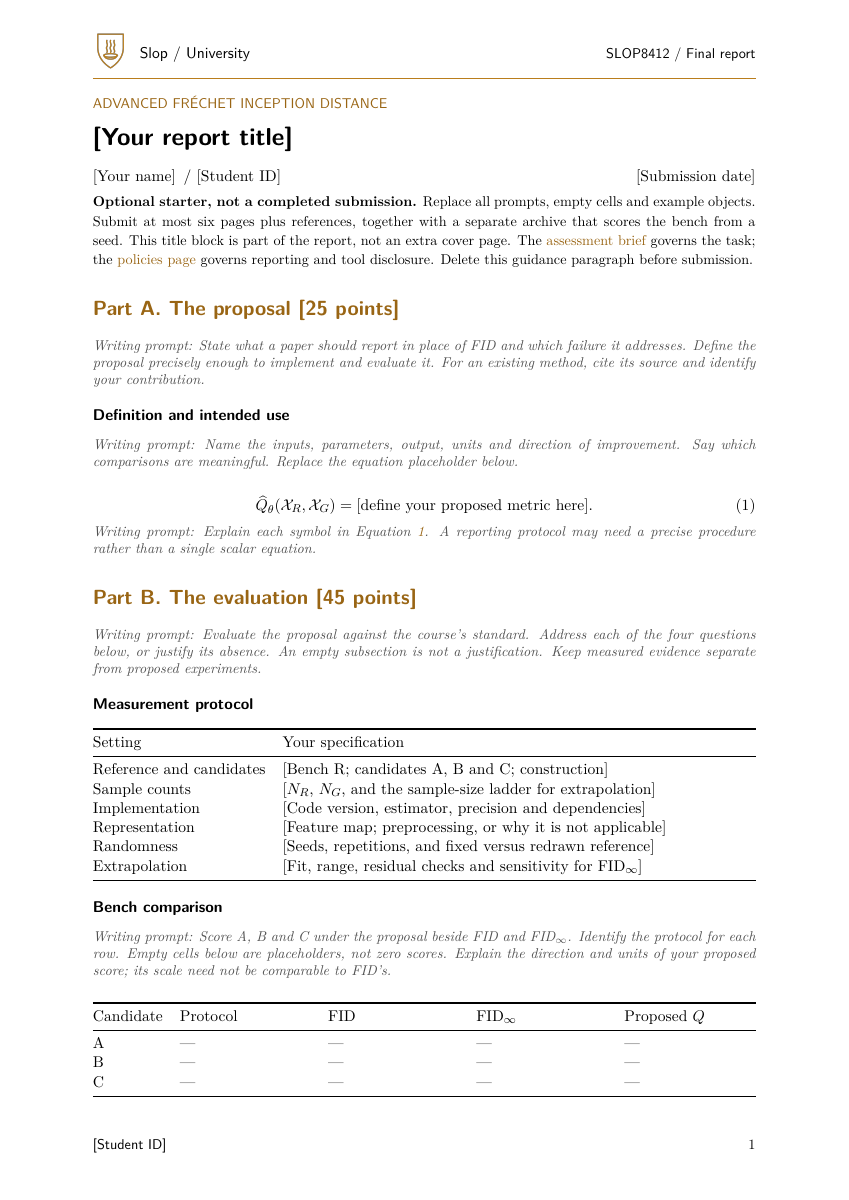
Preview blank or too small? Use “Open PDF in a new tab” or download it. The same structure is outlined below.
A / The proposal 25 points
Define the proposal, its intended use and your contribution. An equation placeholder is included; replace it with your own definition.
B / The evaluation 45 points
Compare A, B and C against FID and FID∞. Address estimator bias, blind spots, human correlation and adoption cost, or justify an absence. The starter includes protocol and results tables and a figure placeholder.
C / Where it fails 30 points
State when you would still report FID and how the proposal fails. Point the reader to the separate archive that reproduces your evidence.
References
Add the sources you actually used. No citations, scores or results are supplied as answers.
Use the LaTeX project
- Extract the ZIP. Keep
main.texandslop-crest.pngtogether. - Open
main.texin your LaTeX editor and select pdfLaTeX. Replace the title fields and writing prompts. - Compile twice to resolve equation and figure references. The ZIP includes a README with commands.
- Check the completed report’s page count. The starter’s length is not a page allocation; your title block counts within the six-page limit.
This page previews a precompiled PDF. It does not compile LaTeX, save student work or accept submissions. Consult the course policies for reporting and tool disclosure.
Supporting experiment / Workspace
An exported number still needs an argument.
01 Predict
Name one controlled pixel change and write what you expect it to do to the score. State what result would contradict your account.
02 Open the lab
Image lab / pixels to featuresRun an identity control and one altered candidate in Image lab, then export both measurement records.
03 Record
Keep the counts, encoder identity, preprocessing, candidate order and intervention with both records. Separate measured settings from assumptions.
04 Result
Draft two sentences: what the comparison showed, and whether it agreed with the prediction. Use the lecture’s reporting questions to defend those sentences.
05 Explain the limitation
An export is evidence, not a generated report or proof of human preference. These tiny image sets do not replace the final report’s shared-bench evaluation against FID and FID∞.
Keep this supporting experiment distinct from the task above. Workspace use and reporting guidance →
Submission review
Spec
The brief poses the problem and leaves room for a response. The spec is the fixed part: what a marker checks. Some lines can be checked mechanically; the rest call for judgement.
Tick each requirement after reviewing your evidence. These ticks record your review, not a grade or confirmation that the requirement is met.
Without JavaScript, ticks last until you leave this page.
How it is marked
| Criterion | Weight |
|---|---|
| The proposal | 25% |
| Evaluation by the course's own standard | 45% |
| Honesty about where it fails | 30% |