Week 12: The next dashboard
If you were inventing this vocabulary today, with no legacy dashboard to imitate, what would you keep, and what would you throw out — and what happens once the vocabulary lives in software the manufacturer can change after the sale
10 May 2027
Every dashboard this course has studied so far, however digital it looked, was still a product shipped once. The Mercedes MBUX Hyperscreen in week 1 could reconfigure its layout, but the alert vocabulary underneath it — what counts as urgent, what colour it goes, what it’s called — was fixed at the factory and stayed fixed for the life of the car, exactly like the Jaguar E-Type’s needles. A software-defined vehicle breaks that assumption. Its entire alert vocabulary is software, delivered over the air, which means a car sold in March can have a materially different dashboard language by December without a single physical component changing. The guiding question for this last week is not “is this good?” but the one the whole course has been quietly building toward: if you were inventing this vocabulary today, with no legacy dashboard to imitate, what would you keep, and what would you throw out?
A synthesis, not a new topic#
This week doesn’t introduce a new channel — it asks what happens to every channel already covered once it can be redesigned after the sale. Week 3’s idiot light was a hardware compromise: one bulb, one wire, cheap because it had to be, permanent because changing it meant a new production run. A software-defined telltale has no such excuse — which means when it’s still vague, that’s a choice, not a cost constraint. Week 5’s red/amber/green convention and week 6’s chime escalation were designed to be learnable once; an over-the-air update can silently redraw the boundary between amber and red, or swap a chime’s pattern, and a driver’s hard-won fluency in their own car’s language goes stale without their consent. Week 9’s driver- assistance alerts and week 10’s alarm-fatigue research both assumed a fixed false-alarm rate a driver calibrates trust against over months; a manufacturer that retunes a forward-collision threshold by firmware update mid-ownership is quietly moving the target the driver already learned to read. And week 11’s regulatory divergence, which treated “the same telltale, different country” as a fact about manufacturing variants, becomes a fact about update rollout schedules instead — the same car, in the same driveway, can be one software version behind its neighbour’s.
Case study: Tesla and Rivian, the dashboard as a maintained product#
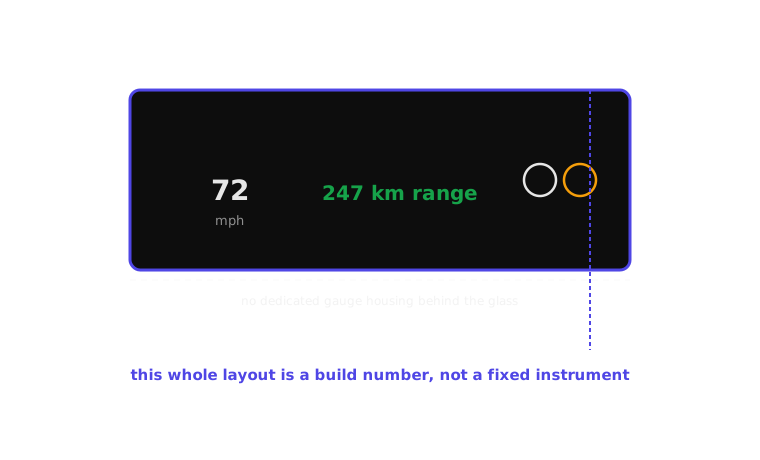
Tesla’s Model 3 and Model Y, previewed already in week 1, ship without a separate instrument cluster: speed, range, and every telltale live on a touchscreen running software Tesla updates on its own schedule, sometimes overnight, sometimes changing what a warning icon looks like or when it fires without the driver requesting anything. Rivian’s R1T and R1S do keep a dedicated driver display, but it too is a rendered surface, not a wired panel — Rivian has, across firmware releases, altered how its driver- assistance alerts present and even renamed features. In both cases the design intent is genuinely attractive: a warning that turns out to be miscalibrated, ambiguous, or wrong doesn’t have to wait for a model year to be fixed, it can be fixed for the entire fleet by Tuesday. The strength is real — no other era of dashboard could recall a bad design decision.
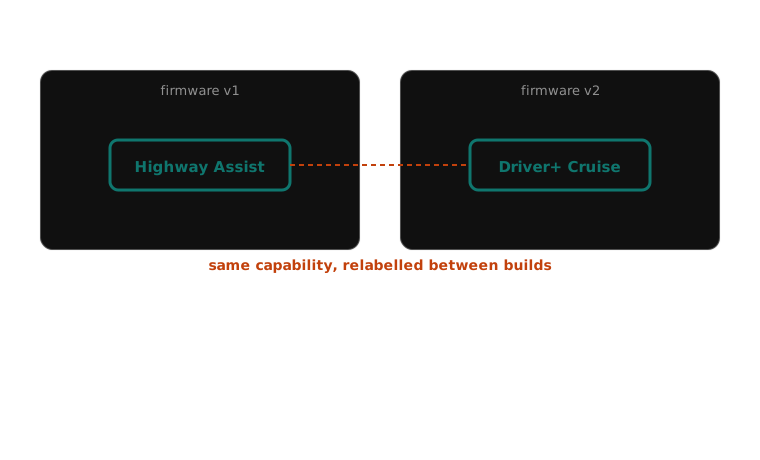
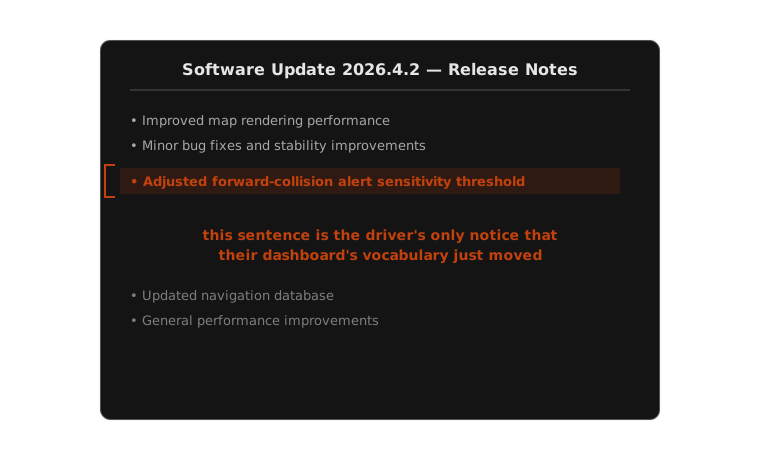
The weakness is the one this course hasn’t had to name directly until now: a driver’s mental model of their own dashboard is a learned vocabulary, and this course has spent eleven weeks establishing how much cost goes into learning it — foveal reading in week 7, a false-alarm threshold calibrated over months in week 10, a colour convention trusted since week 5. An OTA update can spend all of that without asking. Nobody voted on the new chime; nobody was told, in language a non-engineer would read, why the lane-keeping alert now trips earlier than it did last month. The car changed the meaning of a word in a language the driver thought they already spoke. A synthesis worth taking into the final assessment: an alert- vocabulary change delivered over the air should be disclosed to the driver, in plain language, at the moment it takes effect — not buried in a release note nobody reads — because week 7 already established that a driver cannot be expected to notice a meaning has changed just by looking at the same icon.
The software-defined dashboard, read against the six-question framework that has run through every week of this course: urgency thresholds that a manufacturer can now retune after the sale, not just at the factory; visibility unchanged in principle but delivered on a rendered surface that can be redesigned overnight; meaning the one dimension an OTA update puts most at risk, since a symbol’s learned meaning can be quietly redefined without the driver’s consent; modality still sight, sound and touch, but all of it now software rather than wired hardware; timing conventions — chime patterns, escalation points — that can change on a schedule the driver never sees; and a required driver action that depends on a vocabulary the driver can no longer assume is stable from one month to the next. Every dimension this course introduced in week 1 still applies to a software-defined vehicle — what’s changed is that all six can now move after the sale, which is exactly the design problem the final assessment asks you to take a position on.
What’s due this week#
The final assessment, The Instrument Cluster You’d Trust, is due this Wednesday, 14 May. This lecture is deliberately the synthesis of the whole semester rather than a self-contained new topic, because the assessment asks for exactly that: a complete alert vocabulary, defended as a coherent system, drawing on gauges, lights, icons, colour, sound, text, and — where your chosen vehicle warrants it — HUD or driver-assistance alerts. There is no week 13. Use the studio this week to pressure-test your vocabulary against a peer’s before you submit it.
Teaching team
- Marisol Quaye — convenor