Week 12
The next dashboard
If you were inventing this vocabulary today, with no legacy dashboard to imitate, what would you keep, and what would you throw out?
Learning objectives
By the end of this week you should be able to:
- identify which channels a software-defined dashboard can change after the vehicle has already been sold, versus which stay fixed at manufacture
- explain why an over-the-air alert change can silently invalidate a driver’s already-learned vocabulary, using at least one specific week’s material as evidence
- compare a factory-fixed dashboard vocabulary against a software- defined, updatable one across consistency, trust and accountability
- synthesise material from across the whole semester — needles, lights, icons, colour, sound, text, HUD, driver-assistance alerts, trust, and regulation — into a single coherent design position
- propose a principle for how a manufacturer should disclose an alert- vocabulary change to drivers when it happens
Opening example: the chime that changed overnight
A Tesla owner’s forward-collision warning has always sounded a particular way. One week, after a routine overnight software update, it sounds different — earlier, at a slightly greater following distance, with a subtly altered tone. Nothing under the hood changed: same radar, same camera, same car. The release notes, if the owner reads them at all, say something like “improved forward collision warning sensitivity.” The driver was not asked, and in many cases was not told in any way they’d actually notice before it happened on the road.
Why this example carries the week
Every previous week in this course treated a dashboard element as something a driver learns once and can rely on for the life of the car — a red light means the same thing in year one and year ten. This example breaks that premise cleanly: the car itself changed its own vocabulary, on its own schedule, without the vehicle changing hardware at all. That is a genuinely new situation. Week 1 already flagged Tesla’s software-first cluster as a preview of this; this week is where the preview becomes the whole subject.
What actually became different
Nothing about what a forward-collision warning is for changed. What changed is entirely underneath the surface a driver reads:
- the threshold at which the alert fires
- the timing of the alert relative to the hazard
- possibly the tone or pattern of the chime itself
- all of it, delivered without a factory recall, a dealer visit, or a new model year — the traditional occasions on which a car’s behaviour used to visibly change
The dashboard’s appearance — the icon, its position, its colour — can stay pixel-for-pixel identical while its meaning moves underneath it.
Which channels get more fragile once they’re software
Not every channel is affected equally by this shift. Some become more fragile precisely because software makes them cheap to change:
- week 5’s colour convention (red/amber/green) is fragile because the boundary between amber and red is now a tunable parameter, not a wired bulb — a manufacturer can move it without anyone approving the move
- week 10’s alarm-fatigue calibration is fragile because a driver’s learned false-alarm tolerance is invalidated the moment the underlying detection threshold is retuned by update, without the driver’s trust being retuned alongside it
- week 9’s driver-assistance narration is fragile because the alert’s justification — why the car intervened — can change even when its appearance doesn’t
Which channels get more flexible, for the same reason
The same shift that makes some channels fragile makes others genuinely better than they could be in a factory-fixed car:
- week 3’s idiot light, once a permanent hardware compromise, can now be replaced with an actual explanation on a display, after the fact, at zero manufacturing cost — the excuse that justified vagueness in the 1960s no longer applies to a 2020s software-defined cluster
- week 7’s text-on-dashboard translation problem can be fixed retroactively — a mistranslated warning string is a bug that ships an update, not a recall
- week 11’s regulatory divergence becomes a rollout schedule rather than a permanent manufacturing variant — a compliance fix can, in principle, reach every market’s fleet without a different production line
Direct comparison: a chime, fixed vs. updatable
Week 6 covered the mandated seatbelt-chime escalation and Tesla’s comparatively minimal chime set as two design philosophies. Put them next to this week’s subject directly:
| Aspect | Mandated seatbelt chime (fixed) | Tesla-style software chime (updatable) |
|---|---|---|
| Who can change it | Only a regulator, via a rule change | The manufacturer, at will |
| How a driver learns of a change | A new model year, visibly different | Possibly never, if release notes go unread |
| Consistency across the fleet | Every unit of a model year, identical | Depends which update each car has received |
| Driver recourse if it’s wrong | None until the next model year | Reported as feedback, fixed on the manufacturer’s timeline |
The mandated chime is inflexible by design — that inflexibility is also the only reason every driver of that model year can trust it means the same thing every time.
Real example: BMW’s subscription-gated features
BMW’s now-abandoned experiment charging a subscription for heated seats (and, more relevantly here, for certain driver-assistance feature tiers) is useful for this week because it shows the software-defined dashboard isn’t only a safety story — it’s also a business one. The same over-the-air channel that can fix a mistranslated warning string (week 7) can also gate an already-installed safety feature behind a paywall, changing what the dashboard is allowed to tell a driver depending on a billing decision, not a hazard.
Real example: Rivian’s renamed and re-presented alerts
Rivian’s R1T and R1S have, across firmware releases, altered how driver- assistance features are named and presented on the driver display — not just tuning a threshold, but changing the vocabulary itself, the words and icons a returning driver has to re-recognise. It’s useful alongside Tesla because it shows this isn’t a single-manufacturer quirk: it’s a structural consequence of building the entire cluster in software, and it happens across otherwise very different companies.
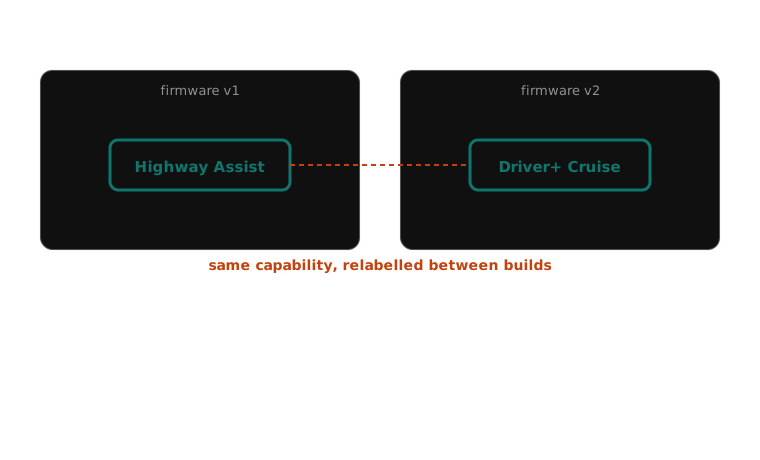
The feature didn’t change. The word for it did.
Real example: Volvo, still the throughline
Volvo’s telltale colour discipline (week 1), its City Safety alert that narrates a decision (week 9), and its driver-fatigue text messages (week 7) have all appeared already this semester as examples of a manufacturer choosing restraint and consistency. It’s worth asking directly, as a software-defined dashboard becomes the industry default: does a manufacturer with that track record earn more licence to change a driver’s vocabulary after the sale, or does the size of the update channel mean the question of trust doesn’t actually depend on a manufacturer’s past behaviour at all?
The process: how a driver’s vocabulary changes without them asking
A software-defined alert doesn’t change randomly — it follows a real pipeline, worth naming precisely because every stage is a point where a human decision, not a technical necessity, determines what the driver eventually sees:
- Signal from the field — telemetry, owner complaints, or incident data flags a problem or an opportunity in an existing alert
- A new design or threshold is proposed — internally, by an engineering or UX team, not by the driver who will receive it
- Validation and testing — simulation, closed-course testing, sometimes a staged rollout to a subset of the fleet
- Pushed as an over-the-air update — delivered to some or all vehicles, on the manufacturer’s schedule
- The driver’s dashboard vocabulary changes — without the driver requesting it, and not always with a disclosure they’d actually notice
- The driver has to relearn part of a language they believed they already knew — usually by trial and error, on the road
Where this pipeline differs from every earlier week
In every earlier week’s material, stage 5 and stage 6 above didn’t exist as separate events — a driver learned a dashboard’s vocabulary once, roughly at purchase, and that vocabulary was the same vocabulary for the life of the car (week 1’s Jaguar E-Type is the extreme case: no telltales at all to relearn, because none were ever added). The software-defined pipeline inserts a recurring relearning cost that earlier weeks never had to budget for, and nothing in the pipeline above requires the manufacturer to tell the driver it happened.
Case study, part 1: the original — an alert vocabulary that lives in software
Tesla’s Model 3 and Model Y ship with no separate driver instrument cluster — speed, range, and every warning live on the centre touchscreen, rendered by software that updates on Tesla’s own schedule, sometimes overnight. Design intent: treat the entire cluster as a maintained product, not a fixed instrument — fix a bad design decision for the whole fleet without a recall, and add capability (new alert types, refined thresholds) that a 1961 or even a 2004 dashboard had no path to ever receiving. Strength: a genuinely miscalibrated alert can be corrected in days for every vehicle that has ever shipped, something no earlier week’s case study could do at all.
Case study, part 2: the weakness — a vocabulary the driver didn’t agree to
Rivian’s comparable approach — a dedicated driver display, still software- rendered, still updated post-sale — shares the same structural weakness as Tesla’s: the driver’s mental model of their own dashboard is invalidated on the manufacturer’s timeline, not the driver’s. Week 10 established that trust in a warning system is a running average built from every past encounter with it; an OTA update resets part of that average without resetting the driver’s confidence that they still know how to read it. A driver who has correctly, patiently, learned to trust an alert’s threshold can be wrong about that threshold the very next morning, through no fault of their own attention or judgement.
Case study, part 3: consequences and a synthesis
The consequence is a specific, nameable cost this course hasn’t had to name until now: relearning cost imposed without consent. Week 7 already established that a driver can’t be expected to notice a meaning has changed just from looking at an unchanged icon — that finding applies with full force here, except the “meaning” in question isn’t a translation choice made once, it’s a threshold that can move again next month. Suggested synthesis, carried into the final assessment: any OTA change to an alert’s trigger, threshold, or presentation should be disclosed to the driver, in plain language, at the point it takes effect — not buried in a changelog — because disclosure is the only mechanism available in a software-defined vehicle that does the job a fixed factory dashboard did automatically, for free, just by never changing.
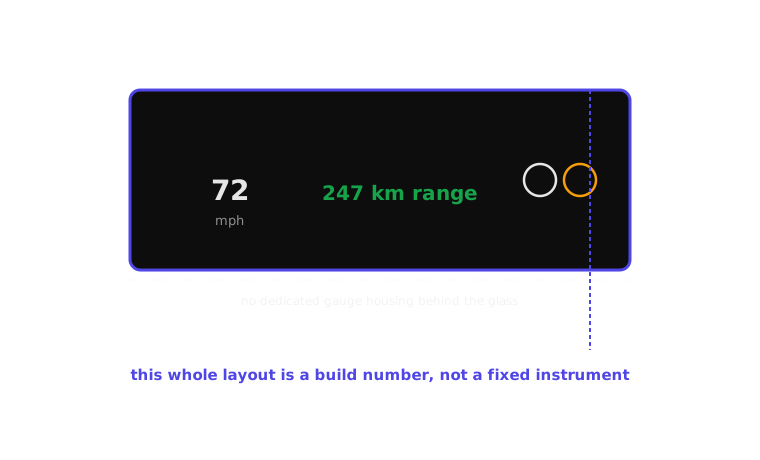
The instrument cluster as a version number: what you’re reading may not be what next month’s owner reads.
Comparison: fixed-at-the-factory vs. software-defined vocabulary
| Dimension | Fixed at the factory | Software-defined, updatable |
|---|---|---|
| Consistency for the life of the car | Guaranteed — same meaning, year one to year ten | Not guaranteed — meaning can shift with any update |
| Driver trust, once earned | Stable; earned once, holds | Has to be re-earned after every meaningful change |
| Design accountability for a bad alert | Visible — a recall, a known model-year defect | Diffuse — a quiet patch, easy to ship without scrutiny |
| Speed of fixing a genuine flaw | Slow — waits for the next model year | Fast — days, for the whole fleet at once |
| Who decides the vocabulary, and when | Fixed once, at design time, by an engineering team | Decided repeatedly, post-sale, on the manufacturer’s own schedule |
Neither column is simply better — the table is the whole argument for this week: speed of correction and stability of meaning are in direct tension, and a software-defined dashboard has only picked one side of that trade.
The disclosure, in full
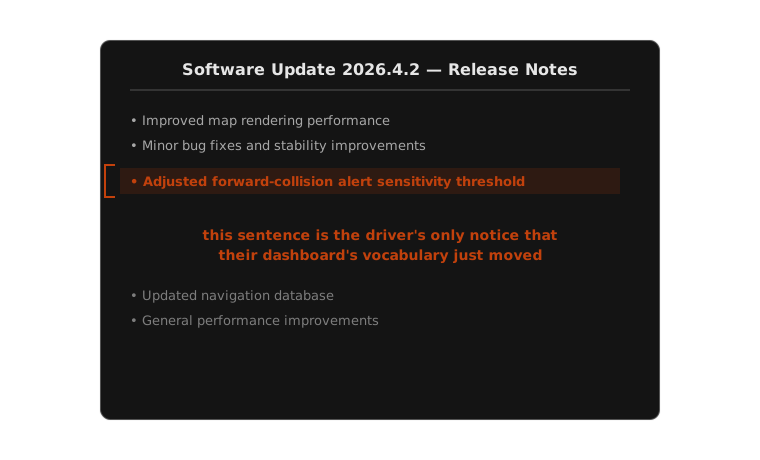
The whole disclosure, for a change to a language you already trusted.
Exercise: pressure-test your own vocabulary against an update
Final classroom preparation before the capstone submission. Working from the vehicle and alert vocabulary you’re building for The Instrument Cluster You’d Trust:
- Pick one alert from your own vocabulary and imagine you, as the manufacturer, need to change its threshold six months after sale, based on field data showing it fires too often
- Sketch how that change would be disclosed to the driver — what they’d see, and when
- Identify which of your other alerts would be most damaging to change silently, and which would be least damaging, and say why
Discuss: does your vehicle’s context (a delivery van, a motorcycle, a low-speed shuttle) change how much relearning cost a driver can absorb safely?
Mini knowledge check — the whole semester
- Name one channel (needle, light, icon, colour, sound, text, HUD, driver-assistance alert) that becomes more fragile once it lives in updatable software, and explain why, referencing the week it came from.
- A manufacturer silently retunes a forward-collision warning’s threshold by OTA update. Using week 10’s terms, what happens to the driver’s trust calibration, and why doesn’t the driver’s attention or judgement explain the result?
- Compare the Jaguar E-Type (week 1) and a Tesla Model 3/Y directly: which one guarantees its dashboard means the same thing on day one and day one-thousand, and what does that guarantee cost it?
- Propose one concrete rule a regulator or manufacturer could adopt to make OTA alert changes fair to drivers, drawing on at least two weeks’ worth of material.
Summary: the whole course, in five ideas
- A dashboard is a language, not a neutral report of measurements (week 1) — and like any language, it can drift, be relearned, or be changed by someone other than its speaker
- Every channel this course studied — needle, light, icon, colour, sound, text, HUD, driver-assistance alert — is a trade-off, never a free upgrade over what came before it
- Trust in a warning is a running average built over time (week 10), which means it can be spent by a false alarm and reset, without consent, by an update
- Regulation (week 11) and manufacturing cost (weeks 3 and 7) have always been the forces holding a dashboard’s vocabulary stable — software removes both constraints at once, for better and worse
- The question this course has actually been asking since week 1 was never “what does this light mean,” but “who gets to decide what it means, and when do they get to change their mind”
A dashboard is a language
A car uses it to talk to a human under time pressure. Every needle, light, icon, colour, chime, sentence and windscreen graphic this semester has been one sentence in that language.
Now go design one you’d trust. The Instrument Cluster You’d Trust is due this Wednesday, 14 May.