Week 11: The same car, different countries
Why the same vehicle platform ships with a different urgency vocabulary depending on which market it's sold into, and what that says about whose "urgent" a dashboard is actually built around
3 May 2027
Every week so far has treated a dashboard’s vocabulary as though it were fixed once and shipped everywhere: red still means red, a chime still means attend-to-this, an icon still means the same fault. That’s mostly true within one car. It stops being true the moment you compare the same model sold in two different countries. A vehicle can leave the same factory, on the same platform, with a materially different set of alerts — some present in one market and absent in another, some mandatory here and optional there, some tuned to a different threshold of “urgent enough to say something.” The guiding question: is a dashboard’s “urgent” the same everywhere, or is it a local dialect?
Regulation is a language’s grammar, not just its rules#
A dashboard doesn’t invent its own vocabulary from scratch — it inherits one from whichever regulatory body has jurisdiction over the market it’s sold into. Euro NCAP, the US NHTSA, and Japan’s own type-approval regime don’t just set safety minimums; they set which alerts exist at all, and how loudly. When Euro NCAP makes a feature a precondition for its top safety rating, manufacturers who sell in Europe have a strong commercial reason to fit it as standard there, whether or not any law technically requires it. A feature NHTSA hasn’t rated the same way, or a Japanese regulator has approved on different terms, doesn’t carry the same pressure — so the same manufacturer, selling what is otherwise the same car, can reasonably decide to fit it as standard in one market and leave it optional, delayed, or absent in another.
Layout is also a language, and it isn’t just mirrored#
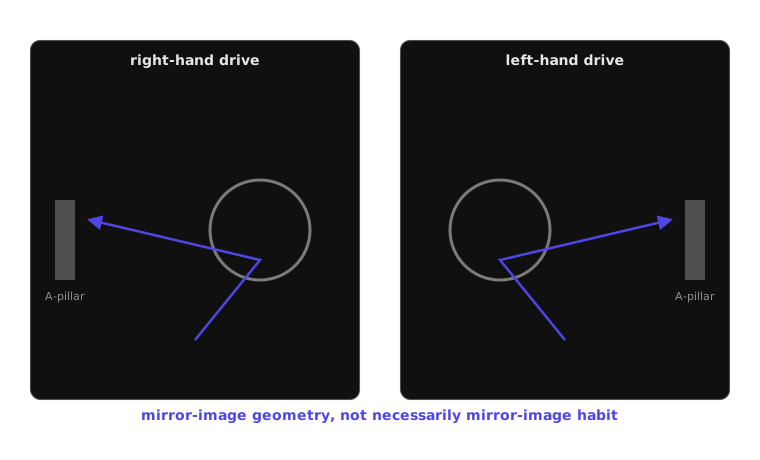
The regulatory divergence is the more visible half of this week; the right-hand-drive/left-hand-drive divide is the quieter half, and it’s often misunderstood as pure mirroring. Moving the steering wheel and pedals across the car is not the only change — the instrument cluster’s position relative to the door pillar, the driver’s shoulder, and the windscreen’s A-pillar blind spot changes too, and a driver’s whole scanning habit is built around where those things sit relative to each other, not just where the wheel is. A driver’s glance path from road to cluster to mirror to blind spot is a learned motor habit, tuned over years to one geometry. It does not simply flip when the car does.
Case study: the same telltale, tuned three ways#
Take speed-limit-recognition warnings and seatbelt-reminder chimes as the concrete pair. Euro NCAP has, since the mid-2010s, made both a precondition for its highest ratings, which pushed manufacturers to fit escalating seatbelt chimes and camera-based speed-sign recognition as standard across whole European model ranges well ahead of any EU legal mandate forcing the issue outright. NHTSA’s rulemaking and rating programs have moved on a different timeline and with different emphasis — seatbelt reminders have been incentivised through NCAP-style ratings and, more recently, federal rulemaking, but historically with less aggressive escalation than the European chime, and speed-limit recognition has had no equivalent US mandate pushing it into base trims. Japan’s regulator has approved and required its own overlapping but not identical set, on its own schedule. The result: the same platform, sold in Frankfurt, Detroit and Tokyo, can carry three genuinely different alert vocabularies for what is functionally the same underlying risk. Layer the RHD/LHD point on top and the divergence compounds — a UK-market car’s cluster sits on the side of the car closest to the kerb and the door pillar the driver’s habitual glance already favours, while the same model built for a LHD market puts that same cluster on the opposite side of a scanning habit built for a different road position entirely. Neither “urgent enough to alert on” nor “where a driver looks first” turns out to be a fact about the world; both are set market by market, by regulation, convention and habit, and a manufacturer either harmonises around the strictest common vocabulary or manages three separate ones.
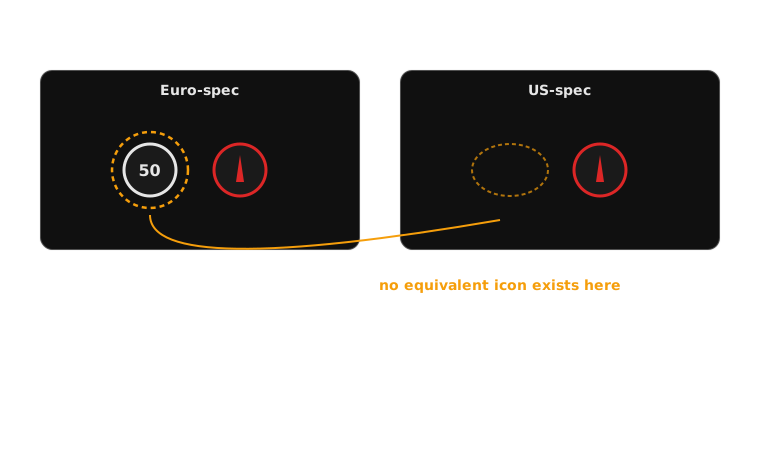
Market-dependent vocabulary itself, read against the six-question framework introduced in week 1: urgency thresholds that regulators, not physics, set differently market by market; visibility, including the glance path’s own geometry, which changes under RHD/LHD in ways a simple mirror-image doesn’t capture; meaning that can differ by region even when the icon looks identical; modality unchanged across markets — still sight, sound and touch — even while what triggers each channel diverges; timing rules such as escalating seatbelt chimes that some regulators mandate and others don’t; and a required driver action that a manufacturer can choose to demand in one market and leave optional in another. The lesson this week adds to the framework is that none of its six answers is a fact about the vehicle — each is a decision a regulator or a market made, and a different regulator can make a different one for the identical car.
Next week is the capstone: if this week showed that a dashboard’s vocabulary is contingent on regulation and habit rather than fixed by physics, week 12 asks what’s actually worth keeping if that vocabulary were designed today with no legacy to imitate. The final project is due at the end of that week, so this is a good week to start consolidating whatever case you’ve been building toward it.
Teaching team
- Marisol Quaye — convenor