Week 11
The same car, different countries
Is a dashboard’s “urgent” the same everywhere, or is it a local dialect?
Learning objectives
By the end of this week you should be able to:
- Identify at least two dashboard features that are mandatory in one regulatory market and optional, delayed, or absent in another
- Explain how a rating criterion from a body like Euro NCAP propagates into a standard-fit dashboard feature without ever becoming a law
- Compare the seatbelt-reminder or speed-limit-recognition alert as implemented under Euro NCAP/EU regulation versus US NHTSA regulation versus Japanese regulation
- Explain why a right-hand-drive and left-hand-drive version of the same model are not simply mirror images of each other’s scanning demands
- Argue, with a stated trade-off, whether a harmonised minimum alert vocabulary would help or hurt drivers in at least one specific market
Opening example: one platform, three dashboards
Take a single global model — a mainstream compact SUV built on one platform and sold, with only modest changes, in Europe, North America and Japan. Pop the bonnet and the platform is close to identical. Look at the instrument binnacle instead, and it isn’t. The European-market car very likely has a standard speed-limit-recognition display and an escalating, multi-stage seatbelt chime for every seat, front and rear. The US-market car very likely has neither as standard, or has a shorter, less insistent seatbelt chime that legally only has to run for a matter of seconds. The Japanese-market car may mandate an entirely different feature — automatic emergency braking as standard even on the most basic domestic trim — years before that became a US requirement.
Opening example: what the car is actually saying, and to whom
None of this is the manufacturer being inconsistent. Each version of the dashboard is answering the question “what is urgent enough to interrupt this driver?” correctly, for the regulatory environment it was built to satisfy. The car isn’t confused about what matters — the definition of “matters enough to alert on” was handed to the manufacturer by a different authority in each market, before a single line of dashboard software was written. That is the whole premise of this week: urgency on a dashboard is not measured, it’s assigned, and it’s assigned locally.
Regulation as grammar, not just rules
Three bodies do most of the work in this week’s case study, and they are not interchangeable:
- Euro NCAP — a voluntary, ratings-based body. It doesn’t write law, but a five-star rating is commercially important enough in Europe that its scoring criteria function as a de facto mandate for anything sold there
- US NHTSA — sets binding Federal Motor Vehicle Safety Standards (FMVSS), and separately runs its own New Car Assessment Program (NCAP) rating, but the binding standard and the rating criteria don’t always move in step, and don’t always match Euro NCAP’s
- Japan’s regulator (MLIT) and JNCAP — sets its own type-approval requirements and runs its own ratings program, on its own schedule, shaped by a market with its own vehicle mix (kei cars are a large share of Japanese sales and have their own rules)
A feature can be a hard legal requirement in one of these systems, a rating-only incentive in a second, and simply not addressed in a third.
Real example: Intelligent Speed Assistance, mandated in the EU
The EU’s General Safety Regulation (Regulation 2019/2144) required Intelligent Speed Assistance — a system that reads speed-limit signs or digital map data and displays, and can gently push back against, the current limit — on all new vehicle types from July 2022, extending to all new vehicles registered from July 2024. This is why a current Volkswagen Golf or Ford Focus sold in the EU shows a speed-limit icon and a soft warning chime that a nearly identical Focus or Golf sold in the US does not carry as standard. The feature is useful for this week specifically because it is a hard EU legal mandate with no equivalent US federal requirement — the clearest possible case of the same platform, two vocabularies.
Real example: the seatbelt chime, mandated two different ways
The US federal standard (FMVSS 208) requires a seatbelt warning light and an audible chime, but historically only for a brief minimum duration — a few seconds is enough to satisfy the letter of the rule. Euro NCAP, by contrast, has for years awarded rating points only to seatbelt reminders that escalate — getting louder, more frequent, or adding a visual pulse the longer the belt stays unfastened — and, in its more recent protocols, only awards full points when that escalation covers rear seats too. Manufacturers chasing a five-star Euro NCAP rating fitted the escalating version across whole European ranges well before any EU law forced the point. The US-market version of the same model can legally ship with the minimum chime instead, and often has.
Comparison within the core content: Euro-spec vs US-spec, same model
| Aspect | Euro-spec dashboard | US-spec dashboard |
|---|---|---|
| Speed-limit recognition | Standard, EU-mandated since 2024 | Not federally required; often absent or a paid option |
| Seatbelt chime | Escalating, often covers all seats | Legally sufficient after a few seconds; may not escalate |
| Driver behind the wheel | Sees continuous ambient reminders of both limit and belt status | Sees a shorter, more easily satisfied version of the same category of alert |
| Why the gap exists | Euro NCAP scoring pressure plus a binding EU mandate | No equivalent federal mandate for speed-limit display; a weaker minimum chime requirement |
Same platform, same underlying risk, two different answers to “how insistent should this be.”
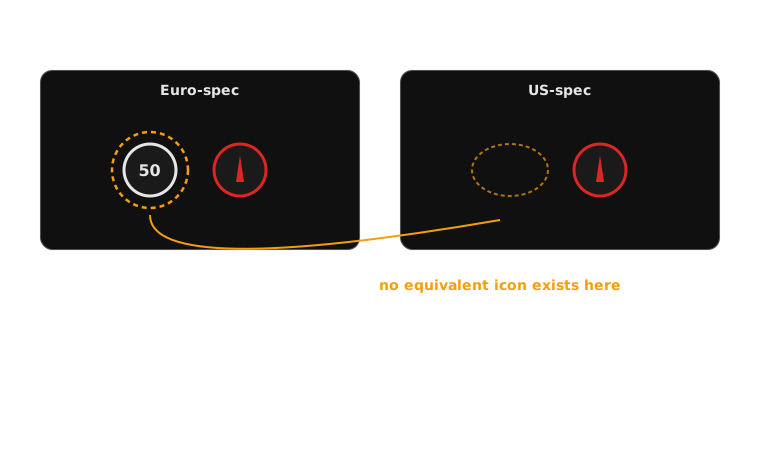
Same platform, same dashboard architecture — one market’s regulator asked for an icon the other market’s regulator never required.
The process: from a rating criterion to a dashboard icon
The gap between markets isn’t random — it follows a repeatable chain:
- A safety body sets a criterion — Euro NCAP adds a scoring point for escalating seatbelt reminders; the EU General Safety Regulation mandates Intelligent Speed Assistance outright
- A manufacturer decides standard vs optional, per market — fit it as standard where the rating or law demands it, leave it optional or absent where neither body has asked for it
- The implementation is localised — icon conventions, spoken or written language for any voice/text component, and RHD/LHD instrument layout are all adapted for that specific market’s build
- The same platform ships with a different alert vocabulary — a Golf built in the same factory carries a materially different dashboard depending on the country it’s destined for
Steps 1–2 are regulatory and commercial decisions made long before step 4’s dashboard exists.
Real example: Japan’s own schedule, Toyota and Honda
Japan’s path doesn’t track Europe’s or the US’s. Japanese manufacturers and MLIT moved to make automatic emergency braking (AEB) standard on new kei-cars and many mainstream domestic models well ahead of equivalent US federal action — an industry-government push through the early 2020s aimed specifically at Japan’s older-driver demographic and dense low-speed urban driving. A domestic-market Toyota or Honda kei car can carry AEB and its associated dashboard warning as standard while a similarly positioned small car sold new in the US, at the same time, did not have to. This matters for the week because it shows the divergence isn’t simply “Europe strict, US lenient, Japan somewhere in between” — each market leads on the feature that answers its own most pressing risk profile.
Real example: Tesla and the software-defined shortcut
Tesla is useful here for the opposite reason: because its dashboard is software-defined rather than fixed at the factory, Tesla can localise an alert’s threshold, language or presence with an over-the-air update rather than a hardware or trim change. Where a conventional manufacturer’s market-by-market divergence is baked in at production, Tesla’s is, in principle, adjustable after the car is already on the road. That doesn’t remove the underlying regulatory divergence — Tesla still has to satisfy each market’s requirements separately — but it changes how the divergence gets implemented, and it’s the thread this week hands forward to week 12.
Layout is a language too — and it isn’t just mirrored
It’s tempting to assume a right-hand-drive car is simply a left-hand-drive car flipped left-to-right: move the wheel, mirror the cluster, done. The instrument binnacle position relative to the door pillar does mirror. What doesn’t automatically come along for the ride is the driver’s scanning habit — the learned, practiced sequence of glances between road, cluster, mirrors and blind spot, built over years around one specific geometry and one specific side of the road to watch for oncoming traffic and merging vehicles.
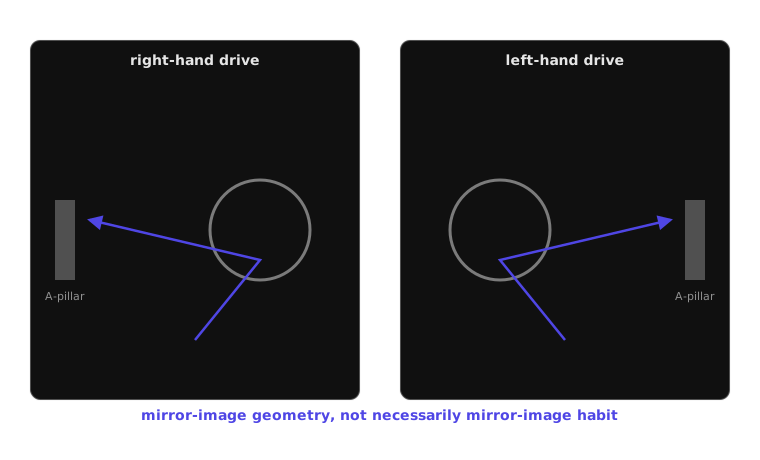
Flipping the wheel flips the geometry. It doesn’t automatically flip a decade of scanning habit with it.
Real example: the indicator stalk that didn’t mirror
A concrete, well-documented case of layout not simply mirroring: grey-market right-hand-drive conversions of American pickup trucks for Australia — Ford F-150 and Ram 1500 conversions carried out by firms such as RMA Automotive and Walkinshaw — have been reported by Australian motoring press to leave the indicator stalk on the left-hand-drive-convention side, opposite the side Australian drivers have used their whole driving lives, because fully re-engineering the steering column is costly. The wheel and cluster moved. The habit-critical stalk position, on some of these conversions, didn’t follow — and drivers used to Japanese- or European-convention RHD cars notice immediately.
Real example: Mazda and the JDM/UK stalk convention
The same point shows up even without a conversion involved. Japanese domestic-market cars, including Mazda’s, commonly place the indicator stalk on the right and the wiper stalk on the left, matching the steering wheel side. British-built or European-sourced right-hand-drive cars sold in the UK, by contrast, typically keep the indicator on the left stalk, unchanged from the left-hand-drive layout, purely moving the wheel and pedals. Two genuinely different RHD conventions exist side by side, both long- established, and a driver moving between a JDM import and a UK-market car of the same nominal handedness still has to relearn which stalk does what.
Case study: the same telltale, tuned three ways
Bring the regulatory and layout threads together on one alert pair — speed-limit recognition and seatbelt reminders — across the three markets this week has been building toward. Euro NCAP’s rating pressure plus the EU General Safety Regulation gave Europe a standard, escalating, all-seats version of both. The US federal minimum gave American drivers a legally sufficient but far less insistent version of each, with no federal push behind speed-limit display specifically. Japan’s own schedule prioritised a different feature entirely — AEB as standard, ahead of either — reflecting a domestic risk profile built around an ageing driver population and dense low-speed streets rather than the motorway-speed risk profile Euro NCAP’s criteria were largely built to address.
Case study: strengths, weaknesses, consequences for the driver
The European approach’s strength is consistency — a driver who learns the escalating chime once can trust it will behave the same way in almost any new European car. Its weakness is that “more insistent, in every seat” has a real cost in driver annoyance, which is exactly the alarm-fatigue trade-off week 10 raised. The US approach’s strength is that manufacturers retain more freedom to tune insistence to what a specific model’s buyers tolerate; its weakness is that “legally sufficient” and “actually effective” are not the same claim, and the gap is measurable in seatbelt-usage statistics between regions. Japan’s approach shows a third strength — leading on the feature that matches the market’s actual risk — at the cost of a driver moving between Japan and Europe finding neither market’s “most urgent” feature familiar.
Case study: a suggested synthesis
None of the three approaches is simply correct. A plausible synthesis, and one worth arguing with rather than accepting outright, is a harmonised minimum alert vocabulary — a small, shared core (a small number of universally red-tier alerts, a shared minimum seatbelt-chime escalation curve) that every market’s regulator agrees to, layered underneath whatever market-specific features each region’s risk profile and rating body still add on top. That would mean a driver’s most safety-critical alerts transfer between countries even while everything above that floor stays locally tuned — trading some of each market’s autonomy for a driver’s ability to carry urgency literacy across a border.
Comparison: the same alert, three regulatory regimes
| Feature | Euro NCAP / EU | US NHTSA | Japan (MLIT / JNCAP) |
|---|---|---|---|
| Speed-limit recognition display | Mandated for all new vehicles from July 2024 (GSR) | No federal mandate; rating incentive only, inconsistently applied | No equivalent nationwide mandate at the same point |
| Seatbelt reminder | Escalating, rating-driven, increasingly covers rear seats | Legally required but minimum duration can be brief (FMVSS 208) | Required, on a separate domestic schedule and standard |
| Automatic emergency braking | Rating-driven, widely standard by mid-2020s | Federal mandate (FMVSS 127) targeted for 2029 | Industry-government push made it standard on many domestic models earlier |
| Driving side / cluster layout | LHD across almost all EU markets | LHD | RHD |
The table’s real point isn’t any single cell — it’s that no column is strictly “ahead.” Each regime leads somewhere and lags somewhere else.
Classroom exercise: build your own three-market comparison
Pick one dashboard alert this course hasn’t already used as its running example — a tyre-pressure telltale, a driver-drowsiness warning, a blind- spot indicator, anything with a plausible regulatory story. Working in small groups, research and answer:
- Is this alert mandated by law, incentivised by a rating body, or neither, in the EU, the US, and Japan?
- Where the requirement differs, is the gap regulatory, commercial, or a naming/localisation difference dressed up as a bigger gap than it is?
- If you had to pick one market’s version as the floor for a harmonised minimum, which would you pick, and what would the other two markets lose?
- Name one RHD/LHD layout consequence, beyond mirroring, that this alert’s on-screen position would need to account for.
Mini knowledge check
- Name one dashboard feature that is a hard legal mandate in the EU and not in the US, and name the regulation responsible.
- Explain, in one sentence, how a Euro NCAP rating criterion can end up standard-fit on a car without ever becoming a law.
- A right-hand-drive and left-hand-drive version of the same model are often described as “mirror images.” What, specifically, does that description leave out?
- Give one real manufacturer or market example from this week where Japan, not Europe, led on a safety feature.
Summary
- A dashboard’s alert vocabulary is not a fixed, universal fact about a vehicle — it’s assigned market by market, by regulation, rating pressure and convention
- Euro NCAP, US NHTSA and Japan’s MLIT/JNCAP don’t just enforce different minimums, they operate through different mechanisms — binding law, rating incentive, and domestic industry-government agreement — and don’t move on the same schedule
- A single platform can ship with genuinely different standard-fit alerts depending on destination market, before a single unit is built
- Right-hand-drive and left-hand-drive versions of the same model mirror the instrument layout but not automatically the driver’s scanning habit or every regional switchgear convention
- A harmonised minimum alert vocabulary is a real, arguable proposal, not a settled answer — it trades local autonomy for cross-border urgency literacy
Bridge to week 12: what would you actually keep?
This week’s whole argument is that almost nothing about a dashboard’s current vocabulary is inevitable — not which alerts exist, not how urgent they’re allowed to be, not where the cluster sits relative to the driver. Regulation, rating pressure, historical accident, and a century of convention decided all of it, market by market. Week 12 asks the question that follows directly from that: if none of this vocabulary is a fixed fact, and a software-defined dashboard like Tesla’s or Rivian’s can now be redesigned and re-shipped after the car is already sold, what would you actually keep if you were designing this vocabulary today, with no legacy instrument cluster to imitate at all?
Next: Week 12 — The next dashboard
The capstone: software-defined dashboards as a maintained UI, not a fixed instrument — and the question of what’s worth keeping with no legacy left to imitate.