Week 9: The vocabulary of almost-autonomy
What an alert is actually claiming once the car can act on its own judgement, and why Volvo's City Safety (2008) is the moment the dashboard started narrating decisions instead of reporting symptoms
19 April 2027
Every alert this course has studied so far, from the oil-pressure idiot light to a heads-up navigation arrow, has done the same job: describe a fact about the world and leave the response to the driver. The fuel is low. The tyre is soft. The lane markings say you’re drifting. This week’s alerts break that pattern. When a forward-collision warning fires at the same instant the car applies its own brakes, the dashboard is no longer describing a symptom — it is narrating a decision the car is making, or has already made, on the driver’s behalf. The guiding question: when the car starts giving advice instead of just reporting state, what is the alert actually claiming?
Two different sentences, wearing the same red light#
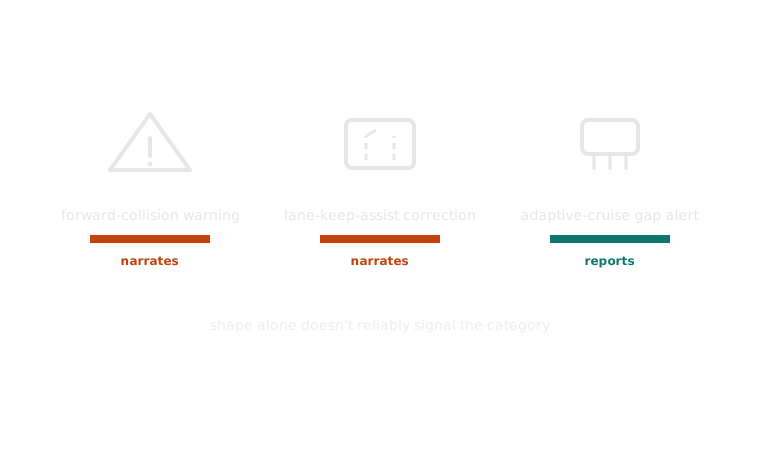
“Your oil pressure is low” and “I am braking” can share the same red telltale, the same urgent tone, the same half-second of attention — but they are grammatically different claims. The first describes a condition that exists whether or not the driver acts; ignore it and the oil pressure stays exactly as low. The second describes an action the car itself is already taking, regardless of what the driver decides. A driver trained by eight weeks of dashboards that describe the world is not automatically equipped to read one that describes the car’s own behaviour instead.
The warning can arrive with the intervention, not before it#
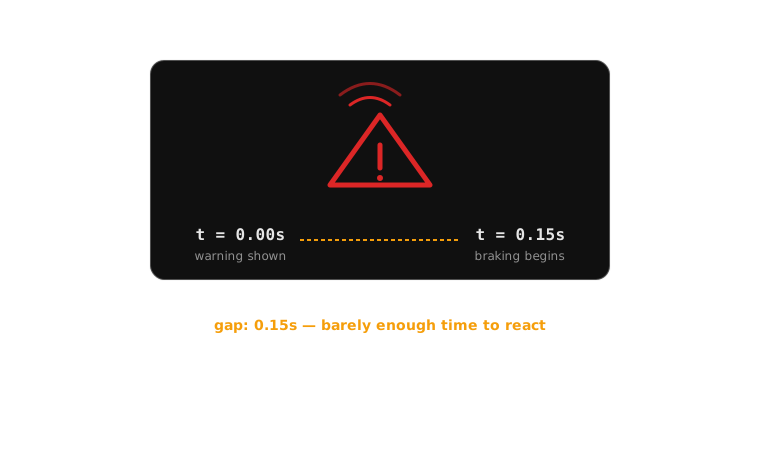
Every earlier alert type in this course preserves a sequence: the car detects a condition, tells the driver, and the driver has seconds to act before anything else happens. An almost-autonomous alert can collapse that sequence. At short following distances there isn’t time to warn and then brake, so the system warns and brakes together, or brakes first and lets the warning explain what already happened. That is a physical constraint of time-to-collision, not a design failure — but it asks the driver to interpret an alert that may describe the past rather than offer a choice about the future.
Case study: Volvo City Safety, 2008#
Volvo introduced City Safety on the first-generation XC60 in 2008: a low-speed system, originally active below roughly 30 km/h, meant to prevent or soften the most common urban collision, a nose-to-tail shunt in slow traffic. A forward-facing sensor tracks the vehicle ahead; if a collision looks imminent and the driver hasn’t braked, the system brakes for them. Its interface set the template for the whole category: where there’s enough time, the driver gets an audible and visual warning before the car intervenes; where there isn’t, the system skips straight to braking, because a warning arriving after the braking has already started isn’t warning anyone of anything they can still change. That staging is the case study’s real lesson and its real weakness. A driver who feels the car brake hard with no preceding cue has no way to tell, in the moment, whether it just corrected a hazard they never saw or whether something has gone wrong with the car itself — and the alert that would resolve that ambiguity is exactly the one the shortest-range cases don’t have time to give. A workable synthesis keeps the staged warn-then-brake logic wherever the time budget allows it, but adds a distinct, sustained visual cue timed to the onset of any autonomous braking, so even a driver with zero warning time can retroactively read “the car just intervened” instead of “the car just malfunctioned.”
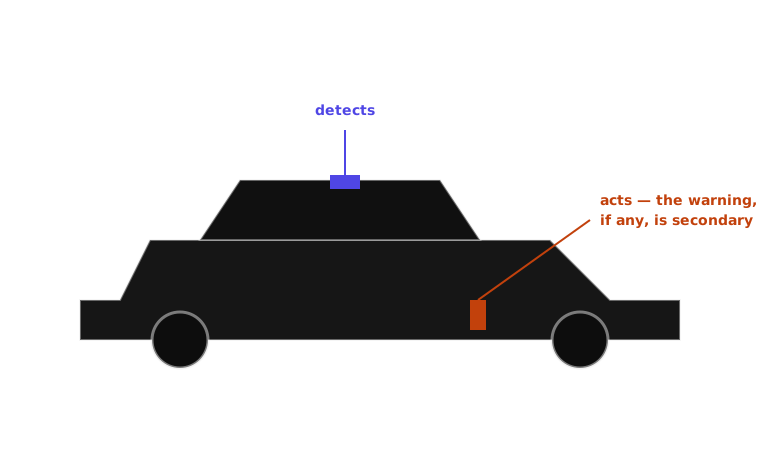
The almost-autonomous alert, read against the six-question framework introduced in week 1: urgency that can be near-total, since the window to act may already have closed; visibility unchanged from earlier warning lights — foveal or peripheral depending on placement — but arriving with, not before, the event it describes; meaning that has quietly shifted from state to narrated decision, without the driver being told the grammar changed; still visual-plus-audio modality, the same channels week 6 covered; timing collapsed to near-zero lead time in the shortest-range cases; and a required action that can be nothing at all, because the car has already taken it. City Safety’s real design problem is that the framework’s own categories blur here — an alert that fires after the action it announces is barely an alert in the sense weeks 1–8 used the word.
No assessment is due this week. Next week asks what happens to this more assertive vocabulary when it’s wrong too often: the trust and alarm-fatigue research behind drivers switching their own safety systems off.
Teaching team
- Marisol Quaye — convenor