Week 8: Heads-up: the dashboard on the windscreen
What changes when an instrument stops living in the dashboard and starts living in the driver's own view of the road
12 April 2027
Every instrument this course has looked at so far lives below the windscreen, in a spot the driver has to choose to look at. That choice costs time — half a second down, half a second back up, at 100 km/h roughly 28 metres travelled blind each way. A head-up display (HUD) stops charging that toll by putting the instrument in the driver’s line of sight, so reading it and watching the road become the same act. The question isn’t “does that work?” — it plainly does, for speed — but “what else changes once a manufacturer can draw on the windscreen, and what happens when they draw too much?”
Depth, not just position#
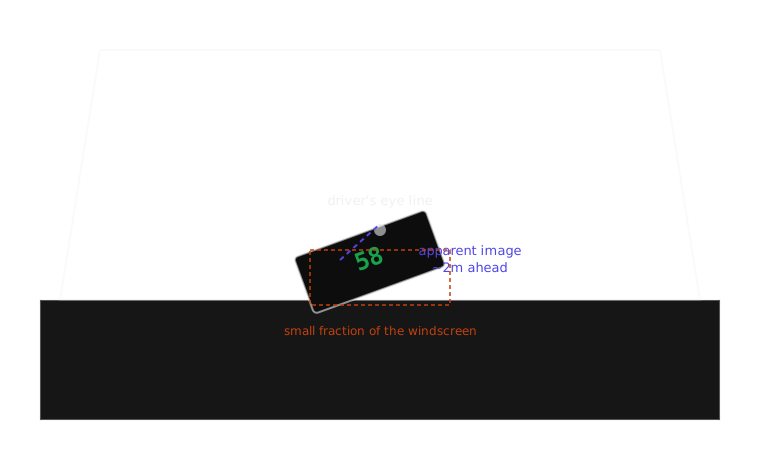
A gauge cluster’s design problem is legibility from a fixed head position at a fixed distance. A HUD’s problem is different: the image has to sit at a specific depth in the driver’s field of view, usually projected several metres ahead so the eye doesn’t have to refocus from road to dashboard and back. Get that focal distance wrong and the refocusing cost the HUD was meant to remove comes back anyway, just relocated. This is why early HUDs carried almost nothing — a single number, changing the eye’s direction but not its depth.
From reporting to overlaying#
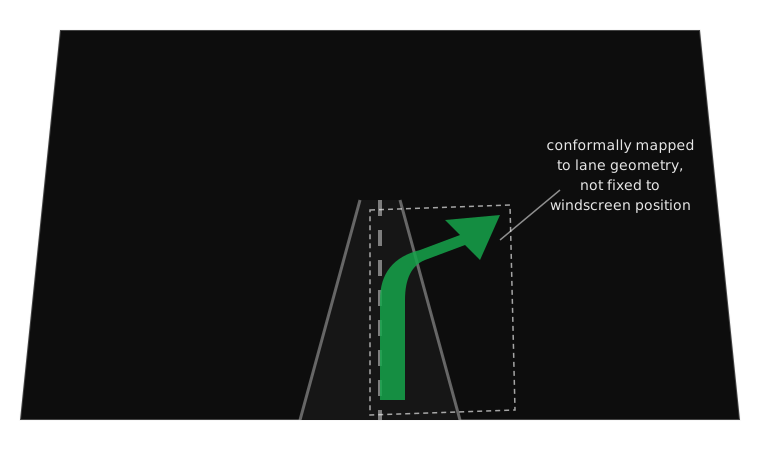
The larger shift is what a windscreen instrument is allowed to point at. A dashboard gauge only ever refers to itself — a needle means “here’s your speed,” full stop. A windscreen graphic can be drawn in registration with a specific object outside the car: the exact lane, the exact turn a navigation arrow means. Once a display is conformal to the world, it stops being a gauge and starts being annotation — a larger claim on attention, and a larger risk: annotate too much of the road and you’ve built clutter over the one view a driver cannot afford to lose.
Case study: from one number to the whole windscreen#
The 1988 Oldsmobile Cutlass Supreme was the first mass-market car sold with a factory HUD, borrowed openly from fighter-jet avionics, where pilots had used windscreen-projected instruments since the 1950s to stay eyes-up during high-speed manoeuvres. Oldsmobile’s version was deliberately minimal: a green, monochrome speed readout reflected off a small combiner, solving one problem — glancing at the speedometer — and nothing else. Fixed to the car, not the world, it could report a number but never point at anything.
Modern augmented-reality HUDs, fitted to various current Mercedes-Benz, BMW and other premium models, do something categorically different: they paint a navigation arrow onto the actual lane the driver should take, or highlight a hazard where it sits on the road, updating in real time as the driver’s head shifts. The gain is real — the arrow means “turn here,” not “turn right in 200m.” The risk is the risk of any annotation over a live scene: at what point do a navigation arrow, a hazard highlight and a following-distance graphic, rendered at once, stop supplementing the road and start competing with it?
The HUD, read against the six-question framework introduced in week 1: urgency it inherits from whatever it displays rather than adding on its own; visibility that is foveal in position but no longer requires refocusing, since the image sits at road depth rather than dashboard depth; meaning ranging from self-evident (a conformal arrow drawn onto the actual lane) to fully learned (a bare speed number); modality still purely visual, but layered directly over the driving scene instead of beside it; timing typically continuous while the underlying data keeps updating; and a required action the conformal graphic can make almost automatic (“follow this exact line”) in a way a dashboard needle never could. The risk the framework doesn’t price on its own is competition: stack enough conformal graphics on the one view a driver cannot look away from, and the HUD starts fighting the road for the same attention it was built to protect.
Assessment 2, Redesign a Warning, is due this Friday, 16 April — worth noting here, since a HUD alert is exactly the kind of multi-channel system that assignment asks you to take apart. Next week: displays that stop reporting a state and start recommending an action, via Volvo’s City Safety.
Teaching team
- Marisol Quaye — convenor