Week 3: The idiot light
What a dashboard loses, and gains, when a continuous measurement becomes a single light — from the 1950s–60s US gauge-to-light shift to the modern check-engine light
8 March 2027
A gauge tells you a number and lets you watch it move. A light tells you one bit: attend, or don’t. Somewhere between those two is a decision someone made about what a driver could be trusted to read, and how much of their attention a given fact deserved. This week asks what that decision costs, using the clearest case in the whole history of the dashboard: the US industry’s mid-century swap of oil-pressure and ammeter gauges for a single warning light, and its modern descendant, the check-engine light.
Reading a gauge is a skill, and skills fail under pressure#
A continuous gauge assumes the driver is monitoring — glancing at a needle’s position relative to a normal range, catching a slow drift before it becomes a failure. That assumption held better in theory than in practice. Internal industry research through the 1950s found that a large share of drivers either didn’t look at their oil-pressure or ammeter gauges at all, or looked without knowing what a “normal” position was, which meant a genuinely informative instrument was doing no better than furniture. A gauge nobody reads correctly isn’t conveying continuous information — it’s conveying nothing, at the cost of dashboard space and manufacturing dollars.
Collapsing a range to a threshold is a design act, not a simplification#
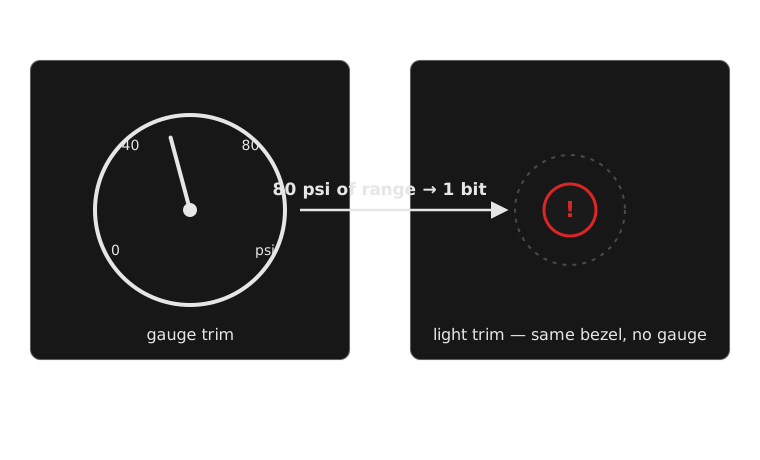
Replacing that gauge with a light didn’t just make the same information smaller. It replaced a range with a threshold: someone decided the exact pressure value at which oil pressure stops being “fine” and starts being “attend now,” and everything on the fine side of that line disappears. The driver loses the ability to notice a slow decline — pressure easing down over months — because a threshold light is silent right up until the moment it isn’t. What’s gained is unambiguous urgency: no interpretation required, no skill assumed, no missed reading of a needle sitting in an unfamiliar zone.
Case study: the idiot light and its modern descendant#
By the mid-1950s, US manufacturers were replacing standalone oil-pressure and ammeter (charge) gauges with a red telltale wired to a simple pressure or voltage switch — on below threshold, off above it. Mechanics and some motoring writers of the period called it the “idiot light,” partly out of contempt for the simplification and partly because manufacturers had concluded, not unreasonably, that most drivers were already treating the gauge like one. The light was cheaper to build, impossible to misread, and gave up the one thing a gauge offered: warning before the threshold, not at it. An oil-pressure light coming on at speed can mean the engine has seconds of useful life left, with no gauge history to say whether this was sudden or overdue.
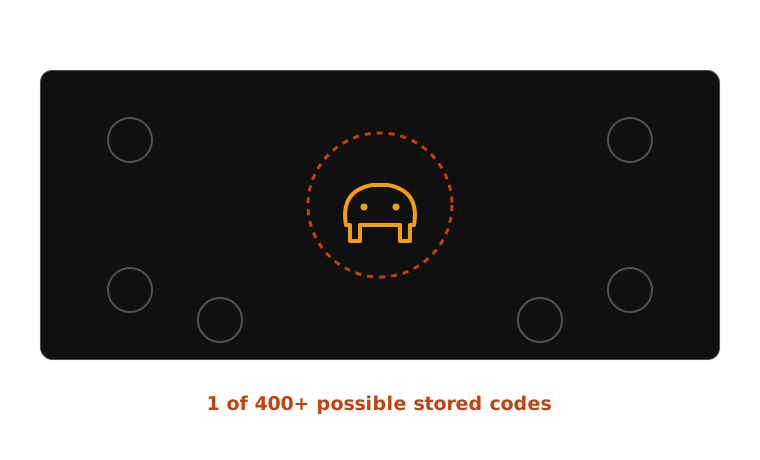
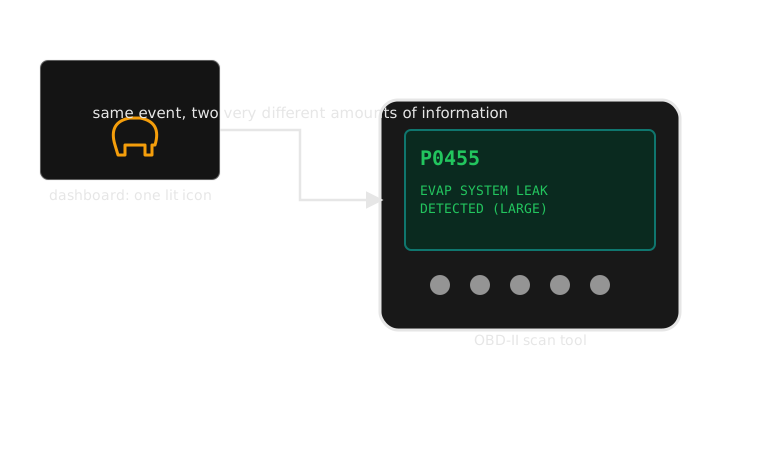
The check-engine light is the same idea pushed to its most ambiguous extreme. Where the idiot light collapsed one continuous value to one binary state, the check-engine light collapses hundreds of possible underlying faults — a loose fuel cap, a failing catalytic converter, a misfiring cylinder — into the same single amber icon. It solves the readability problem completely: nobody misreads it. It solves nothing else: the driver knows only that something, somewhere, needs a diagnostic scan, with no way to tell “pull over now” from “get this looked at eventually” from the dashboard itself.
Next week stays with this same telltale bank and asks a different question: once you’ve decided something deserves a light, how does a driver tell it apart from every other light next to it — the vocabulary of icons and symbols. Assessment 1, the Alert Audit, is due at the end of that week.
Teaching team
- Marisol Quaye — convenor