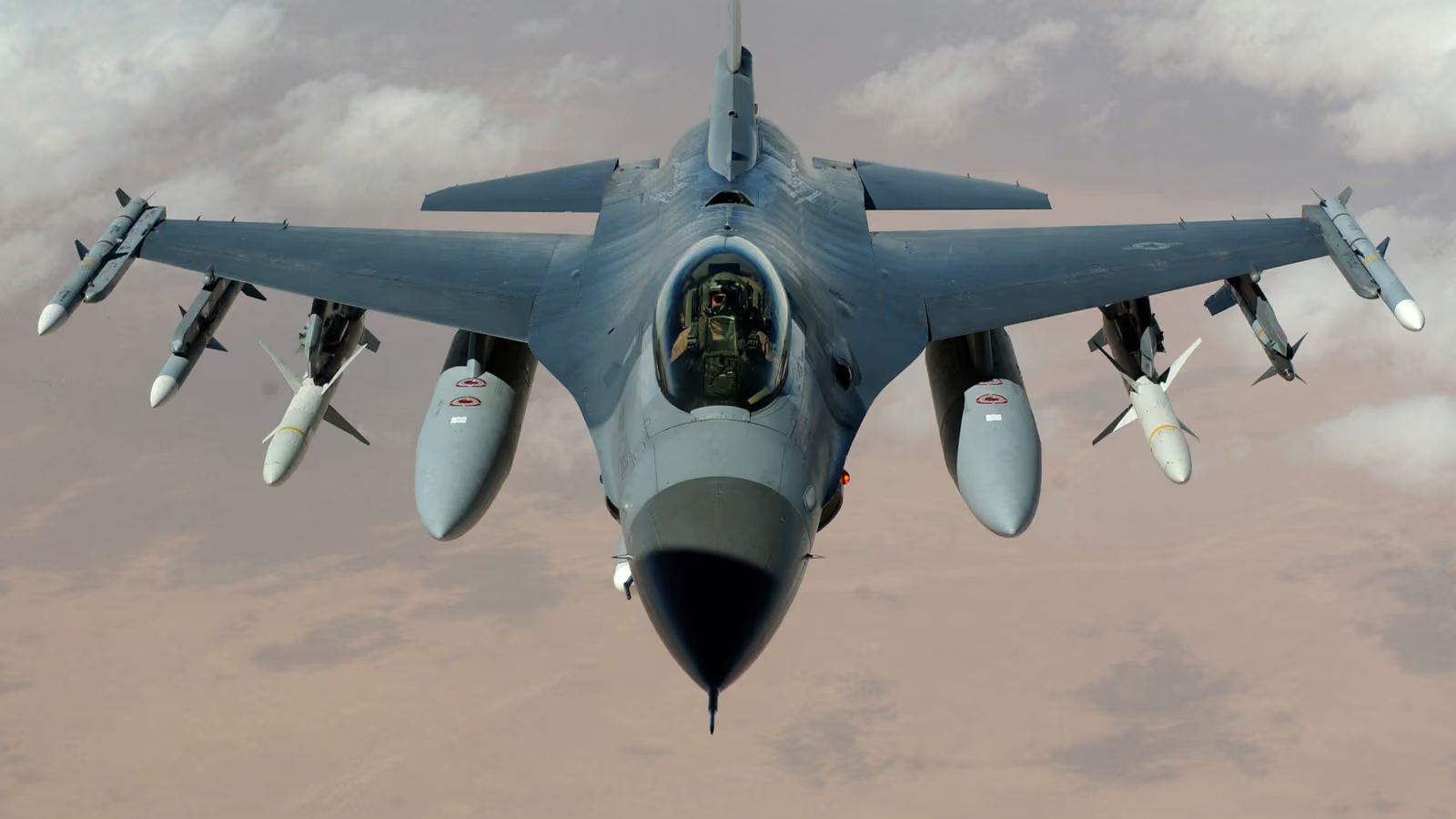
Twelve weeks on taking a single-seat jet off the ground and bringing it back able to fly again: departure and recovery only, with no air combat or formation flying in the syllabus.
The subject is a single-seat, digitally fly-by-wire jet aircraft with no instructor seat: the course exists because a pilot's first flight in this type is necessarily solo, and everything taught before it is preparation for that fact. Teaching runs across twelve weeks in three phases — ground instruction, simulator, and live flying — ending in a solo check ride assessed on whether the aircraft returns able to fly again.
Learning outcomes
At the completion of this course, you will be able to:
- perform this aircraft's emergency egress procedure under time pressure and without visual reference
- explain how a relaxed-stability airframe's flight control system produces both its handling qualities and its operating limits
- apply specific energy management to plan and fly an approach that arrives at a chosen point in a chosen energy state
- fly a standard circuit and approach to published tolerances, referenced to angle of attack rather than airspeed
- state, defend and apply a personal decision altitude and approach criteria under check-ride conditions
How the course runs
SLOP4386 runs in Semester 1, 2027, as a Slop University School of Invented Disciplines course at undergraduate level 4.
Teaching is organised into three phases across twelve weeks: four weeks of ground instruction, four weeks in the simulator, and four weeks of live flying, the last of these built around a single solo sortie and a check ride. Ground and simulator weeks each pair a lecture with a practical period; flying weeks have none.
The course has three staff: a convenor who teaches the ground phase and signs the flying authorisation, a simulator instructor who runs weeks 5–8, and a crew chief who owns the aircraft and is the only person who can declare it unserviceable.
Prerequisites
Final-year students who have completed a first course in aerodynamics and can manipulate an energy equation without derivation. No flying experience is assumed or required.
Assessment
Assessment is weighted across four components: an egress and systems examination (15%), a simulator progression check (20%), a written judgement on personal decision-making (15%), and a check ride (50%) assessed holistically on whether the aircraft returns able to fly again, and whether that outcome followed from the pilot's decisions rather than from chance.
A go-around initiated on a student's own pre-briefed criteria is not penalised in any assessment; continuing an approach past those criteria is treated as the failure, independent of how the landing turns out.