Week 11: Naps and memory
Sleep does not merely rest the brain, it files what happened — and the timing relative to learning is what decides the benefit
17 May 2027
Everything so far has treated the nap as recovery — something that undoes tiredness. This week it does something else entirely: it processes what you learned. This is the strongest experimental literature in the course, and the most immediately useful to anyone sitting exams in a few weeks.
Outline#
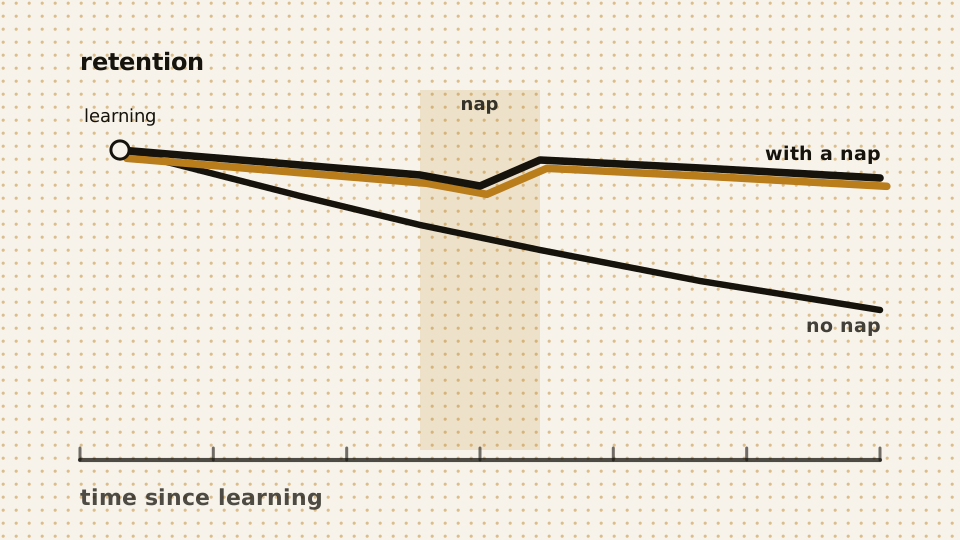
- Consolidation. New memories are initially fragile and become durable over time. A good deal of that work happens during sleep, not merely in spite of it, and it can be observed as improvement without further practice.
- Two mechanisms, roughly. Slow-wave sleep is associated with stabilising declarative material — facts, events, things you could state. REM is associated with procedural skill and with the recombination that shows up as insight. A nap long enough to include both is doing two jobs.
- Which recalls week 2. Nap length decides which stages you get, so it decides which kind of consolidation you get. The twenty-versus-ninety choice returns here with a different reason behind it.
- Sleep before learning. A rested brain encodes better. Sleep deprivation impairs the formation of memories, not only their retrieval — so the all-nighter damages the material studied during it.
- Sleep after learning. Material learned and then slept on is retained better than material learned and then spent an equivalent waking period. A daytime nap produces a measurable version of this effect.
- So the honest advice is both, and it is unwelcome. Sleep before you study and after you study. The practice this displaces — studying instead of sleeping — is the one students reliably choose.
- Reading the literature carefully. Effect sizes here are modest, the tasks are laboratory tasks, and word-pair recall is not a degree. The direction of the finding is solid; the magnitude is routinely oversold.
The claim to argue with#
A nap after studying is not a reward for studying. It is part of the studying, and skipping it costs more than the time it would have taken.
Before next week#
Week 12 is the synthesis: you design an institution that permits napping. Bring your workplace map from week 7, your costings from week 8 and your named beneficiary from week 9. The final session assembles them rather than starting anything new.
Teaching team
- Marisol Quaye — convenor