Week 9: Infants, elders, shift workers
The three groups with the clearest physiological claim to daytime sleep, and how differently each is treated for taking it
3 May 2027
Until now the course has mostly concerned healthy adults on a standard day. This week is about the people for whom the nap is least optional, and about a pattern that holds across all three: the strength of someone’s claim to daytime sleep is a poor predictor of whether they are permitted it.
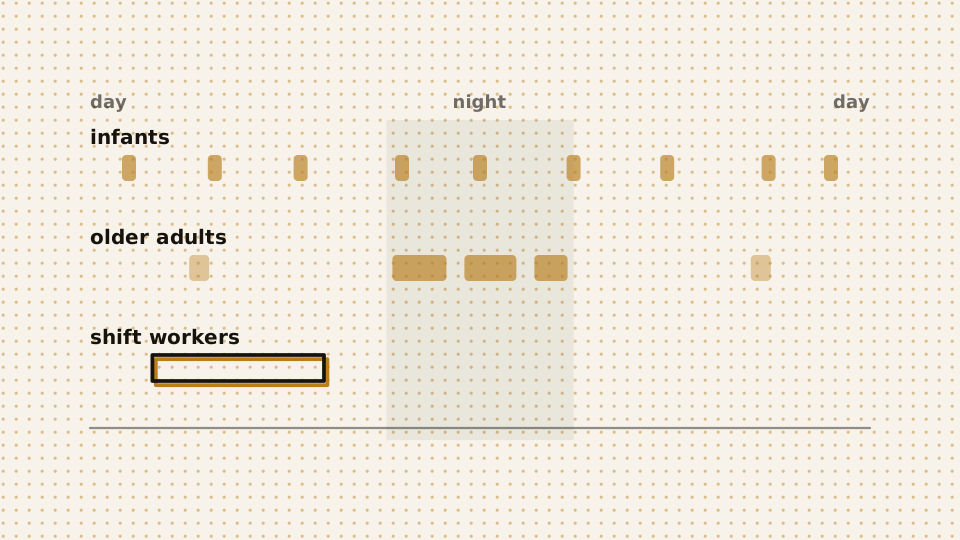
Outline#
- Infants and children. Polyphasic by default, consolidating gradually over years. Naps here are uncontroversial and institutionally provided — and the age at which provision stops is set by school timetables rather than by anything developmental.
- Older adults. Nighttime sleep fragments with age and daytime sleep often returns. The interesting part is the interpretation: the same behaviour that is developmentally normal in a child is read as decline in an older person, and sometimes medicalised.
- Shift workers. The clearest case in the course. Circadian misalignment is a measurable occupational hazard with documented consequences for error rates and long-term health. Rostered napping demonstrably helps.
- And they are the least likely to get it. Safety-critical industries frequently prohibit on-shift sleep outright. Week 7’s explanation applies directly: the objection is to how it looks, not to what it does.
- Where it was fixed, and how. Aviation is the case worth studying, because controlled rest on the flight deck was regulated into existence against industry resistance. Not bought, not encouraged — required.
- Who is missing from this list. Carers, people with chronic illness or disability, and anyone whose fatigue is contested rather than assumed. Their claim is strong and their access is not a policy question anyone has taken up.
The claim to argue with#
Across all three groups, permission to sleep in the day correlates with social position and not with physiological need. The nap pod cannot fix this, because it was never the kind of problem a purchase addresses.
Before next week#
Next week we turn to measurement — the wearables and apps that promise to tell you how you slept. Bring your device’s readings for one night if you have one, and your honest impression of that same night. We will need both.
Teaching team
- Marisol Quaye — convenor