Week 4: Espionage
Mycoheterotrophy — plants that take carbon from a shared fungal network without photosynthesising any back, and whether the network can tell.
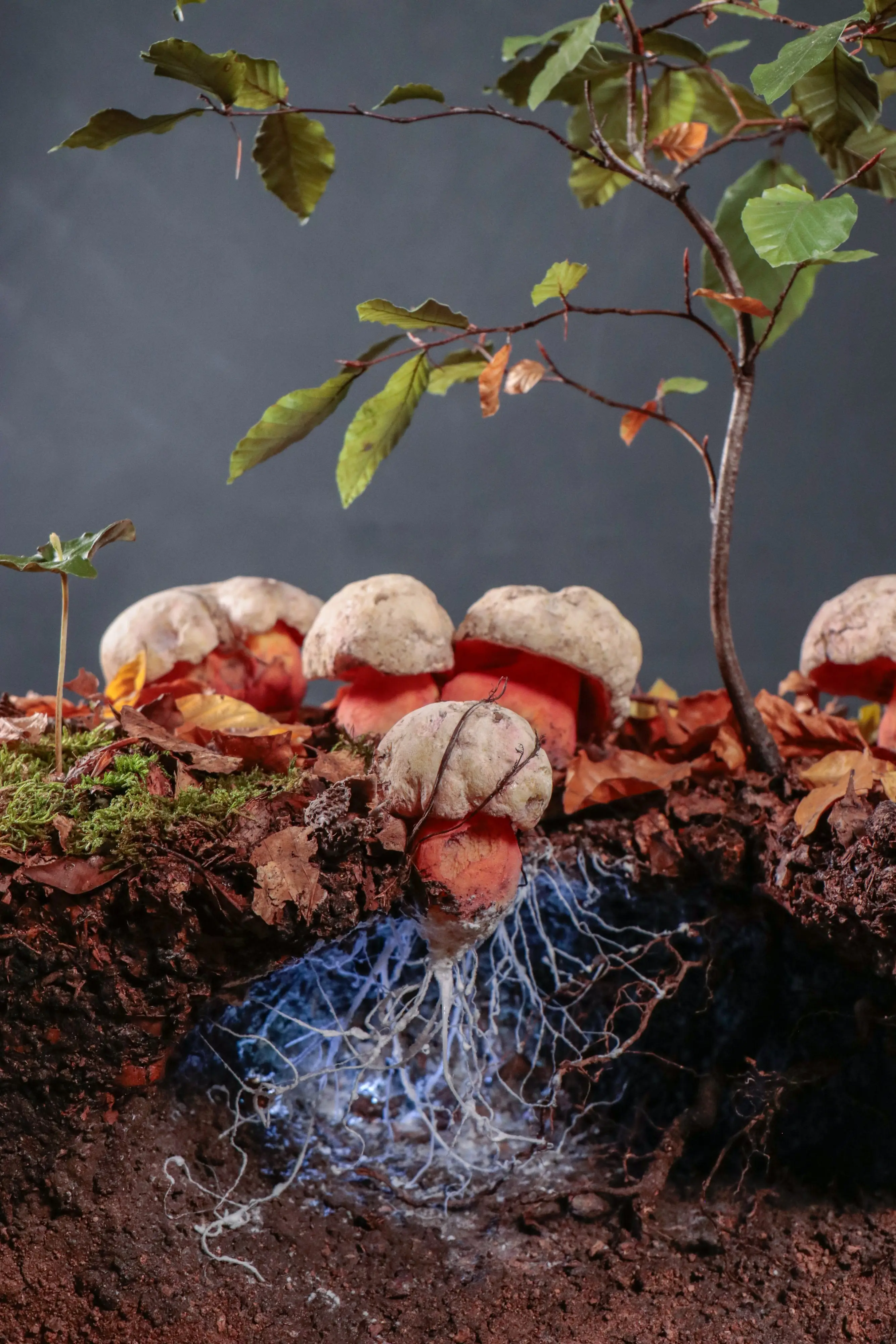
TB0815 · diorama S. Brandt, NHM Basel · CC BY 4.0
Dispatch 04
Dispatch 04- Date
- 15 March 2027
- Metaphor
- Espionage — extracting value from a network while paying nothing into it
- Phenomenon
- Mycoheterotrophy: plants such as Monotropa uniflora and many orchid species that draw carbon from mycorrhizal fungi without photosynthesising any back
Outline#
- full mycoheterotrophs: Monotropa uniflora (Indian pipe) and its relatives have no chlorophyll and take carbon entirely from ectomycorrhizal fungi that are also linked to a photosynthesising tree
- the fungus in these cases typically gets nothing back from the mycoheterotroph — it keeps supplying the tree as usual, and the mycoheterotroph exploits a link that already exists for someone else’s benefit
- initial mycoheterotrophy: orchid seeds carry almost no food reserve and germinate only with fungal carbon support; most orchids switch to photosynthesis as adults, some stay dependent for life
- why “espionage” is not an overreach here the way week 3’s “aid” was: unlike a gradient-driven transfer, there is no reciprocal payment at all, and no market mechanism from week 2 that would obviously catch it
- open question carried into weeks 5 and 6: does the network have any way to detect and cut this off, or is it close to undetectable free-riding
Teaching team
- Dr. Marguerite Osei — convenor