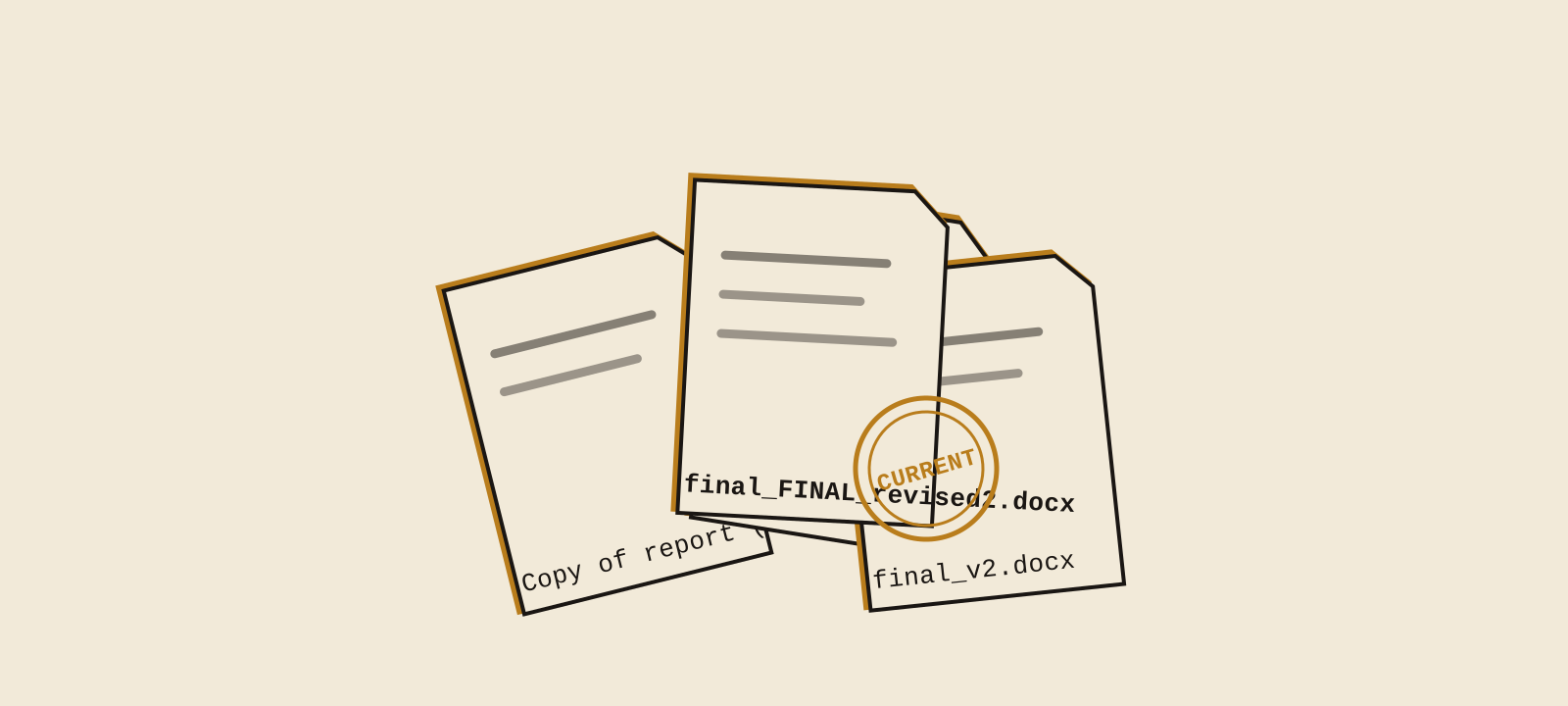
Twelve weeks of file forensics. Every week ends with a duplicate, a conflict, or a decision about which copy counts, and you write down why you decided that.
Opening statement
There is no such thing as “the file.”
There is the attachment you emailed. The copy in Downloads. The one you renamed. The autosave. The version your collaborator edited. The PDF you exported. The PDF they annotated. The copy stored in Drive. The copy Drive created when syncing failed.
This course studies what happens next.
What you will do
Every week hands you a folder that already has too many files in it. You inspect one (your own, or one staged to be misleading) and argue for which copy counts. You reconstruct an edit history from timestamps and metadata that contradict each other. You merge two versions of the same document and write down what you cut, and why. You run one file through a chain of format conversions and mark the exact step where it stopped being itself. Twelve weeks, four pieces of evidence, no essays.
Who it is for
For anyone who has three files called final and no reliable way to say which one to send. No programming background is assumed. Comfort with ambiguity is not assumed either. The course does not resolve it. Most weeks end on a decision, not an answer.
Where to go next
Syllabus
The thesis, the twelve-week schedule, and how the four assessments fit it.
Lectures
The weekly argument, one core question at a time, with slides.
Labs
The weekly hands-on exercise: files to inspect, timelines to reconstruct, conflicts to resolve.
Assessment
What is marked, what it is worth, and when it is due.
People
Who teaches the course and how to reach them.