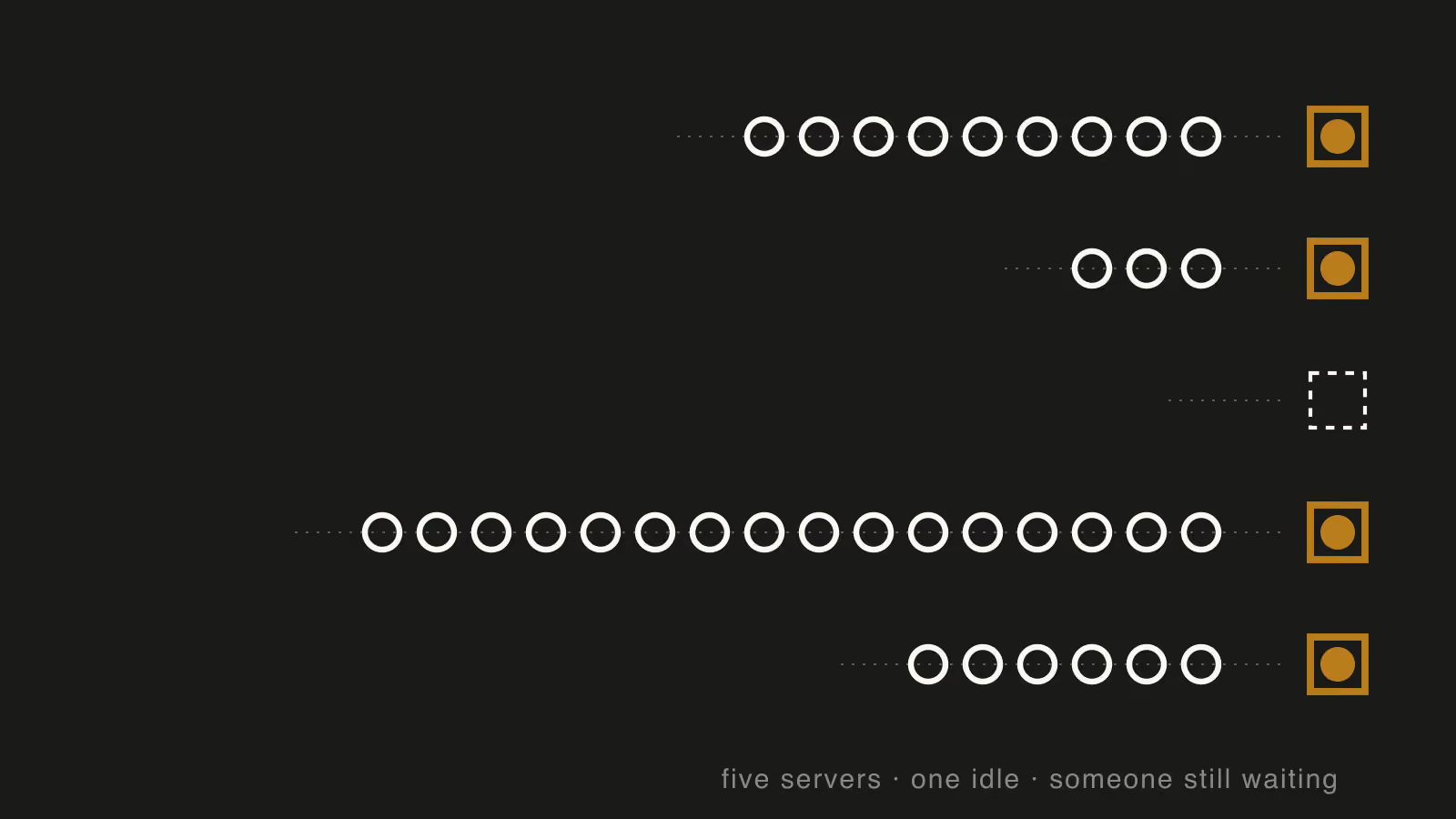
Queues are not accidents. Every line you have stood in was designed by someone who decided whose time was worth less. Twelve weeks on how queues form, what waiting costs, and who pays when the rules change.
There is no neutral queue.
Every line you have ever stood in was running a rule that decided who went first. Somebody chose that rule — or, more often, inherited it from whoever laid out the room and never looked at it again. It is deciding whose time is worth less, and it is doing that without saying so, to people who have no way to bill anyone for the hours.
This course is twelve weeks on how queues form, what waiting costs, who pays for it, and what changes when you change the rule. It is not a queueing theory unit, though you will have the core of the mathematics by week 3 and it takes about forty minutes. The mathematics answers how long. The interesting question is who.
What you will do
Measure real queues, with a stopwatch, in person — starting in the first lab and continuing all semester. Build simulations and break them. Board a taped-out aircraft cabin four different ways and time it. Triage forty case cards under pressure and then find the pattern in your own errors.
You will finish with a design brief for one real queue: diagnosed with evidence you gathered, redesigned to the level of an ordering rule and its exceptions, costed honestly for whoever ends up worse off, and defended against the strongest version of the alternative you rejected.
Who it is for
Anyone in second year or beyond. No prerequisites, no prior statistics, no programming required — the simulation work can be done in a spreadsheet, on paper, or with the course simulator, and several people every year do it with dice. What it asks for instead is a willingness to stand in a car park for forty minutes counting people, and to accept that most of the queues you are about to look at are somebody's unexamined decision rather than a fact of nature.
Where to go next
The shape of the semester
The three acts, the twelve ideas, and the chain showing what each week stands on. Start here if you want to know whether it holds together.
Lectures
Twelve weeks, four of them carrying a simulation you can drive yourself.
Labs
The weekly fieldwork: what to bring, what happens, what leaves the room.
Assessment
Four pieces — measure, reorder, simulate, redesign. What each is worth and when.