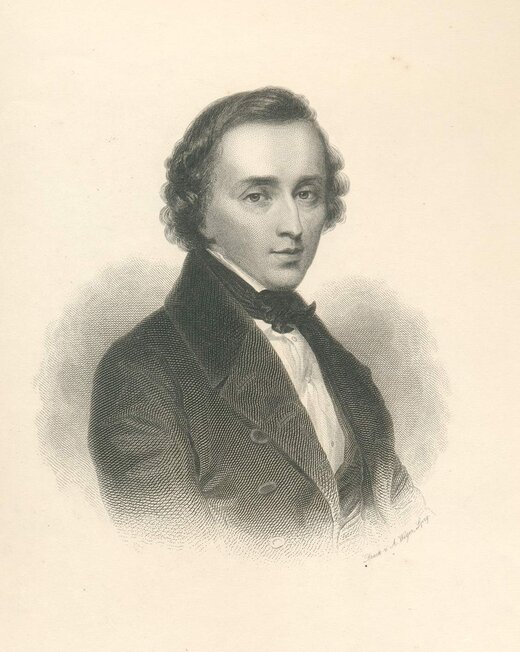
A Warsaw childhood, and a visiting star
Frédéric Chopin (1810–1849) grew up in Warsaw, already a celebrated boy pianist by his early teens. Touring virtuosi regularly passed through the city, and Hummel himself visited Warsaw in 1828, giving concerts that the teenage Chopin is recorded as having heard. Hummel’s music was also widely published and taught across Europe at the time, and Chopin’s own teachers and surroundings kept him well acquainted with it well before that visit.
Inheriting the brilliant style
Chopin’s early works, written while he was still a student and rising performer in Warsaw, show many of the fingerprints of the brilliant style that Hummel had done so much to popularise: elaborate, singing ornamentation, rapid passagework built for a virtuoso soloist, and an orchestra that mostly frames and accompanies the piano rather than competing with it. Chopin did not stop there — across the next two decades he reshaped that inheritance into a much more personal, harmonically adventurous language — but the starting point is clearly visible in his first large orchestral work.
Piano Concerto No. 1 in E minor, Op. 11
Composed in 1830, shortly before Chopin left Poland for good, and premiered that October in Warsaw with the composer as soloist, Op. 11 was written at the height of his exposure to the brilliant-style concertos then in vogue. Its three movements — a large-scale minor-key opening movement, a nocturne-like “Romance,” and a dance-inflected finale — follow a shape very close to the one Hummel’s own A minor concerto had helped establish, even as Chopin’s melodic writing already sounds distinctly his own.
Listen: Piano Concerto No. 1 in E minor, Op. 11 (I. Allegro maestoso)
A MIDI-rendered excerpt, not a professional recording — see Sources.
CLICK HERE IF THE MUSIC DOES NOT START