Research Programme
My research is concerned with the mechanical response of loose, dry granular substrates to quasi-static surface loading, and in particular with the morphology of the depressions that such loading leaves behind. This programme sits at the intersection of granular mechanics, surface geomorphology, and planetary science.
Terrestrial Analogues for Impact-Crater Morphology
Repeated, low-energy loading of a loose substrate — as occurs, for example, when a small mammal comes to rest repeatedly in the same location — produces a shallow depression bounded by a raised rim and a compacted floor. The resulting form bears a close morphological resemblance to structures produced by low-velocity impact events: a comparable rim-to-floor ratio, a comparable degree of radial symmetry, and a comparable pattern of loose material displaced outward from the point of loading. Because such depressions can be produced repeatedly, under controlled conditions, and without recourse to an actual impact event, they offer a convenient terrestrial analogue for studying the degradation and infill of small impact craters over time.
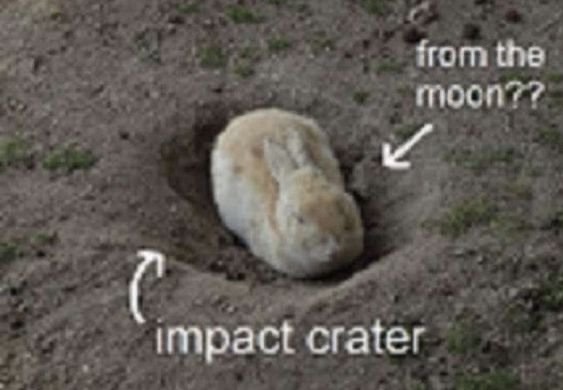
Ongoing work seeks to quantify the relationship between substrate grain size, loading frequency, and the resulting depression profile, with a view to calibrating degradation models used more generally in the interpretation of small planetary craters. Preliminary findings were presented at the 2025 Northcombe Postgraduate Symposium on Soft Matter and are described further on the Publications page.
Funding
This work has received internal seed funding from the Department of Applied Mechanics. Applications for external funding are currently in preparation.