Week 10: Measuring the nap
Wearables report sleep stages they cannot see — what the devices actually measure, and how far the number on the screen is from it
10 May 2027
This course has been asking you to measure yourself with a nine-point scale and a reaction-time task, while most of you own a device that claims to do better. This week is about whether it does. The answer matters beyond gadgets: nearly every popular claim about sleep now rests on data of this kind.
Outline#
- The reference standard. Polysomnography — brain activity, eye movement, muscle tone — is how sleep stages are defined. It requires a lab, electrodes and a scorer. Everything else is an approximation of it, and the size of the approximation is the subject of this lecture.
- What a wrist device actually has. Movement, and usually heart rate from an optical sensor. That is the whole input. Not brain activity, not eye movement.
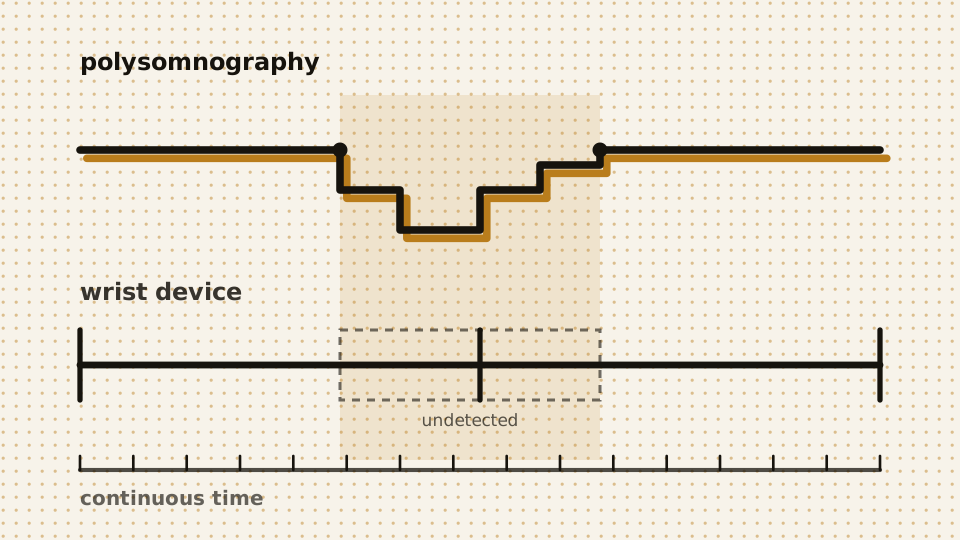
- From movement to a hypnogram. Actigraphy is decent at separating sleep from wake, because sleeping people move less. Stage classification is inferred from patterns in those two signals by a proprietary model, and that inference is where the confidence in the display comes from rather than from anything observed.
- The known failure mode. Lying still while awake reads as sleep. This matters most for the people most worried about their sleep, whose devices reassure them precisely when they should not.
- Short sleep is the hard case. A 20-minute nap sits near or below the resolution of these systems. The course’s central object is close to invisible to the instruments most people would use to observe it.
- Validation, and its absence. Some devices have published agreement studies against polysomnography; most do not, and agreement on stages is consistently worse than agreement on total sleep time. Algorithms also change in firmware updates, so last year’s validation may not describe this year’s device.
- Why the number is so confident. A hypnogram with clean coloured bands is a design decision. The underlying estimate has uncertainty that the display does not show, and showing it would make the product worse and the data better.
The claim to argue with#
Your sleep tracker is a reasonably good movement sensor wrapped in a presentation layer that implies a measurement it did not take.
Before next week#
Week 11 asks what a nap is for rather than what it looks like — memory consolidation, and whether to sleep before or after studying. It is the week most directly useful to you as students, and it arrives with a practical question you can test in the exam period.
Teaching team
- Idris Fenn — tutor