Week 6: Siesta, 午休, inemuri
Three societies that kept a place for daytime sleep, and the very different things each of them permits
29 March 2027
Last week argued that industrial work removed the nap. This week complicates that, because it did not remove it everywhere, and the places that kept it did not keep the same thing. Three regimes, and the differences between them are more instructive than the fact that all three exist.
Outline#
- Siesta. A break in the working day itself, historically tied to heat and to a split shift. Note what it is: a gap in the schedule, taken at home, invisible to the employer. The Spanish version has been substantially eroded by the standard office day, which is itself evidence for week 5’s argument.
- 午休 (wǔxiū). The Chinese midday rest, institutionalised in schools and many workplaces — a scheduled, collective period, often at the desk. Written into the rhythm of the institution rather than left to the individual.
- Inemuri. Japanese sleeping-while-present: dozing in a meeting, on a train, at a desk. Not scheduled at all, and tolerated on a specific condition — that it reads as exhaustion from overwork. It is permitted because of what it signals, not despite it.
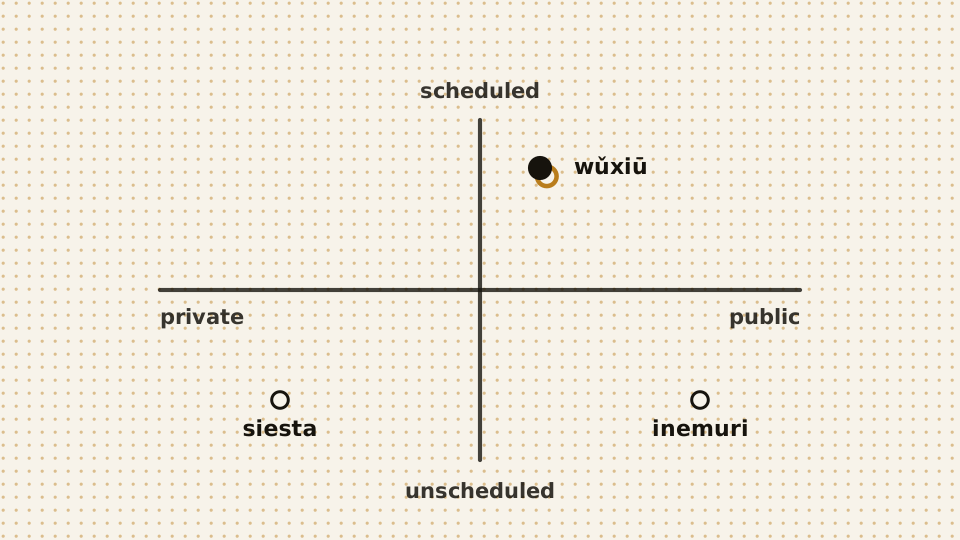
- The axis that matters. Not “do they nap?” but where, with whom, and whose permission is implied. Siesta is private and unscheduled by the employer; wǔxiū is collective and scheduled; inemuri is public and unscheduled.
- Against the tourist reading. Each of these is commonly described in English as a charming national quirk. Each is a labour arrangement, and each is contested within its own country.
The claim to argue with#
The interesting question is never whether a culture naps. It is what a person has to be seen to be, in order to be allowed to.
That question is week 7’s, and your Cultural Case Study will live or die on whether you ask it.
Before next week#
Your Nap Log is due this week — see the assessment page for what to submit. After that, read one first-hand account of napping at work in the culture you chose. One account, read closely, beats five summaries.
Teaching team
- Marisol Quaye — convenor