Week 4: Why 2pm
The afternoon dip is not caused by lunch — it is a scheduled trough in the circadian rhythm, and it arrives whether or not you eat
15 March 2027
Everyone has an explanation for the afternoon slump and almost everyone’s is the same one: lunch. It is a good explanation. It is also wrong, and what replaces it is the reason this course can claim the nap is a biological need rather than a habit.
Outline#
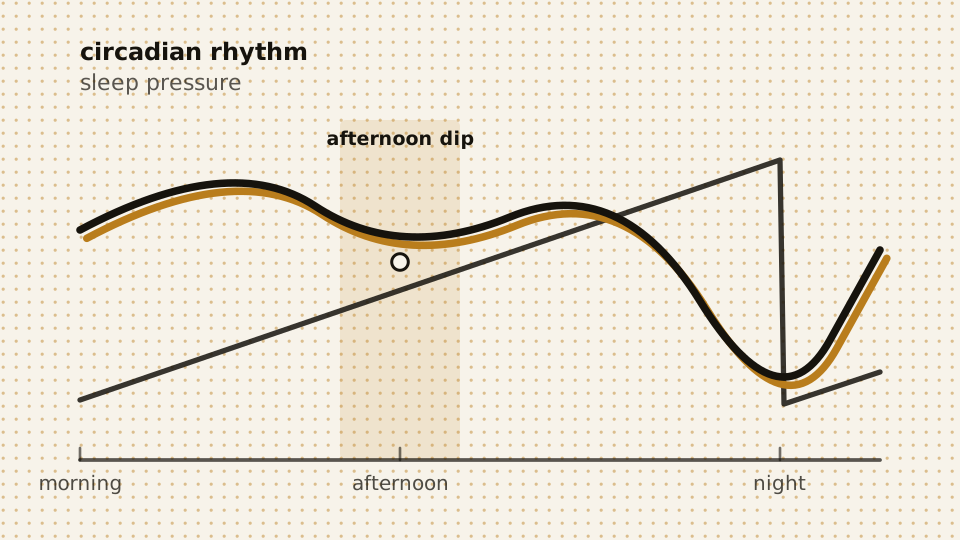
- Two processes, not one. Sleep pressure rises steadily the longer you are awake. The circadian rhythm oscillates on roughly a twenty-four-hour cycle, independent of it. What you feel at any moment is the two of them combined.
- The afternoon trough. The circadian rhythm has a second dip, smaller than the one at night and roughly twelve hours away from it. For most adults it lands in the early afternoon.
- So the dip is scheduled. It is on the clock, not on the menu.
- The evidence that it isn’t lunch. Skip the meal and the dip still arrives. Move the meal and it does not move with it. The effect of food on alertness is real but small, and it is not what people are pointing at.
- Chronotype. The trough is not at the same hour for everyone, which is why a nap policy fixed to a single time of day helps some people and inconveniences the rest. Week 12 has to solve this.
- The institutional consequence. If the dip is scheduled and predictable, then a workday that ignores it is not neutral. It is a design decision, and someone made it.
The claim to argue with#
The post-lunch dip is misnamed twice over: it is not caused by lunch, and for a good number of people it is not after lunch either.
Before next week#
Bring the trough estimate you wrote in week 1 and did not revise. Next week we stop asking what the body does and start asking who decided it was unreasonable — the history is where this course turns.
Teaching team
- Marisol Quaye — convenor