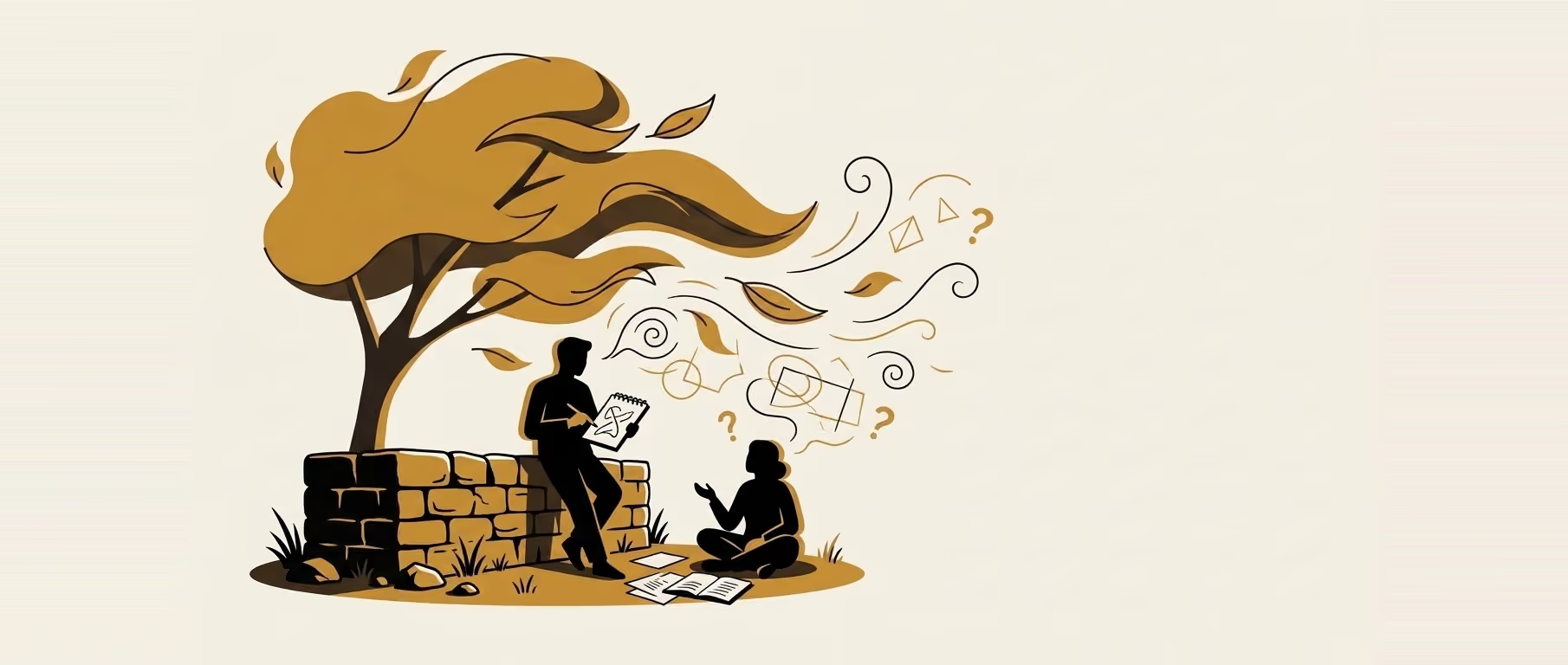
Thinking that never gets to finish starts again. That is what a spiral is. This course builds the conditions under which one can close, outdoors, in silence, ten minutes at a time. Then it aims the same unreasonable rigour at what could go right.
Unfinished thinking
A thought that doesn't get to finish doesn't go away. It goes back in the queue. This course argues the trouble was never volume. You're not thinking too much. You're thinking in a loop that never reaches an end, so it starts again. That changes the question. It stops being how to think less, and becomes what a thought needs in order to finish.
Those conditions turn out to be oddly specific, and mostly unavailable. That's what the semester is for.
The second reading of the title is deliberate too. This course is unfinished, and so is the research behind it. Half the studies cited here are small. Several are contested. And the claim above has never been tested directly.
Where it starts, though
Not there. It starts with the part you already know. Re-reading a two-word reply more times than it deserved. Having the same thought at 2am you'd already had at 11pm. Shelving a decision because thinking about it more felt like doing something about it. The first four weeks are about that, out loud, in a room where everyone else is doing it too. The argument above doesn't get made properly until week 5, once you have a stack of your own examples to test it against.
What you will do
The semester pairs lectures with crits, and the crits are where most of it happens. Each one hands you a small provocation and turns you loose on it with the rest of the room. Overanalysing a text message in layers. Guessing the ending of something a classmate overthought. Making and eating a sandwich in complete silence. Running the same excessive rigour on a best-case scenario instead of a worst one. The lectures are held outdoors, and they supply the research the argument rests on. Every class opens with ten minutes of nothing.
What it isn't
Not a wellness course, and not therapy. The science here is real and cited, including the parts where the evidence is thinner than the internet suggests. You will be told which claims are findings and which are someone's hunch. The course's own central claim is labelled a hunch, because that is what it is. It also takes almost nothing seriously, which turns out to be the point rather than a tone choice.
Who it is for
Anyone who has re-read a two-word reply more times than it deserved, or shelved a decision because thinking about it more felt like progress. No background in psychology or philosophy needed. The only prerequisite is a mind willing to catch itself in the act. Nothing you share is marked, and you can pass on any activity without giving a reason.