Where we were
Week 2 gave you the double empathy problem as a theory. Weeks 9 and 10 gave you pacing and disclosure.
This week: the evidence for week 2, and what two people do about it.
Diffusion chains
Eight people. The first hears a story and retells it to the second, who retells it to the third, down the chain.
Some chains all autistic. Some all non-autistic. Some mixed.
Crompton, Ropar et al. (2020), Autism 24(7)- all autistic: a chain of 8 people, each retelling the story to the next.
- all non-autistic: a chain of 8 people, each retelling the story to the next.
- mixed: both, in one chain: a chain of 8 people, each retelling the story to the next.
Where the loss happens
| Chain | Detail retained | Rapport |
|---|---|---|
| All autistic | no significant difference from non-autistic chains | higher than mixed |
| All non-autistic | no significant difference from autistic chains | higher than mixed |
| Mixed | declined significantly more steeply | lower |
Misreading runs both ways
People filmed reacting to events; non-autistic observers guessed which event.
Observers were less accurate for autistic people — yet autistic people were rated just as expressive for most events, and their reactions were described differently.
Sheppard et al. (2016), Journal of Autism and Developmental Disorders 46(4)Same judgement, different consequence
Ask autistic observers too: autistic and non-autistic raters made similar trait judgements of autistic adults.
The difference was what came next — for autistic raters, those judgements didn’t reduce their interest in interacting.
DeBrabander et al. (2019), Autism in Adulthood 1(4)Why does misreading become disliking?
Week 2: style is judged in seconds, before content.
This week: autistic people’s reactions are misread, not missing.
Nothing yet joins the two.
Score the videos for readability
Sheppard’s videoed targets, scored for how readable they were. New neurotypical perceivers rated them.
Neurotypical targets rated more favourably — whether the greeting’s details were concealed (Study 1) or disclosed (Study 2).
Alkhaldi, Sheppard & Mitchell (2019), JADD 49(10)Readability correlated with favourability — r = .58 and r = .63 — independent of target diagnosis.
In the room: readable to whom? (7 min)
Three minutes. One person you find easy to read, one you find hard. Write one concrete behaviour each. The asleep test applies.
Or compare fictional behaviours: nods after each sentence / waits, then gives a full reply. Mark interpretations as predictions; omit identifying details.
Three minutes, in pairs. Swap. Would your partner’s “easy” behaviours be easy for you?
One minute. Hands up if anything on their easy list was on your hard list.
Rapport signals are implementation-specific
Back to the diffusion-chain videos, coding mutual gaze and backchannelling — the “mm-hm”, the nod.
In mixed pairs, less of both went with lower rapport.
In autistic pairs, less backchannelling went with higher rapport.
Rifai et al. (2022), Autism in Adulthood 4(1)Five minutes with a stranger
Not clips. Not vignettes. 125 people, put into pairs — both autistic, both non-autistic, or mixed.
Five minutes of unstructured conversation with someone they’d never met, then both rate it.
Morrison et al. (2020), Autism 24(5)The bleak half
Autistic adults were rated more awkward, less attractive, and less socially warm —
by autistic and non-autistic partners alike.
Only the non-autistic adults’ interest in meeting again followed that judgement.
And the number that matters most
Autistic participants reported disclosing more about themselves to autistic than to non-autistic partners.
How much a person opens up is not a fixed property of that person. It moved with who they sat opposite — in five minutes, with a stranger.
“Work on your social skills” addresses one endpoint of a two-endpoint problem.
In the room: the pairing effect (8 min)
Four minutes. One thing about how you talk that changes depending on who you’re with. Then write the test: how would you know if you were wrong? What would you observe?
No example? Use the untested hypothesis: “Alex writes more in the shared document than Alex says on calls.”
Three minutes, in pairs. Read out only the test. Check each other’s tests are runnable.
One minute. Anyone whose test needs the other person’s cooperation: say so.
Who pays for the mismatch
12 autistic adults on time with neurotypical friends and family: being in a minority, and conforming to what the other people were used to in order to spend time with them.
With autistic people: belonging, and being able to be themselves.
Crompton, Hallett et al. (2020), Autism 24(6)Over years, the majority’s misreadings push towards isolation — which damages mental health, and costs everyone else what those people would have contributed.
Mitchell, Sheppard & Cassidy (2021), British Journal of Developmental Psychology 39(1)The course’s proposal: agree what happens between the two implementations.
Give both people a part in changing it.

Break
14:55–15:05
Resume at 15:05.
A clause that won’t work
| Weak clause | Why | Fixed |
|---|---|---|
| “Alex will be more direct.” | no scope or check | “In our document: action, addressee, deadline or ‘no deadline’.” |
| “Sam will try to contribute more.” | a verdict wearing a clause | “Sam says ‘sounds good’ out loud when agreeing.” |
| “We’ll communicate better.” | nobody conceded anything | pick one behaviour each, and a way to check it |
The test is week 2’s: could someone who wasn’t there run it, and find out whether it held?
What this week’s evidence doesn’t settle
The qualitative work is 12 people. The chains are 72. The conversation study is 125.
The mixed chain’s seating order isn’t a detail this course checked, so the drawing leaves those seats blank.
And Alkhaldi et al. is correlational — its authors say so.
Conversion against interoperation
| Question | Conversion | Interoperation |
|---|---|---|
| Who changes | one side, entirely | both sides, partly |
| Scope | everywhere, indefinitely | this exchange, this relationship |
| When it breaks | silently, blamed on oneself | out loud, with an agreed signal |
| What it costs | the week 6 ledger, for one person | a few clauses each |
Both sides get a pen

One more standard
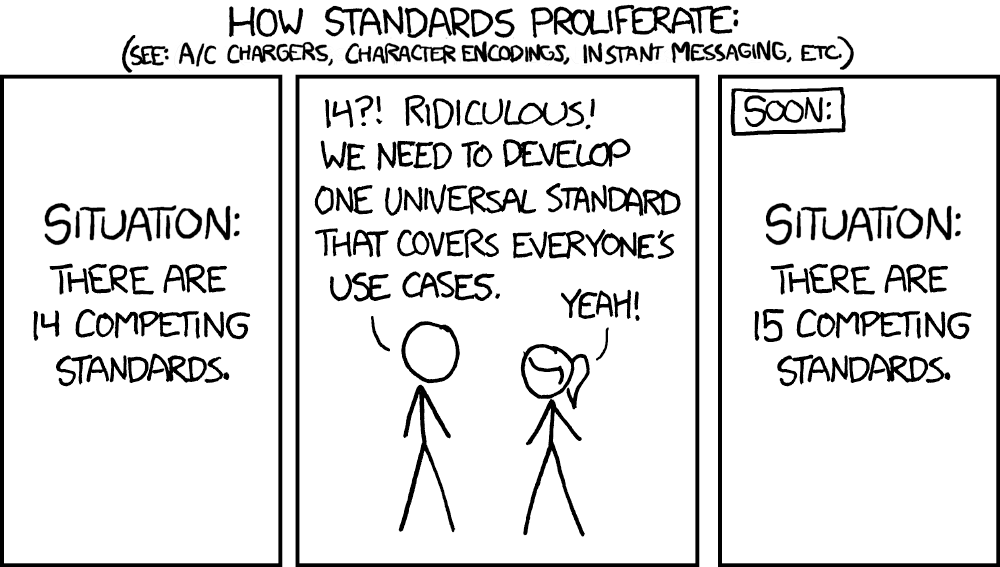
Read the comic as text
How standards proliferate (see: A/C chargers, character encodings, instant messaging, etc.). Situation: there are 14 competing standards.
Two people: “14?! Ridiculous! We need to develop one universal standard that covers everyone’s use cases.” “Yeah!”
Soon: situation: there are 15 competing standards.
The bilateral protocol
Alex backchannels constantly, hints, answers fast. Sam answers slowly, speaks directly, rarely says “mm-hm”.
| # | Clause | Who concedes |
|---|---|---|
| 1 | Sam can answer by message within 24 hours, not on the spot | Alex: immediacy |
| 2 | Alex writes action, addressee, proposed deadline or “no deadline” in the shared document | Alex: the envelope |
| 3 | Silence is not a vote; wait for both answers; either can say “still thinking” | both: the timeout |
| 4 | Sam says “sounds good” out loud when agreeing | Sam: one token |
| 5 | Either can say “mismatch”, with no explanation owed | both |
A question mark is not a conformance test
| Fictional request | Three-field check |
|---|---|
| “Could the diagram be ready soon?” | missing addressee and deadline; unclear action |
| “Sam, please upload the labelled diagram to our folder by Friday 18:00.” | action, addressee, proposed deadline |
| “Sam, please suggest another title in the document. No deadline.” | all fields; no deadline invented |
An explicit request is not yet an agreed deadline. That needs a reply.
In the room: break the clause, then repair it (8 min)
1 min, pairs: why would a question-mark test pass the weakest request and reject the others?
3 min: apply the three-field check. Rewrite the first request with a proposed deadline of Friday 18:00; check each other’s wording.
2 min: Alex posts it at 17:55. Sam works until 20:00. Revise how deadlines become agreed and how late requests are handled.
2 min: each person uses “mismatch” once and proposes an arrangement. Record concessions or unresolved points. This is a fictional rehearsal.
This room is the worked example
Eleven weeks. A deliberately mixed class, building vocabulary:
payload · timeout · repair initiator · rate limit · ledger · mismatch
Not anyone’s native implementation. A shared protocol, negotiated one week at a time.
In the room: one clause each (9 min)
Work with your report partner if present; otherwise rehearse Alex and Sam with a classmate and label the result for later negotiation.
Three minutes. Separately: one thing the other does that costs you something. A behaviour, not a verdict.
Four minutes. Together: turn both into one clause — what each side will do, and how either checks it next week.
Two minutes. Agree your mismatch word.
What interoperation is not
- Not meeting in the middle. Clauses needn’t be symmetrical. One side may concede four things and the other one.
- Not permanent. Scoped to a relationship and a situation, and renegotiable — saying so is what makes it safe to agree now.
- Not a promise that it works. Every clause is a hypothesis; clause 5 exists because some will be wrong.
What this week added to the vocabulary
- interoperation — two implementations agreeing a protocol for the exchange at hand
- conversion — one implementation replacing itself
- the bilateral protocol — the clauses, and the mismatch word
Next week: open issues, errata, and where to read further.
Check yourself against this week
Which chain condition lost detail faster? What does that establish, and what does it leave unknown about individual links?
Does your draft protocol have a clause each partner conceded, and a way to flag a mismatch?
Can you separate interoperation from conversion with an example from your own semester?
If time remains
When the costs of a shared protocol are unequal, what would make the agreement fair enough to accept and possible to renegotiate?
Optional discussion. Finish by 15:55.