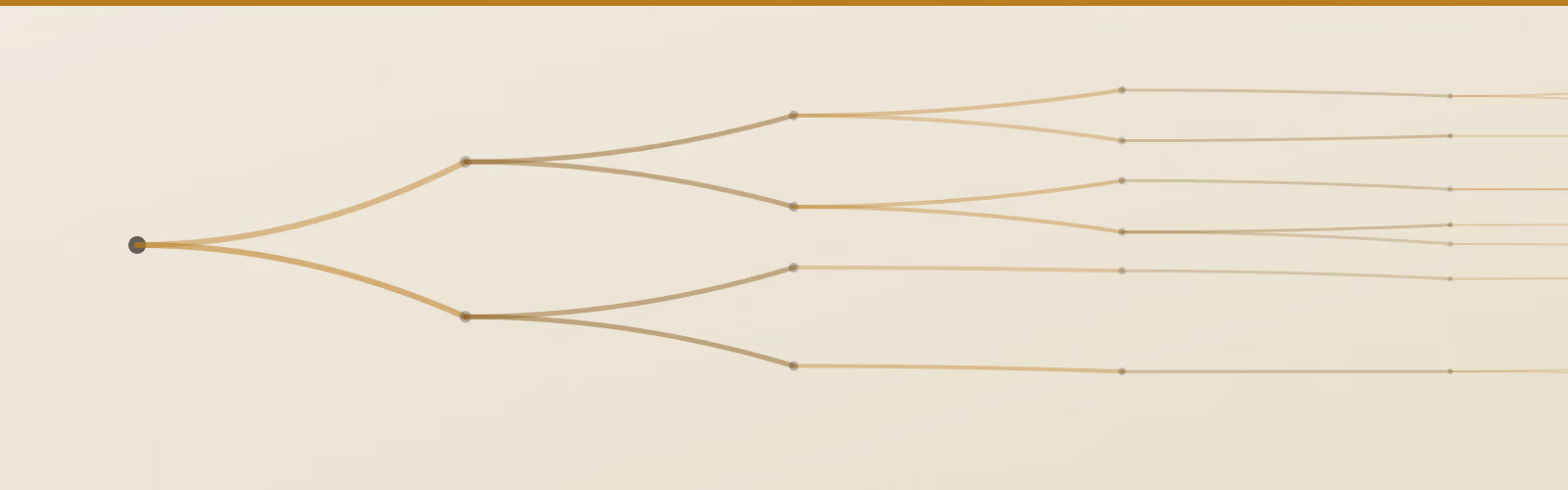
A simplified replication model, its parameters, and the biology it leaves out.
12 April 2027
A simplified replication model, its parameters, and the biology it leaves out.
Week 6 built a tree from shared copying error in a handful of witnesses. This week asks a narrower question about that same method: what happens to it as the error rate rises, and where does it stop working — inside a model simple enough to state completely.
The model, stated completely#
A 24-symbol sequence over a four-symbol alphabet is the fixed ancestor. Each generation copies the previous one forward: at every position, independently, with a fixed probability (the error rate), the symbol is replaced by one of the other three, chosen at random; otherwise it is left alone. That is the whole model. There is one lineage — no branching, no separate subpopulations, no death and no differential survival of any variant. Ancestor agreement at generation g is the fraction of positions in that generation’s sequence that still match the generation-0 ancestor, not the immediate parent, so it measures how much of the original signal a reconstruction attempt would still have to work with.
Three rates, three seeds, not one dramatic run#
The workshop’s pack runs this model at three fixed error rates, three fixed
seeds each. A single run at a single rate would show a shape; it would not
show whether that shape is a property of the rate or an accident of one
random sequence of substitutions. The nine runs let you see both: the mean
falls faster as the rate rises, and the three seeds at the same rate still
disagree with each other, sometimes by more than the gap between two rates’
means at an early generation. Reporting settings and seeds is what makes this
reproducible rather than illustrative — anyone can rerun settings.json and
get the same nine sequences back.
What a finite run can and cannot show#
Two things follow directly from the model as stated, and neither is a biological claim. First, agreement never falls to zero: with four symbols per position, an unrelated sequence still matches the ancestor at about a quarter of its positions by chance, so every curve here settles toward roughly 0.25, not 0. Second, the fall is not smooth for any one seed — a substitution can by chance restore a match as easily as break one, so a single run can tick up between two reported generations even while the three-seed mean keeps falling. Both are properties of this model at these settings.
What the model does not have is the harder claim to resist: selection (no variant here is more likely to persist than another) and population structure (one lineage, no drift between separate copies, no bottleneck). A simulation with three rates and three seeds cannot locate a general error-rate threshold for readable ancestry, in this model or any other, and it says nothing about a real biological sequence. Three runs are enough to see a trend; they are not enough to bound it.
Before Wednesday#
Download the pack. Read settings.json before you look at the results, and
write your own prediction before opening plot.svg.
Workshop: When ancestry becomes hard to read
Teaching team
- Dr Wren Halloway — convenor