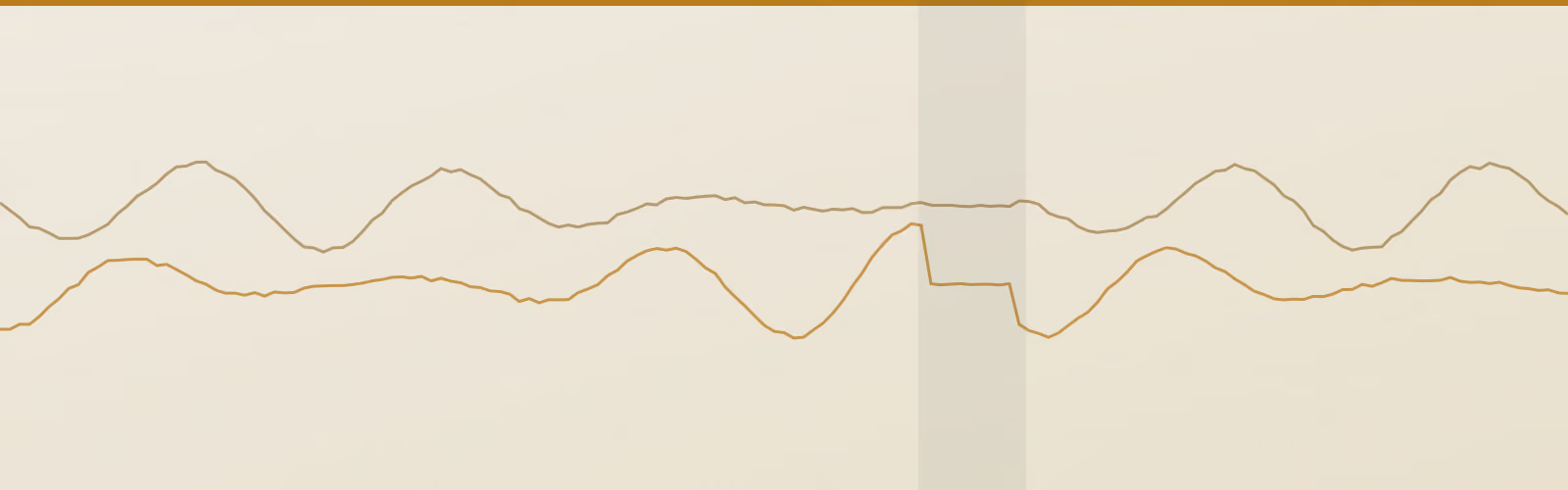
Four explanations for a shared feature, only one of which is ancestry, and what makes the difference between them.
1 March 2027
Last week you measured one copy at a time against a source. This week two copies share something, and the question is what that entitles you to say.
Where this comes from#
Through the 1970s and 80s, cassette duplication carried most of the recorded music in South Asia, largely outside the industry that thought it owned the business. Small operators dubbed from whatever they had, which was usually somebody else’s dub.
From Peter Manuel, Cassette Culture (University of Chicago Press, 1993), introduction and chapter 3. No linkable copy exists, so the claim used here is stated rather than quoted: the technology’s reach came from being cheap and uncontrolled, and the fidelity cost was accepted rather than solved.
The historical point is not the subject of this hour. It is that a population of copies existed with no records of what came from what — which is the situation this course is about, and which is exactly when you have to read the objects instead.
The worked example#
Two copies, W and X. Both carry a raised noise floor. Does that mean they are related?
No. Every analogue dub raises the noise floor. If the source lacks it and all four copies have it, the feature separates copies from the source and separates nothing among the copies. It is a property of the process, not of any particular history.
Now: two copies, X and Y, both carry a 40-millisecond dropout in the left channel at 00:12.400.
That is a different kind of thing. It is a single physical event at a fixed location, and for two dubs to produce the same flaw, the same length, the same channel, the same timestamp, independently, would be a coincidence nobody should accept without argument. The economical explanation is that both were dubbed from a copy that already had it.
Four explanations, one question#
Whenever two copies share a feature, four explanations are available, and ancestry is only the last of them.
It is in the source. The most common and the most easily forgotten. If the original recording has a door closing at 00:04.900, every faithful copy has it, and two copies sharing it tells you only that both were copied from this source. Rule this out first, every time.
Every copy acquired it separately, because the process does that. Noise floor, wow and flutter, generation loss in general. Shared by everything, so diagnostic of nothing.
They were made on the same equipment. This is the one worth slowing down for. Frequency response is a property of a machine and its settings. Two dubs made on the same worn deck will share a rolloff above 12 kHz whether or not they have anything to do with each other. Shared equipment is not shared ancestry, and it produces exactly the pattern that shared ancestry produces: a feature in some copies and not others.
They descend from a copy that already had it. Only now.
What makes the difference#
Not rarity, exactly. The property you want is that independent occurrence is implausible — that the feature is specific enough, and arbitrary enough, that producing it twice by accident would be a coincidence.
A one-off flaw at a fixed timestamp has that property. A frequency response curve does not, because there is a mechanism — the same deck — that produces it twice without any relationship at all.
This is a claim about mechanisms, not about statistics. When you propose a relationship on Wednesday, you are asserting that you cannot think of a plausible mechanism that would produce the feature twice independently. State that assumption, because someone may think of one.
What this week does not do#
You are pairing copies, not building a tree. With four copies and one diagnostic feature you can support one relationship; you cannot say how many copies sat between, or in what order, or whether the intermediate still exists.
Week 6 builds the tree. This week earns one edge of it.
Before Wednesday#
Open the pack, read the feature table and the feature list. Ten minutes. Do not try to decide anything yet.
Teaching team
- Dr Wren Halloway — convenor