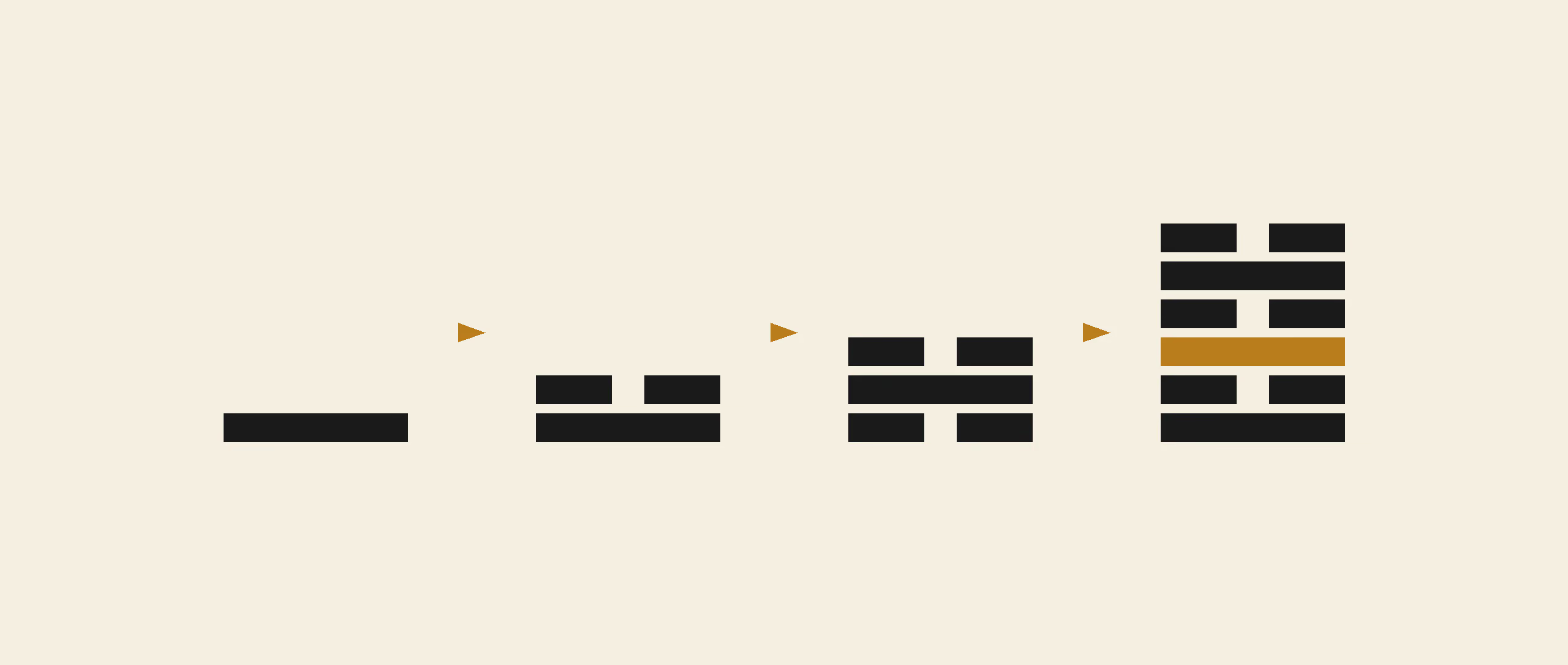
A semiotics course on how a small set of visual signs can encode change itself, not just static categories: from a single yin-yang line, through trigrams and hexagrams, to how their meanings were built, arranged, and reinterpreted across history.
What you will do
Build a visual sign system from its smallest unit upward — a single yin/yang line, then bigrams, trigrams, and hexagrams — and use the changing-line rule to represent transformation directly in the notation. In the second half of the semester, trace how the meanings and images layered onto that notation developed, and were sometimes conflated, across history: the Zhouyi's composite text, two different trigram arrangements, and two historically separate images both called "Taijitu." You leave with the ability to tell a well-sourced historical claim about a sign system from an overstated one, and to apply the same toolkit to a system you've never seen.
Who it is for
Anyone interested in how visual notations work, with no background in Chinese language, philosophy, or history required — the course teaches what it needs as it goes, and is explicit about which claims are historically documented, which are traditional attribution, and which are later interpretation. It asks for comfort reading contested academic sourcing critically, since that discipline runs through every week.