Six invented artefacts the screening content keeps citing by name, illustrated and cross-referenced against the weeks that established them.
A course arguing slop is a genre needs recurring examples, the way a film-studies unit on melodrama keeps returning to the same handful of stills instead of hunting down a fresh one every week. These six are the recurring cast: each invented, each turning up by name in at least two pieces of course content, none embellished past what its originating screening already established. Read this as a reference shelf, not new material. A photograph sits beside each invented still for contrast, not decoration — the real thing on the left, the specimen it never was on the right. If a detail below surprises you, either the screening it links to is wrong or this page is, and either way, say something.
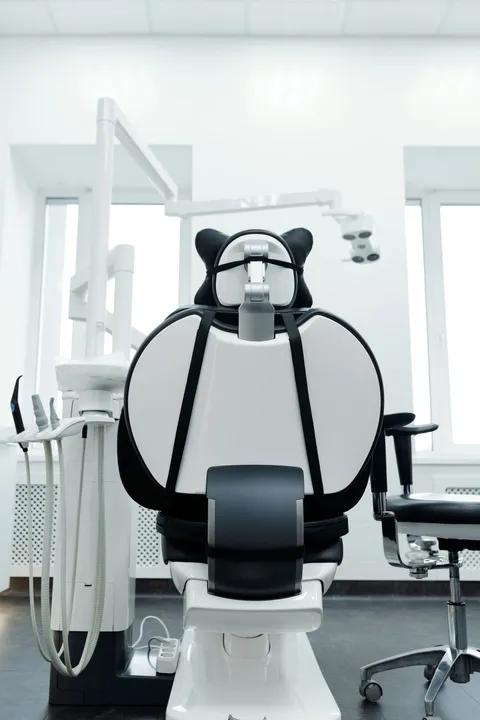
A real dental office. Radiant Smile Dental Co. is not one.
Radiant Smile Dental Co. sells a thirty-second spot for a clinic that, as far as anyone has established, does not exist at the address given. Nobody built a waiting room for it. The clinic's own logo resolves correctly in the opening shot and drifts by the closing shot into a plausible four-letter shape that isn't a word, every patient in the before/after montage wears Tell #6's smile, and the narrator delivers "same-day appointments available" in the exact rising-then-falling pitch it used two lines earlier for "financing options" — the model has no way of knowing one of those clauses matters more to a listener than the other.
What's the tell?
Not any one of the three alone — a distracted scroller would let each pass. Stack the drifting logo, the overcorrected smile, and the pitch that can't distinguish a promise from a price list, and that stacking is the entire reason this ad made the shelf.
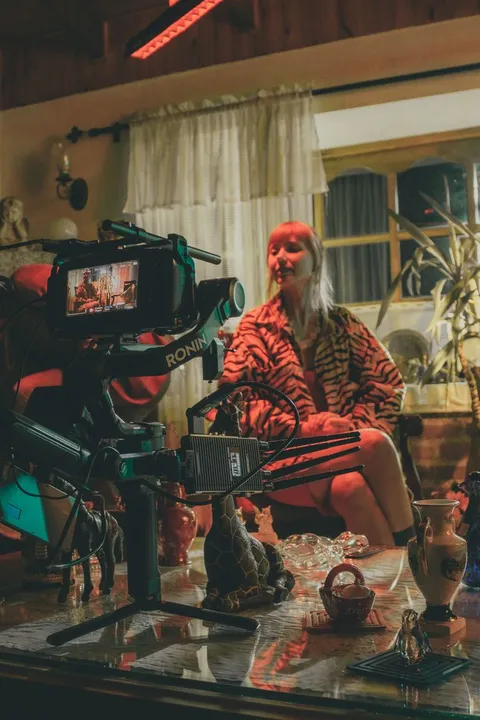
A real crew, on a real set, keeping continuity by hand. Bright Aperture keeps it by copy-paste.
Bright Aperture is a small production outfit with a method instead of a philosophy: generate every scene as exactly six fixed prompts — establishing wide, two singles, two close-ups, one insert — and copy-paste every continuity detail, wardrobe down to time of day, verbatim across all six rather than trust the model to remember what it was just told. It's a workaround for the medium's lack of memory, not a fix for it. Mostly, it works, which is the interesting part.
What's the tell?
A ring, present and correct in the single, relocated to the wrong hand by the time the insert shot renders — in roughly one take in five, by Bright Aperture's own account. Far fewer errors than a crew that varies its wording shot to shot, but not zero, because "coverage" assumes a continuity this medium doesn't structurally have yet.
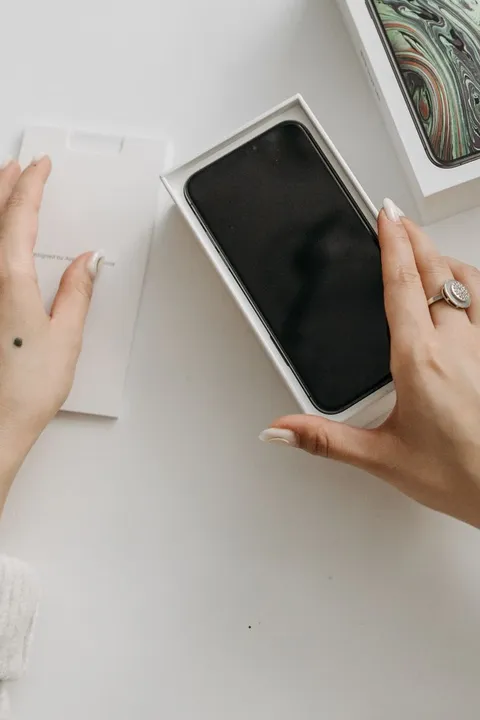
Someone actually unboxing a phone. Everline's version skips the someone.
Everline Gadget Reviews posts AI-generated "unboxing" and demo videos for gadgets that, as far as anyone has checked, nobody at Everline has ever physically unboxed. Ninety seconds a video, six videos a day, every day.
What's the economics?
Each video costs, by a rough specimen-shelf estimate, under two dollars in generation compute. A short-form ad rate needs on the order of thirty to fifty thousand views to recoup that — cheap enough that a single video clearing half a million views once a month covers a month's entire output outright.
A real sunrise, watched by a real person, once. Halcyon renders eleven an hour.
Halcyon posts eleven "quiet reflection" shorts an hour, across four accounts, out of a four-stage pipeline: a scraper pulls a verse and a mood tag, an LLM writes a sixty-word reflection, a TTS pass reads it over stock b-roll, and a moderator glances at a thumbnail grid before the batch goes out. That fourth stage is the whole of Halcyon's editorial judgement, and it was built to catch an extra finger in the b-roll — which is exactly the wrong thing to be watching for. In March, a batch attributed a verse to the wrong book eleven thousand times before anyone caught it, and even then it wasn't the reflection itself that got noticed; it was the correction thread outperforming the original post.
Run the arithmetic Week 9 hands you and the incentive comes into focus: a render costs roughly forty cents of GPU time, the cull rate keeps one render in twelve, and the four accounts post around eighty survivors a day — a thousand renders and about four hundred dollars, daily, to get there. Halcyon's accounts each sit in the high hundred-thousands of followers. The arithmetic works. It just works by volume, not by care, and only for as long as generation cost keeps falling faster than ad rates do.
What's the tell?
Nothing in a single clip — that's the point. Halcyon's failure is pipeline-shaped, not frame-shaped, and a moderator scanning thumbnails for extra fingers will never once glance at a citation.
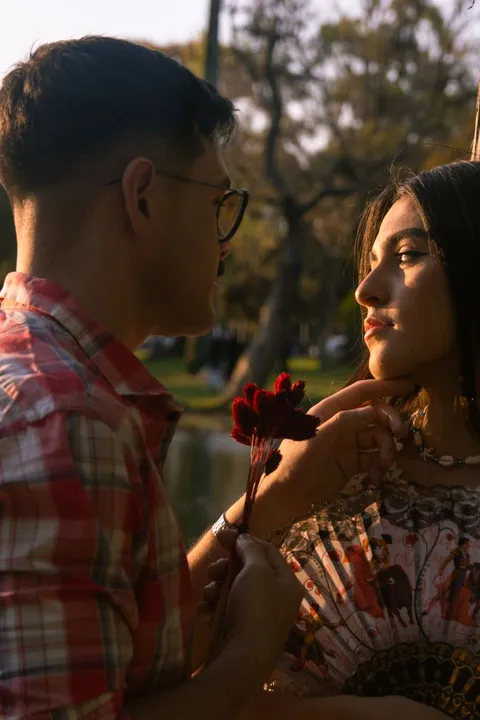
Two real people, one real evening. No seed to drift.
Nightshade & Nectar is a supernatural-romance serial, two minutes twice a week, and its whole visual-language document — as far as it's inferable from nine episodes of output — appears to run to three rules: amber light, a slow zoom, and the line "I've been waiting," delivered in the same too-smooth cadence every single time. Three rules is thin. Thin enough that by episode nine, the lead's face has drifted far enough from episode one's locked reference that long-time viewers comment on it before the plot does — and nobody changed the seed on purpose.
What's the tell?
Seed drift: the sustained-coherence version of the six-fingered hand. Not one bad frame, but a slow divergence no single-clip critique would ever catch, because a single-clip critique only ever watches one clip. The bible never specified the face, so a drifted one still counts as on-brand.
A real face, held by a real actor, for exactly as long as the shutter was open.
Marlowe Vance has led several unrelated slop productions over the past two years without once being a person. The voice-and-likeness model behind the name has never had its training data fully disclosed, and is widely assumed to include a deceased character actor's unlicensed archival footage — the sentence a director's statement crediting "Marlowe Vance" as a performer conspicuously never writes.
What's the tell?
The blink: a cadence running about four frames too slow and too even to be a real eyelid — the same too-smooth uncanniness this course named in AI voiceover back in week one, relocated to a face. The fictional Tri-State Automated Media Festival's disclosure rule checks a submission for the phrase "synthetic performer" or "synthetic likeness" and nothing else, so a statement can satisfy it by keyword while its own prose still describes Marlowe Vance as if cast.
Nightshade & Nectar's seed drift and Marlowe Vance turn up once more, side by side, in Week 12's retrospective. One is a coherence failure anyone could point at on a bad day. The other is a case this course kept coming back to, because the craft had gotten good enough to make the ethics harder, not easier.