Week 11 of 12 — Phase IV, Diagnose and Prove
Failure Autopsy
How can a failure sequence be reconstructed from limited evidence?
Failure recorded
Observed
Inferred
Unknown
The record is blank because the week has not been done yet. Filling it in here would be inventing the evidence.
Test station 11
The apparatus.
Evidence set — specimen 114
Three observations. No order.
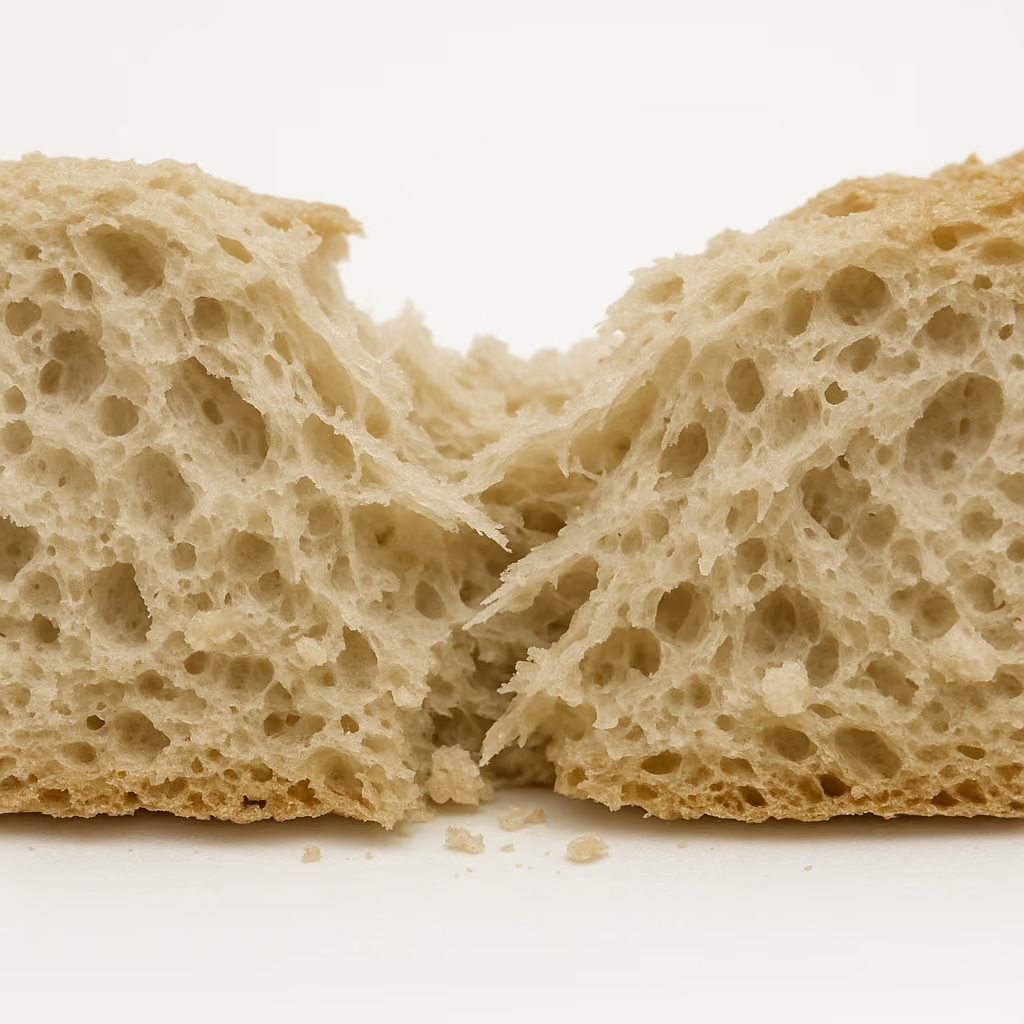
Item A — Torn edge
ObservedThe upper layer has parted. The break is irregular and fibrous: crumb strands still bridge the gap, torn cell walls stand open, and detached crumb has collected below the break.
Not establishedWhether the layer was torn by handling or failed under load.
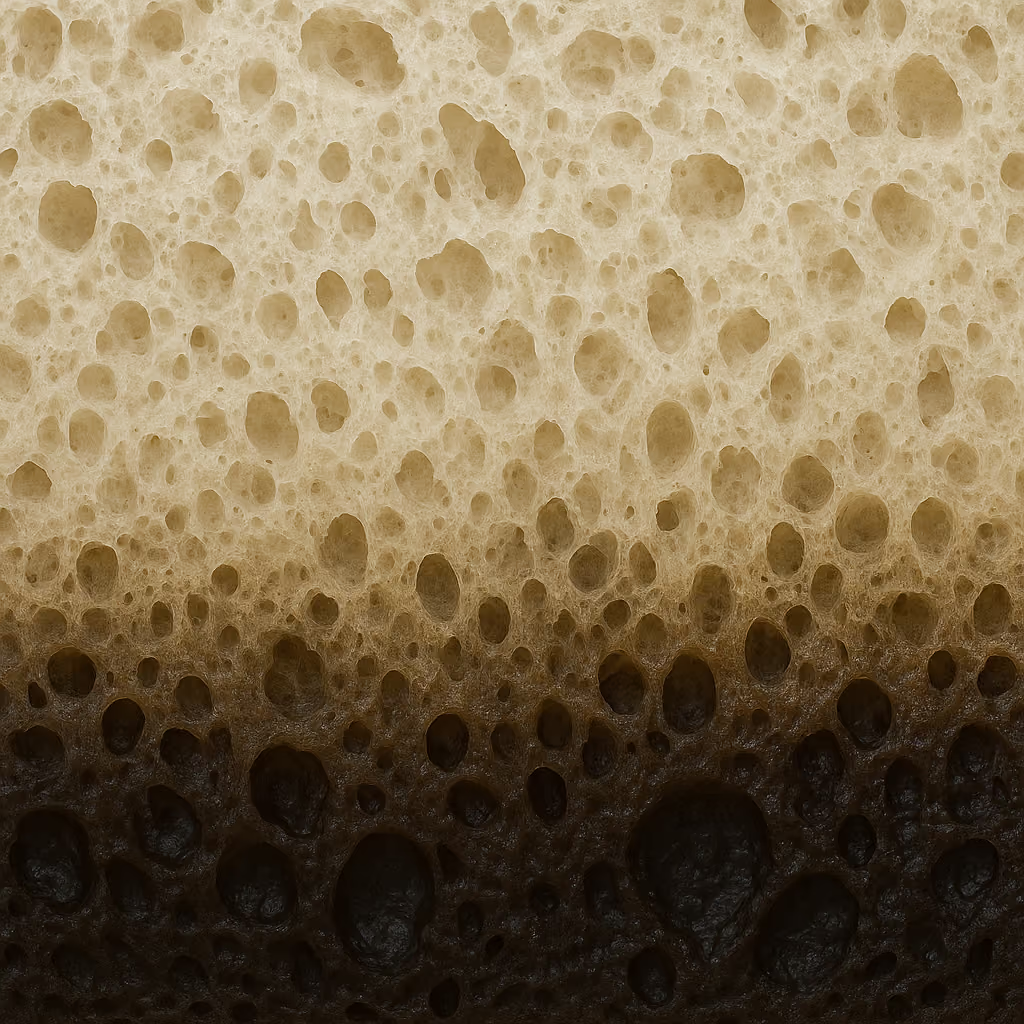
Item B — Wetted boundary
ObservedA cut face shows saturated crumb below and dry crumb above. The boundary is diffuse rather than sharp, and darkening reaches further up the larger cells than the smaller ones.
Not establishedHow long the boundary took to reach this position, and whether it was still advancing when the assembly failed.
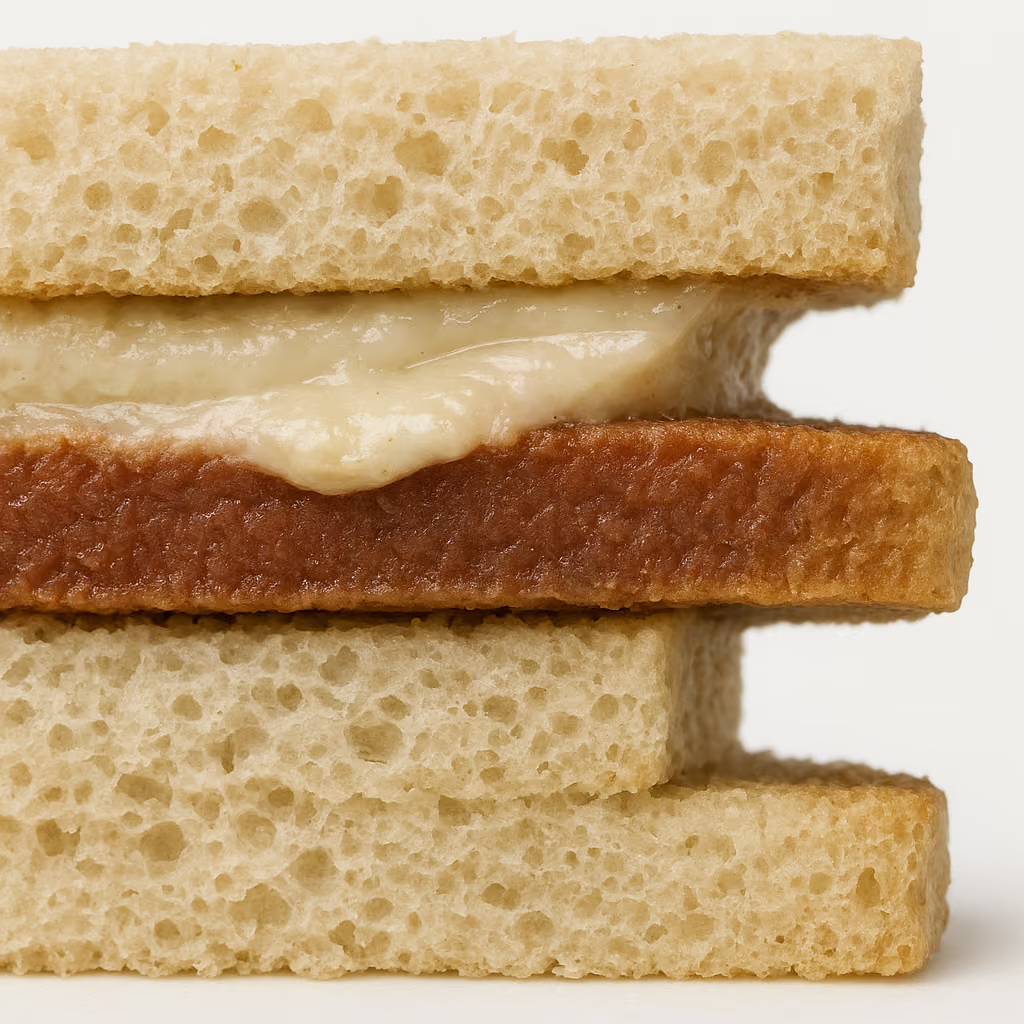
Item C — Displaced layer
ObservedThe middle layers sit out of register with the bread above and below and overhang it. The film at the interface is drawn out and glossy in the direction of the displacement.
Not establishedWhether the interface was already lubricated before the displacement, or was made so by it.
These three items are one specimen, and they establish no order.Each was recorded after the assembly had already failed, so nothing in the set shows which came first. A reconstruction that puts them in a sequence is making a claim, and the claim needs an argument the evidence can carry.
This week
Structural question — how can a failure sequence be reconstructed from limited evidence?
This is the destructive-testing week. The specimens arrive already failed, and nothing about how they failed can be recovered by asking.
Reconstruction from incomplete evidence
A failed assembly presents an end state. What it does not present is an order. A displaced upper layer, a wetted lower boundary and a torn edge are three observations; whether the wetting preceded the displacement or followed it is not an observation but a claim, and a claim needs an argument.
The discipline is separating correlation of appearance from established cause. Two specimens that look alike at the end may have arrived by different routes, and a failure that resembles the Week 4 moisture cases is not thereby a moisture failure. Resemblance narrows the candidate set; it does not close it.
So competing explanations are held open together. Each must account for every fragment in the inventory, or state which fragment it cannot account for, and the explanation that survives is the one leaving fewest fragments unexplained. That ranking is a course convention for making reasoning visible rather than a measure of real-world likelihood — a rare cause can still be the true one, and the method is designed to record that rather than resolve it.
An honest reconstruction therefore ends with something unresolved. A dossier containing no unresolved uncertainty is not a stronger diagnosis; it is a diagnostic sign in itself.
Investigation
In the failure-autopsy room, take an evidence set you did not produce: fragments, a photograph or two, a partial record of the conditions. Inventory it before proposing anything — every fragment listed and marked observed, inferred or unknown.
Then build the causal chain as a branch rather than a line. At each point where the evidence admits two orders, record both and state what evidence would decide between them. Diagnose the sequence you consider most defensible, name at least one competing explanation you cannot eliminate, and say what you would have needed in order to eliminate it.
Failure condition
A reconstruction fails when a resemblance has been written up as a cause: an assembly recorded as having failed by slippage because it looks like the slippage cases, with no evidence of the interface condition at the time. The tell is a chain with no branches and no unknowns.
What leaves the session
A Failure Autopsy: an evidence inventory with observed, inferred and unknown separated; a branching causal chain with the decisive evidence named at each branch; one competing explanation left standing; and a stated residue of uncertainty. This is the working core of the Failure Autopsy assessment, which marks the treatment of that uncertainty alongside the reconstruction itself.
Where this week's evidence goes
Due at the end of this week.
Diagnose — 25%
Failure Autopsy
Reconstruct the most defensible failure sequence from incomplete evidence.
Due 14 May 2027, end of Week 11
The Failure Autopsy this week produces is evidence for that submission. The recording sheet for it, and the standard it is judged against, are in the Field Manual.
Any activity here can be completed with a physical specimen, a non-food analogue, or the supplied evidence pack — see policies and participation.