What the university publishes
- A forty-page assessment policy
- A thirty-page academic integrity procedure
- A flowchart for appealing a mark
What it doesn’t
- How to ask a tutor a question without sounding rude
- How to ask for an extension without sounding like an excuse
Where we were
Part III starts here: negotiating with the protocol rather than only reading it.
Institutions are its most formal version — the one place the protocol is written down, except for the part you need.
The format has a price
Instructors shown student emails written either casually or formally.
The difference accounted for 48% to 64% of the variance in how they felt about the student, how credible they found them, and their attitude to the message.
It also affected whether they agreed to a simple request to meet.
Stephens, Houser & Cowan (2009), Communication Education 58(3)Two groups, two sets of rules
Same study: instructors were bothered more than students — especially by unsigned emails and shortcuts like “RU”.
Students put the problem down to technology. Instructors put it down to training.
Why anyone would care about a subject line
An inbox is a queue with a person at the end of it.
Use the subject line to show what needs an answer before they open the message.
Estimating a yes
In these studies, people underestimated how likely others were to say yes to a direct request for help — by as much as 50%.
They focused on the cost of saying yes and underestimated the social cost of saying no.
Flynn & Lake (2008), Journal of Personality and Social Psychology 95(1)Which cuts against the instinct
If asking feels like an imposition, consider both costs:
what saying yes would ask of them, and what saying no might cost them.
Another reason to leave it in drafts
“They’ll think less of me for asking.”
The fear runs the wrong way
People hold back from seeking advice for fear of appearing incompetent.
People judged someone who asked for advice as more capable than someone who didn’t.
Brooks, Gino & Schweitzer (2015), Management Science 61(6)Three things that moved it
| What moved it | What to do about it |
|---|---|
| the task was hard rather than easy | ask about the genuinely hard part, not page 3 of the outline |
| advice sought from them personally | write to the person, not the room |
| the person asked was an expert | ask whoever actually knows |
The friction is at the interface
Autistic students at UK universities reported more challenges with the social side of university life — and also reported academic strengths.
Gurbuz, Hanley & Riby (2019), Journal of Autism and Developmental Disorders 49(2)The institution knows
11 disability support staff, seven UK universities, on supporting autistic students into university.
They named their own barriers. Alongside lacking resources:
Davies & Bagnall (2024), Autism in Adulthood 7(2)“relying on students to self-advocate their needs”
So why teach the scripts at all?
Because self-advocacy is associated with educational and employment outcomes, socialisation, identity, quality of life.
The review’s own words are “encouraging associations” — a mini-review, not a demonstrated effect of teaching anyone to write an email.
Martino, Brantley & Scarpa (2025), Frontiers in Child and Adolescent Psychiatry 4But their fix isn’t you
The staff’s three recommendation themes:
- comprehensive preparation and sustained support
- positive communication between stakeholders
- an accessible, inclusive university culture
With universal design named as the way to take pressure off individual services.
Davies & Bagnall (2024)Use the scripts where they help.
Needing them does not make the system right to require them.
In the room: rate your last ask (5 min)
1 min, alone: choose a past request, or fictional Alex: twenty minutes drafting a request for report-clause feedback, expecting refusal, not yet sent.
3 min: answer, using “unknown” where needed:
- How long did you spend composing it?
- Did you get what you asked for?
- If you didn’t ask at all — what stopped you?
1 min: separate what happened from what you predicted. Keep the answers private.
One question. The paperwork.

Specimen: the email
Subject: [NT101] Interoperation Report: feedback on a reply-time clause?
Hi Jonah,
I’m in the Thursday lab and drafting a reply-time clause for the Interoperation Report.
Would “reply by 18:00 on the next weekday” make our clause checkable?
I’ve read the brief’s requirement for a check each partner can use. Our first draft only said “reply promptly”.
We’re reviewing the draft on Monday, so a reply before then would help.
Thanks, Alex Chen (u7654321)
Wording and clauses
The wording is a template. Test the clauses in the lab, and check the recipient’s requirements before using them elsewhere.
Seven clauses
| # | Clause |
|---|---|
| 1 | Subject line carries the course code and the request |
| 2 | Greet by name |
| 3 | Context in one or two sentences, no more |
| 4 | One request, as an answerable question |
| 5 | Say what you’ve already checked |
| 6 | Say when you need it by, and why |
| 7 | Full name and student number |
Clause 4 does the most work.
Clause 6, and why it works
Say when you need it by, and why.
Not “as soon as possible”. A date, and the reason that date exists.
It gives the recipient a date to plan around, and a reason for that date.
Specimen: the extension
Hi Wren,
I’d like to request an extension on the Interoperation Report to Wednesday 2 June. I’ve had a health issue this fortnight that’s cost me most of my working time. I’m about half done, and the new date would let me finish it properly.
Thanks, Alex Chen (u7654321)
43 words. A date, a one-line reason, where the work stands.
Clause 5: show where you looked
Say what you’ve already checked.
“I’ve read the brief’s requirement for a check each partner can use. Our first draft only said ‘reply promptly’.”
It shows the recipient where you have already looked, so they can start from there.
Specimen: office hours
“Hi, I’m Alex, from NT 101. I’ve got one question about the Protocol Specification feedback. It should take about five minutes.”
The easiest move to leave out is how long it will take.
It tells the tutor how to budget their attention — and gives you a natural exit: at five minutes, “that’s everything, thanks”.
Why “a health issue” is enough
The extension request discloses a need, not a diagnosis, not a history.
43 words, and none of them owed to anybody.
Week 10 takes this apart properly. For now: the smallest true thing that gets the adjustment is the right amount.
Break
14:55–15:05
Resume at 15:05.
Does this need a reply?
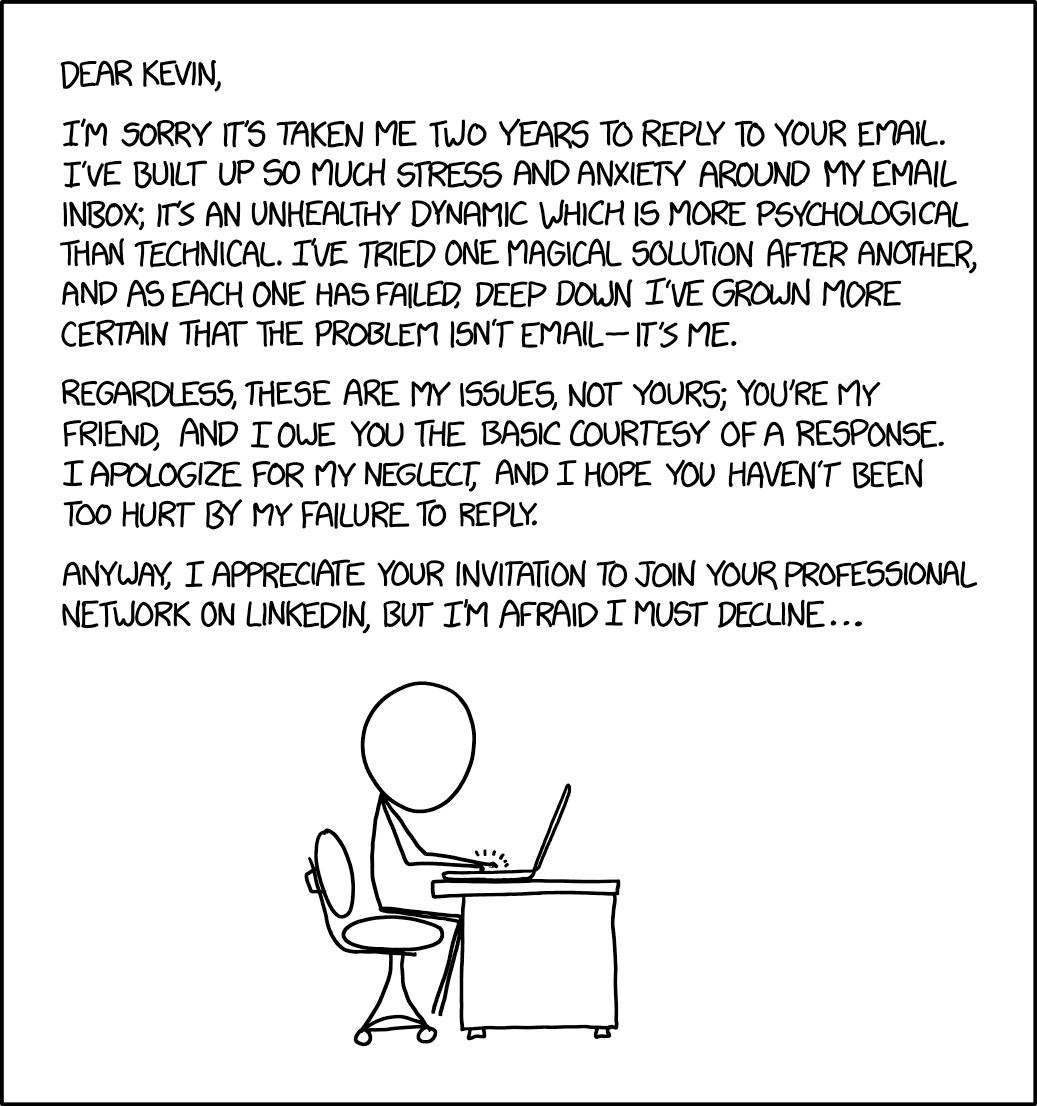
Read the comic as text
“Dear Kevin, I’m sorry it’s taken me two years to reply to your email.”
“I’ve built up so much stress and anxiety around my email inbox; it’s an unhealthy dynamic which is more psychological than technical. I’ve tried one magical solution after another, and as each one has failed, deep down I’ve grown more certain that the problem isn’t email—it’s me.”
“Regardless, these are my issues, not yours; you’re my friend, and I owe you the basic courtesy of a response. I apologize for my neglect and I hope you haven’t been too hurt by my failure to reply.”
“Anyway, I appreciate your invitation to join your professional network on LinkedIn, but I’m afraid I must decline…”
Group work
A group’s first meeting sets its protocol whether or not anyone writes it down.
Write it down. It fits on one screen.
The five clauses of a group agreement
- Roles — who does which part, and who pulls it together
- Channel — where the group talks, where decisions get recorded
- Reply time — “within a day on weekdays”, not “ASAP”
- Decisions — majority, consensus, or the part’s owner
- Going quiet — what happens when someone disappears for three days
In the room: write the going-quiet clause (6 min)
1 min: form a fictional group of three. Its draft says “Reply ASAP; tell us if anything changes.”
2 min, alone: each writes a sentence covering what someone sends, how long others wait before checking in, and what they do not conclude.
2 min, together: read all three and negotiate a version.
1 min: check what each person does after the wait. Keep unresolved alternatives if you cannot agree.
In the room: check the reply, then the exception (10 min)
2 min, pairs: Sam asks: “Could we meet Friday? Can I have until 2 June for the report? Are four clauses enough?” The reply: “I can meet Friday at 11:00.”
3 min: mark what was answered. Draft a follow-up for what remains open. Silence about an extension is not permission.
3 min: the tutor adds, “Keep related report questions in this one thread.” Revise your message so every request is identifiable.
2 min: compare with another pair. Which clause did you vary, and what justified it?
Agree what silence means
Going quiet. What happens when someone disappears for three days.
Without an agreement, the others have to guess what the silence means.
Week 7’s message is what the group agrees to send. This clause is what they agree to accept.
In the room: cut it to one (6 min)
Hi Jonah, could you check our reply-time clause, send the week 9 question cards, and tell me whether I can attend a different lab next week? Thanks, Alex.
1 min: read this fictional draft and choose a request.
3 min, pairs: write one answerable email around it. List the other two as unsent follow-ups.
2 min: swap with another pair. Could a reply clearly answer it? Why did you keep this request?
The five-minute opener, in parts
“Hi, I’m Alex, from NT 101. I’ve got one question about the Protocol Specification feedback. It should take about five minutes.”
- who you are, and which course
- how many questions
- how long
Three facts, and the tutor has an estimate for the next five minutes.
What this week added to the vocabulary
- the seven clauses — the course’s spec for an institutional ask
- ask for a date — make the requested extension specific
- how long it will take — the office-hours time estimate
- going quiet — agree what silence means
Week 10 takes the extension request’s “a health issue” and asks how much more you owe anyone.
Check yourself against this week
Does a real email or supplied-scenario draft pass all seven clauses, with a reason for any exception?
Can you ask for a specific date in under 120 words?
Does your group’s agreement say what happens when someone goes quiet?
If time remains
Which institutional request should become unnecessary if the institution documented its own protocol properly?
Optional discussion. Finish by 15:55.