Three turns
— “Meet you Thursday.”
— “This Thursday?”
— “Next Thursday.”
One misunderstanding, fixed before anyone noticed there was a problem.
Where we were
Week 4: a gap gets read, and sometimes a gap is being given.
This week: what the gap is often being given for.
The speaker gets first go
Conversation has built-in machinery for trouble with speaking, hearing and understanding: the organisation of repair.
A strong skew inside it: speakers fix their own trouble far more often than anyone else fixes it for them.
Schegloff, Jefferson & Sacks (1977), Language 53(2)Once every 1.4 minutes
48.5 hours of conversation, twelve languages, eight language families.
2053 cases of a listener signalling trouble — about one every 1.4 minutes, in every language sampled.
Dingemanse et al. (2015), PLOS ONE 10(9)Misunderstanding isn’t an exception condition.
It’s steady-state traffic.
Three ways to say you didn’t get it
| Type | What it does | Example |
|---|---|---|
| Open request | flags trouble, not where | “Huh?” / “Sorry, what?” |
| Restricted request | asks about one part | “Who?” / “Which Thursday?” |
| Restricted offer | offers a guess | “This Thursday?” |
Every language sampled had all three — and people choose the most specific initiator available.
Dingemanse et al. (2015), PLOS ONE 10(9)So: say the part you got
“Sorry, you want the draft by Friday, or on Friday?”
Shows the speaker exactly which part you caught.
When repair begins
169 other-initiations of repair, timed. Those that located the trouble specifically arrived after shorter gaps than those that didn’t.
The rare ones that simply corrected an error arrived without delay.
The most frequent gap before a repair initiation was about 700 ms.
Kendrick (2015), Frontiers in Psychology 6, 250Part of what that delay is for: giving the first speaker a chance to fix it themselves.
“Huh?” is a word
Found in much the same form and function across ten languages — far more alike than chance would explain.
Learnt, not an involuntary noise. It exists because every language needs a way to say I didn’t get that.
Dingemanse, Torreira & Enfield (2013), PLoS ONE 8(11)- From Trouble to Initiated: most specific initiator
- From Initiated to Repaired: speaker fixes it
- From Repaired to Carry on: one-turn accept
- From Trouble to Repaired: self-repair
Accept in one turn
“Got it.” / “Ah, next Thursday.”
Adding an apology for a misunderstanding can add further turns.
And it moves the conversation’s attention from Thursday to the two of you.
In the room: the repair drill (10 min)
- “Meet you Thursday in the library.”
- “Send the draft to the tutor by Friday.”
- “The room is 214.”
- “Bring the printed worksheet.”
- “The deadline is noon.”
- “Use Update as the email subject.”
1 min: assign roles. Sender mumbles the bold word; listener looks away, uses the most specific available initiator, then accepts the supplied repair.
6 min: six rounds, swapping each time. 2 min: compare what had been heard and what needed repeating. 1 min: each records an initiator to reuse.
Why the skew matters
Speakers fix their own trouble far more often than listeners fix it for them — and that is a design property, not politeness.
Leaving a gap can give the speaker time to repair the problem without a prompt.
Counting a repair
| Scripted example | Repair turns | Acceptance |
|---|---|---|
| “Huh?” / “Next Thursday at two.” | 2 | “Got it” adds 1 |
| “Which Thursday?” / “Next.” | 2 | “Got it” adds 1 |
| “Next Thursday?” / “Yes.” | 2 | “Got it” adds 1 |
| “Thursday — I mean next Thursday.” | 1 | “Got it” adds 1 |
Count from the first turn containing a repair move. Count acceptance separately. Specificity can reduce repetition without reducing the number of turns.
When the error is an offence
Mishearing a day is cheap. Letting someone down isn’t, and the protocol switches subroutines.
Six apology components tested, alone and combined: apologies with more components were rated more effective, and some counted for more than others.
Lewicki, Polin & Lount (2016), Negotiation and Conflict Management Research 9(2)Same direction, plus a mechanism
Two experimental vignette studies: more verbal elements increased forgiveness, especially after a more severe offence.
And the link between completeness and forgiveness was mediated by anger reduction.
Kirchhoff, Wagner & Strack (2012), Peace and Conflict 18(2)The four that mattered
For a more severe offence, Study 2 found these particularly relevant:
- conveying emotions
- admitting fault
- a statement of apology — “I apologize”
- an attempt at explanation
Earlier versions of this course told you to keep explanation out of an apology.
That was too strong.
The template, corrected
| Part | Sounds like |
|---|---|
| Say it | “I’m sorry.” |
| Name what happened | “I didn’t send my section before the meeting.” |
| Say it was yours | “That’s on me, not the deadline.” |
| Say what it cost them | “You had to present without it.” |
| Explain, briefly | “I’d misread the day.” |
| Say what happens now | “It’s in the doc now, and I’ll send the next one early.” |
| Offer a fix | “Want me to take the Q&A next time?” |
Two rows are new.
Where the explanation goes
After the ownership, never before.
Shorter than the apology.
An explanation that arrives first, or runs long, can be heard as an excuse.
Break
14:55–15:05
Resume at 15:05.
The one thing still refused
“but”
Everything before it gets deleted by everything after it.
And the part still easiest to leave out
What it cost them.
Without it, an apology is about you. With it, they know you saw it from their side.
That row is the course’s, not a finding.
The stairs are still there

In the room: same parts, different order (10 min)
Fictional case: a printer jam meant you arrived without the worksheet. Your partner shared a screen.
A: “The printer jammed. I’m sorry. I didn’t bring the worksheet. That’s my mistake. You had to share a screen. I’ll print it at the break. Would you like me to print your copy too?”
B: “I’m sorry. I didn’t bring the worksheet. That’s my mistake. You had to share a screen. The printer jammed. I’ll print it at the break. Would you like me to print your copy too?”
2 min: tick template parts. 3 min: compare order and your preferences. 3 min: each writes a receiver reply. 2 min: compare two replies.
Repair is not a personality
Meta-analysis: 175 studies, 26,006 participants, on whether one person forgives another.
- apology r = .42
- state anger r = −.41
Situational constructs accounted for greater variance in forgiveness than victims’ dispositions.
Two folk theories, same abstract
Effect of gender: non-significant (r = .01).
Effect of age: negligible (r = .06).
Fehr, Gelfand & Nag (2010)In the room: write an apology (10 min)
4 min, alone: write a real apology you can work on privately, or use the fictional worksheet case. Include all seven parts. Nobody reads the whole apology out.
4 min, in pairs: exchange only the “what it cost them” line, or a fictional line if yours would reveal too much. Does it say what the other person had to do? 2 min: revise it and note any omitted part.
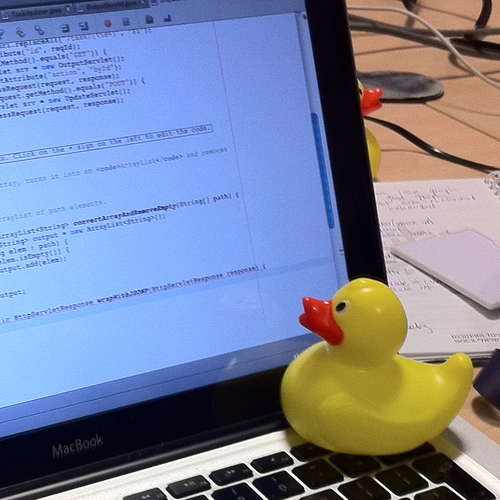
The duck cannot accept your apology

Receiving it
- Someone repairs a misunderstanding of yours: update and carry on. “Oh, next Thursday. Great.” Nothing went wrong.
- Someone apologises: accept in one turn, if you can mean it. “Thanks for saying that. We’re fine.”
- If you can’t mean it yet: “Thanks. I need a bit of time” is conforming.
What this week added to the vocabulary
- repair — the machinery, not an admission of failure
- repair initiator — the move that flags trouble, in three types
- the one-turn accept — acknowledge the repair and carry on
All three come back in week 9, when the thing needing repair is how deep a conversation went.
Check yourself against this week
Have you used the most specific initiator available, at least once, this week?
Can you say where an explanation goes in an apology, and what limits its length?
Can you name the finding behind “repair is error handling, not character”?
If time remains
What would count as a repair being finished when the person who sent it and the person who received it still disagree about what happened?
Optional discussion. Finish by 15:55.