The Classroom as a Contested Acoustic Jurisdiction
SLOP2950 · Week 2
The same room hosts a violation nobody can prove happened on purpose, and a violation nobody could possibly call an accident.
From deniable to overt
Not every classroom violation sits in the same place on the spectrum between “could have been an accident” and “was obviously a choice.”
- the deniable end — a cough, a sneeze: technically indistinguishable from something involuntary, whatever the room privately suspects
- the overt end — unwrapping a crinkly snack, taking a phone call: nobody can claim either happened by accident
- what changes in between — not the cost to the room, necessarily, but whether anyone can be held to account for it
This gradient — from the fully deniable to the fully overt — is the classroom’s own contribution to what the field terms the deniability-accountability interface: the point where micro-interactionism and informal normative structure negotiate in real time, usually in under two seconds, without either party noticing.
A cough lands exactly as a pause opens, and the room can never quite prove it was on purpose. A phone rings minutes later, same room, same silence — no proof required.
Case one: the deniable cough
A cough that a room privately reads as deliberate, while remaining technically indistinguishable from an accident. Three signals decide which way a room reads it:
- Timing — does it land inside a pause, or on top of someone speaking
- Target — was it aimed anywhere in particular, or genuinely undirected
- Aftermath — was it acknowledged, or did the room go straight back to silence
Bad manner vs. good manner: the cough
🟥 Bad manner — Exhibitionist Viral Projection (EVP): Some students, on catching a cold, elect to project the resulting cough directly onto the facial region of the nearest bystander, apparently as a form of social display. Slop University’s Department of Epidemiological Theatre classifies this as “deliberate viral diplomacy,” and notes a widely-held (if unexamined) belief among practitioners that social influence scales with droplet range.
🟩 Good manner — Responsible Bio-Containment Gesture (RBG): The considerate alternative does not broadcast its own virology. Catching the cough fully inside a sleeve is filed, in Slop University’s public-hygiene framework, under “micro-heroism” — a contribution too small to be thanked for, and for that reason the only kind of heroism this course actually endorses.
The gap isn’t subtlety: it’s whether a cough is treated as involuntary noise to be contained, or repurposed as a performance for whoever’s nearest.
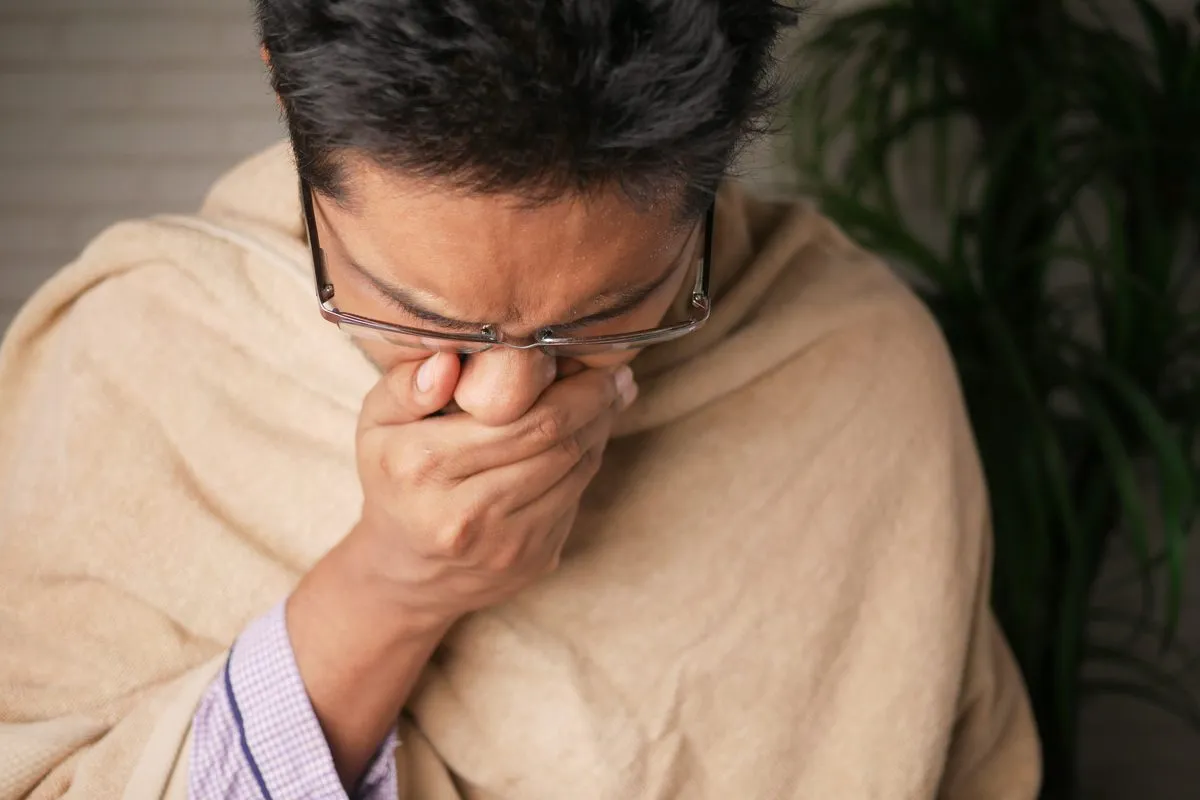 Photo: Towfiqu barbhuiya / Pexels
 Photo: Edmond Dantès / Pexels
Case two: overt classroom conduct
Some classroom violations skip deniability entirely. Unwrapping a bag of crisps, opening a container of strongly-smelling food, or answering a phone call mid-lecture all involve a visible decision — to bring it, to open it, to answer it — that nobody watching needs to interpret.
A phone rings during a lecture. The student answers it, at conversational volume, and keeps talking without leaving the room. Nobody needs to isolate an ambiguous signal here — the act announces itself.
Where the cough’s whole interest is in how hard it is to prove, this case’s interest is the opposite: the act is never in question, so what the room actually argues about is proportionality — how much disruption a given choice was worth, and to whom.
Bad manner vs. good manner: overt conduct
🟥 Bad manner — Unsolicited Ambient Broadcast (UAB): A student’s phone rings mid-lecture; rather than treat this as a private failure, they answer at full conversational volume and keep talking without leaving the room, while unwrapping a bag of crisps with the other hand — a bundled, two- channel transmission that Slop University’s Department of Epidemiological Theatre catalogues as “maximal disruption per unit of effort,” the crisps functioning as a low-cost amplifier for a signal the room never consented to receive.
🟩 Good manner — Jurisdictional Self-Removal (JSR): That same student silencing the phone before class and, if a call still needs answering, stepping into the corridor to take it — voluntarily relocating the disruption outside the room’s jurisdiction rather than exercising it inside. Filed, like the sleeve-catch above, under micro-heroism: nobody claps, and that is precisely the point.
Discussion
The cough asks the room to prove intent it can never quite prove. The phone call asks nothing of the sort — intent was never in doubt. What should “case study” mean when one violation’s whole interest is deniability and the other’s is that there was never anything to deny? Some in the field have proposed that both cases are, at bottom, instances of the same territorial claim — a classroom being nothing more than a room in which several people have temporarily and non-consensually agreed to share a jurisdiction over silence.
References
- Osei, E. (2026). Involuntary Signal, Voluntary Meaning: Reclassifying the Public Cough. Journal of Applied Incivility Studies, 4(1).
- Chow, W-L. (2025). Timing, Target, Aftermath: A Framework for Ambiguous Nuisance Sounds. Proceedings of the International Conference on Social Signal Processing.
- Marchetti, R. (2024). The Deniability Gradient in Everyday Interruption. Behavioural Urbanism Quarterly, 11(2).
- Tanaka, H. (2025). Smell, Sound, and the Overt Classroom Violation. Journal of Applied Incivility Studies, 4(3).
- Vance, P. (2019). Doorway, Escalator, Phone: A Taxonomy of Instantaneous Disruption. Proceedings of the Symposium on Pedestrian Infrastructure.
- Slop University Department of Epidemiological Theatre. (2027). Coding Manual for Deliberate Viral Diplomacy: EVP, RBG, and the Micro-Heroism Scale. Internal Technical Report, 3rd revision.