The knife
SLOP1640 — week 7
Idris Fenn
Why this week is different
Every other week in this course is argued in prose. This one is demonstrated: a blade either does what its geometry predicts or it doesn’t, and the difference is visible in the cut, not in a description of it.
- one idea per slide, one demonstration per idea
- nothing here is cooked — the knife prepares, it does not heat
- what a bad cut costs later is the subject of week 10
The working set
| Knife | Typical use |
|---|---|
| Chef’s / cook’s knife | general chopping, slicing, dicing |
| Paring knife | small, in-hand work: peeling, trimming, coring |
| Utility knife | mid-sized jobs a chef’s knife is too large for |
| Boning knife | separating meat from bone, thin and flexible |
| Filleting knife | fish, thinner and more flexible again |
| Bread knife | serrated, saws rather than presses through a crust |
| Cleaver | heavy, chops through bone and cartilage by weight, not edge angle |
A drawer holding several of them
A knife’s shape is an answer to a specific cutting problem. A cleaver and a paring knife are not the same tool used at different scales — they solve different problems, which is why a kitchen keeps more than one.
Anatomy of a blade
- spine — the unsharpened top edge; where downward force is applied
- edge — the cutting surface, ground to an angle on one or both sides
- bevel — the ground surface behind the edge that creates that angle
- heel — the back of the edge, nearest the handle; does the heavy work
- tip — the front of the edge; does fine, controlled work
- bolster — the collar between blade and handle on some Western knives
- tang — the blade metal that continues into the handle
A knife with no tang running into the handle is a knife that will fail at the handle first, regardless of what the edge can do.
The blade in profile
Edge angle and hardness trade off
The edge angle is measured per side, not across the whole edge. A wider angle behind the edge is more durable and more forgiving of hard contact; a narrower angle cuts with less resistance but needs harder, better- supported steel to hold its shape.
- Western-style edges: roughly 17–22° per side, on softer steel
- Japanese-style edges: roughly 10–15° per side, on harder steel
Neither is objectively correct — softer steel at a wide angle survives a line cook’s pace; harder steel at a narrow angle holds a finer edge longer but chips more easily under careless use. Choosing an edge angle is choosing what kind of failure the knife will have.
Steel and hardness
Hardness is reported on the Rockwell C scale (HRC). Kitchen knife steels mostly fall between 52 and 65 HRC.
- Softer (52–58 HRC) — more resistant to chipping, easier to re-sharpen, loses a working edge sooner
- Harder (58–65 HRC) — holds a working edge longer, more brittle at the edge, more demanding to sharpen well
This is the same trade-off as the edge angle, restated in the metal rather than the geometry — which is why the two move together in practice.
Typical dimensions
| Knife | Blade length | Approx. weight |
|---|---|---|
| Paring knife | 80–100 mm | 40–70 g |
| Utility knife | 120–150 mm | 80–120 g |
| Chef’s / cook’s knife | 200–250 mm | 150–220 g |
| Boning knife | 130–160 mm | 90–130 g |
| Bread knife | 200–230 mm | 150–200 g |
| Cleaver | 150–200 mm | 350–700 g |
Figures are typical manufacturer ranges, not a specification any one knife must meet — a knife well outside these ranges is unusual, not wrong.
Balance
A knife’s point of balance is where it sits level across a single finger — usually near the front of the handle or just onto the blade, just past the bolster on a Western knife.
- balance near the handle: the blade feels lighter, favours control
- balance forward, into the blade: the blade feels heavier, favours a cleaver-style chop that uses its own weight
A cleaver’s weight is forward on purpose. A paring knife’s is not.
Two different operations
Sharpening removes metal to cut a new edge — on a whetstone, worked through a sequence of grits from coarse to fine. It restores an edge that honing can no longer fix.
Honing does not remove metal. A honing rod straightens a working edge that has rolled slightly out of alignment under use, without cutting a new one.
Confusing the two is the most common maintenance error: honing a blade that needs sharpening will not restore it, because there is no metal to straighten back into place.
Verhoeven’s experimental work on sharpening geometry and edge-angle measurement is the source most of this section draws on — see the reading on the closing slide.
Removing metal, on a wheel
Maintenance schedule
The course’s stated schedule for the knives used in session:
- hone — before each session, or when a cut starts to tear rather than slice
- sharpen — roughly every four to six weeks of regular use, or sooner if honing stops restoring the edge
- inspect — check the edge for chips or rolling before each sharpen, not only after
A schedule stated in advance is a maintenance decision, not a reaction to a knife that has already failed — the same argument this course makes about food more generally, applied to the tool.
Honing, between sessions
Grip
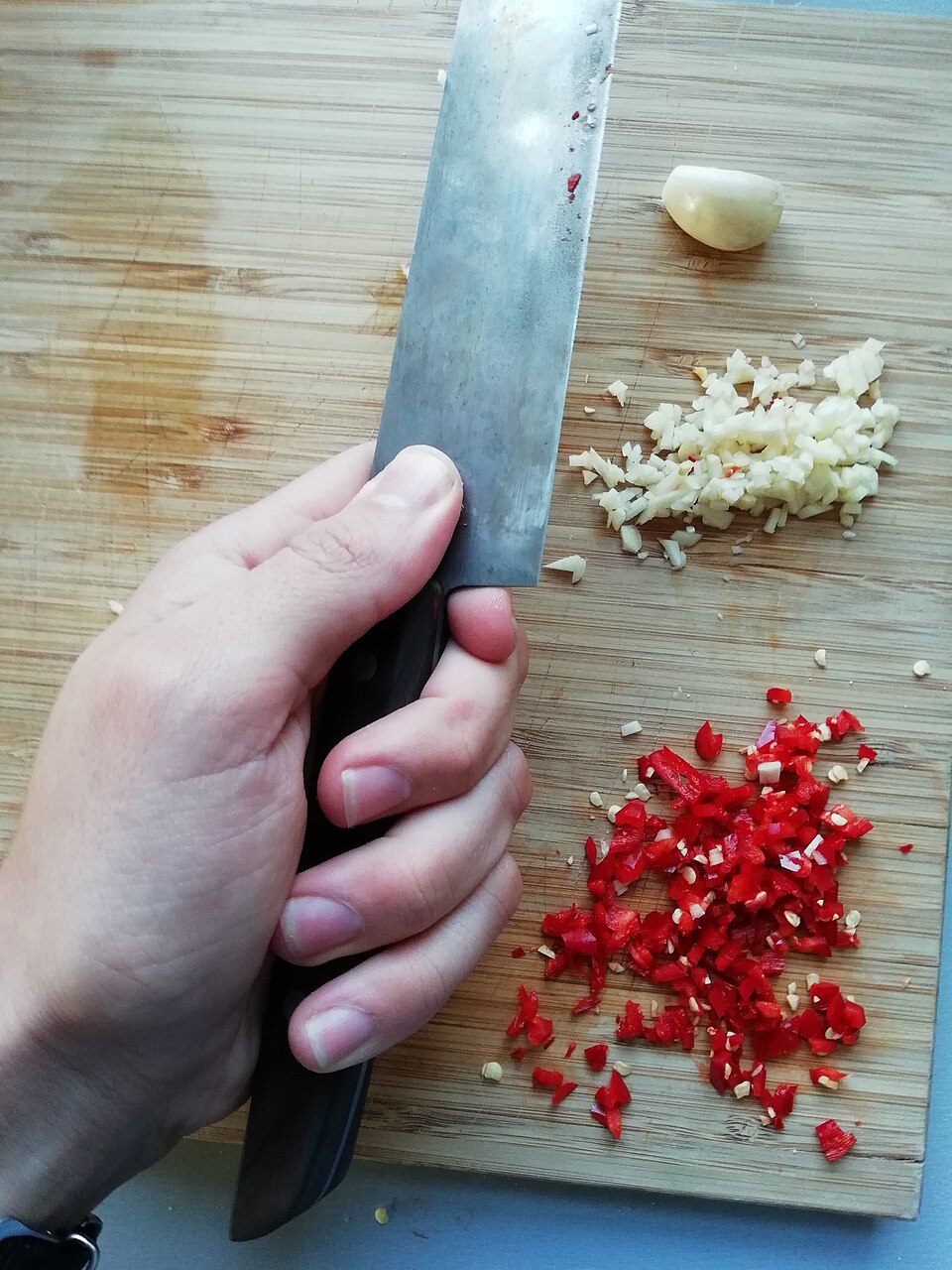
- knife hand — pinch grip: thumb and forefinger ahead of the bolster, gripping the blade itself, not just the handle
- guide hand — fingertips curled under, knuckles forward, guiding the food and shielding the fingertips from the blade
The pinch grip trades the instinct to hold a knife like a hammer for direct control over the front of the blade, which is where most of the cutting work happens.
The standard cuts
| Cut | Cross-section | Typical length |
|---|---|---|
| Julienne | 3 mm × 3 mm | 65 mm |
| Batonnet | 6 mm × 6 mm | 65 mm |
| Brunoise | 3 mm cube | — |
| Small dice | 6 mm cube | — |
| Chiffonade | ribbon, width varies | — |
Julienne and batonnet lengths — Auguste Escoffier School of Culinary Arts, Knife Skills: 10 Knife Cuts Every Professional Cook Should Know.
Why the measurement matters
A cut is a target dimension, not a style. The point of naming and measuring it is that every piece cooks at the same rate — which is exactly where week 10’s argument about consistent preparation starts.
A blunt knife does not fail quietly. It fails as an uneven cut, and the unevenness shows up two weeks from now, in a pan, as something that looks like a cooking mistake.
— Idris Fenn
Reading
Verhoeven, J. D. (2004). Experiments on Knife Sharpening. Iowa State University, Department of Materials Science and Engineering.
Session 7 practises the grip and the cuts above under supervision. Bring whatever is honed; nothing here is sharpened for you.