SLOP6674 · Dispatch 01 · 22 February 2027
Underground Diplomacy
Week 1: Credentials
AI generated Forest-floor cables. Not a field photograph.
This briefing
Two keys, both required
- Metaphor: credentials — what it takes to be recognised as a network at all
- Phenomenon: mycorrhizal structure. Hyphae. The arbuscular / ectomycorrhizal split. What counts as evidence of connection rather than mere proximity
The diplomatic label is a provocation. It does not get to stand in for the biology.
Order of business
What we will do
- Name the claim already in the room
- Get the anatomy straight enough to argue from
- Separate mycorrhiza from network
- Write the credentials test this semester has to keep using
- Say, before week 2, where the word “credentials” itself overclaims
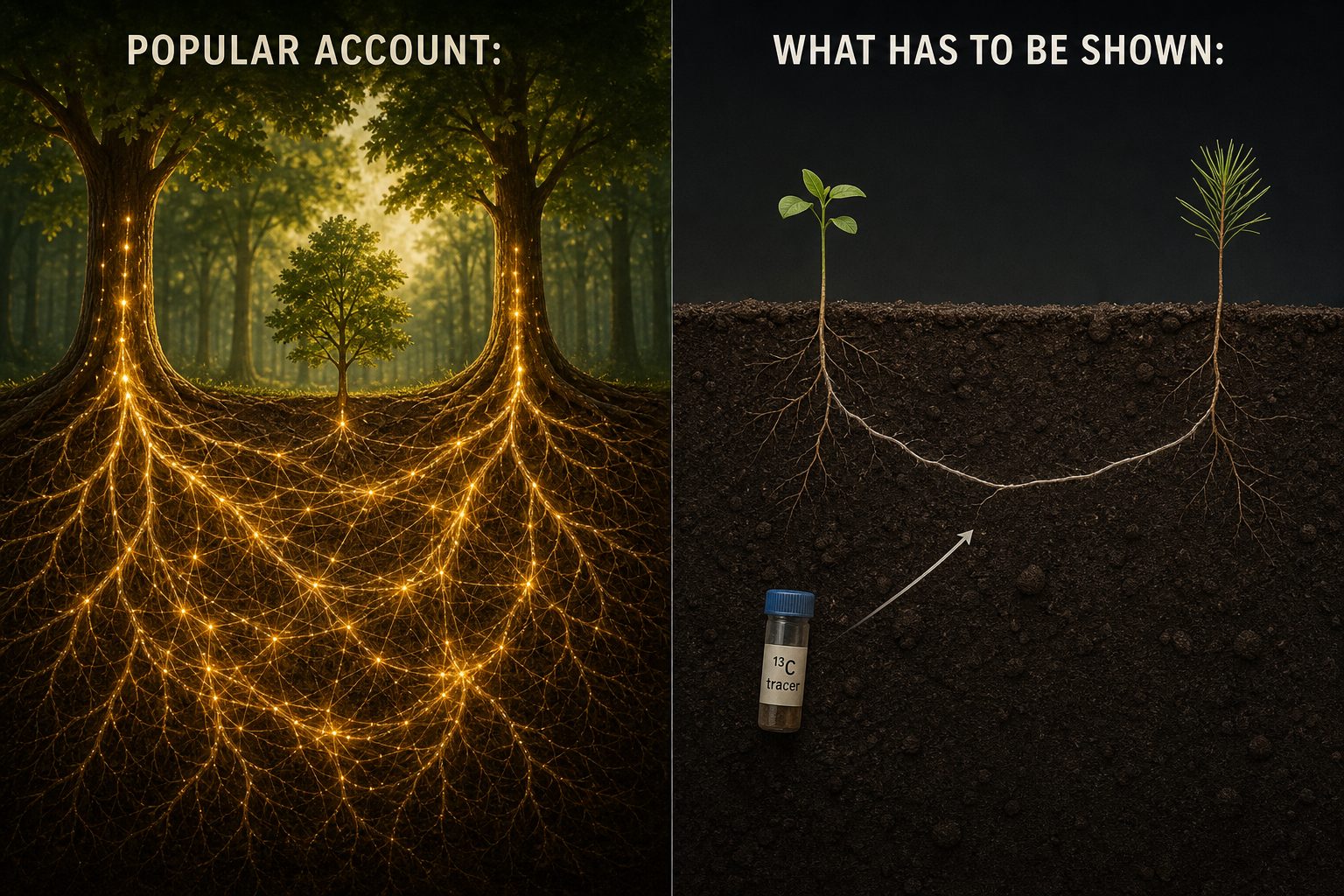
The claim already in the room
Trees talk. Mother trees feed their young. A “wood-wide web” under every forest.
That is a headline. This course will not start by repeating it, or by sneering at it. It will ask what would have to be shown.
AI generated Popular glow versus a tracer. Neither panel is data.
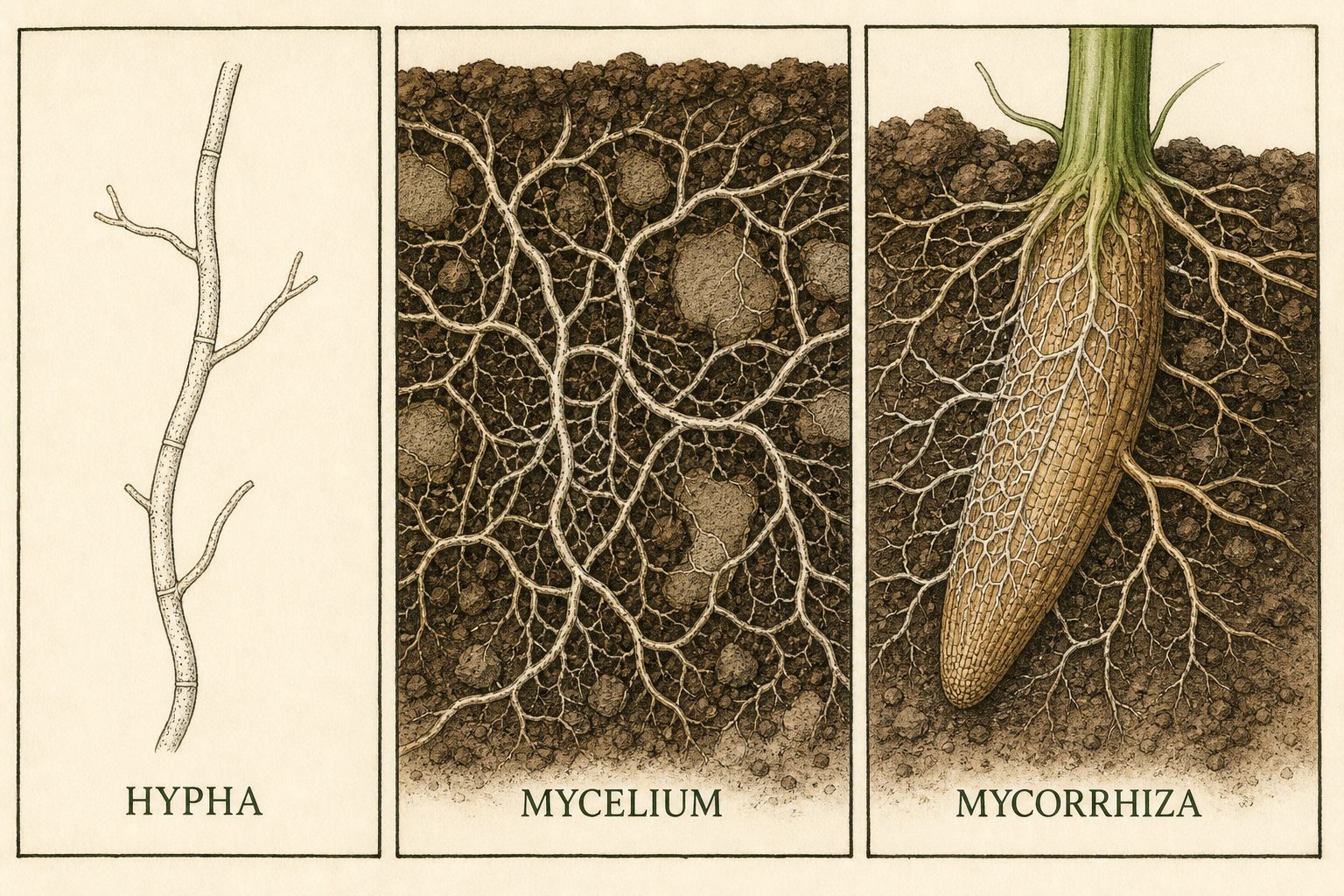
Vocabulary, before politics
Three words that are not synonyms
- A hypha is one fungal filament
- A mycelium is those filaments as a body
- A mycorrhiza is the structure hyphae and a root build together — neither partner makes it alone
AI generated Teaching diagram, not a micrograph.
Two associations, one word
Most of what this course will call “the network” is one of two structures. They are not interchangeable.
| Feature | Arbuscular (AMF) | Ectomycorrhizal (ECM) |
|---|---|---|
| Interface | Arbuscule inside the cortical cell wall | Hartig net between cells, plus a sheath |
| Fungi | Glomeromycota | Mostly Basidiomycota and Ascomycota |
| Typical hosts | Most vascular plant species | A minority of species, many of them forest trees |
Both get called mycorrhizal networks. Neither is automatically a network.
AMF: the fungus goes in
Hyphae enter the root cortex. Inside a cortical cell they branch into an arbuscule — the tree-shaped interface where phosphate and carbon are exchanged.
They do not enter the cytoplasm. The plant membrane wraps the fungus.
CC BY-SA M. Piepenbring, Wikimedia Commons.
What an arbuscule looks like
Stained root of horse gram (Macrotyloma uniflorum). Dark blue masses inside cells are arbuscules; the dense oval at lower right is a vesicle.
This is colonisation. It is not yet evidence that two plants share anything.
CC BY 4.0 Rajarshi Rit, Wikimedia Commons.
One arbuscule, in fluorescence
Rhizophagus irregularis in a maize root. The tree is the arbuscule; the trunk is the hypha that made it.
Confocal images made this structure famous. They still show a pairing, not a network.
CC BY-SA 2.0 Hector Montero, Wikimedia Commons.
ECM: the fungus stays out
Three parts, when the association is typical:
- A sheath (mantle) around the root
- A Hartig net between cortical cells — the exchange surface
- Extraradical mycelium into the soil
The cell wall is not crossed.
CC BY-SA M. Piepenbring, Wikimedia Commons.
What that looks like on a pine
Lactarius deliciosus on Pinus: swollen, forked tips; a mantle in cross-section; hyphae of the Hartig net running between cortical cells.
Short, fat, often dichotomous tips are a field mark. They are still one plant and its fungus.
CC0 Marc-André Selosse, Wikimedia Commons.
Mycelium is not a diplomatic cable
White extraradical mycelium on roots of white spruce (Picea glauca). This is the foraging body of an ectomycorrhizal fungus.
A photograph of threads in soil shows presence. It does not show a shared individual, and it does not show transfer.
CC BY-SA 3.0 André-Ph. D. Picard, Wikimedia Commons.
Who actually hosts whom
AMF are common as species; ECM are common as temperate forest biomass.
- About 72% of vascular plant species form arbuscular associations; about 2% form ectomycorrhizal ones (Brundrett & Tedersoo, 2018)
- Ectomycorrhizal trees are estimated at about 60% of stems globally, and more than 80% outside the tropics (Steidinger et al., 2019)
A rare association can still dominate a biome. That is not a network claim. It is a census.
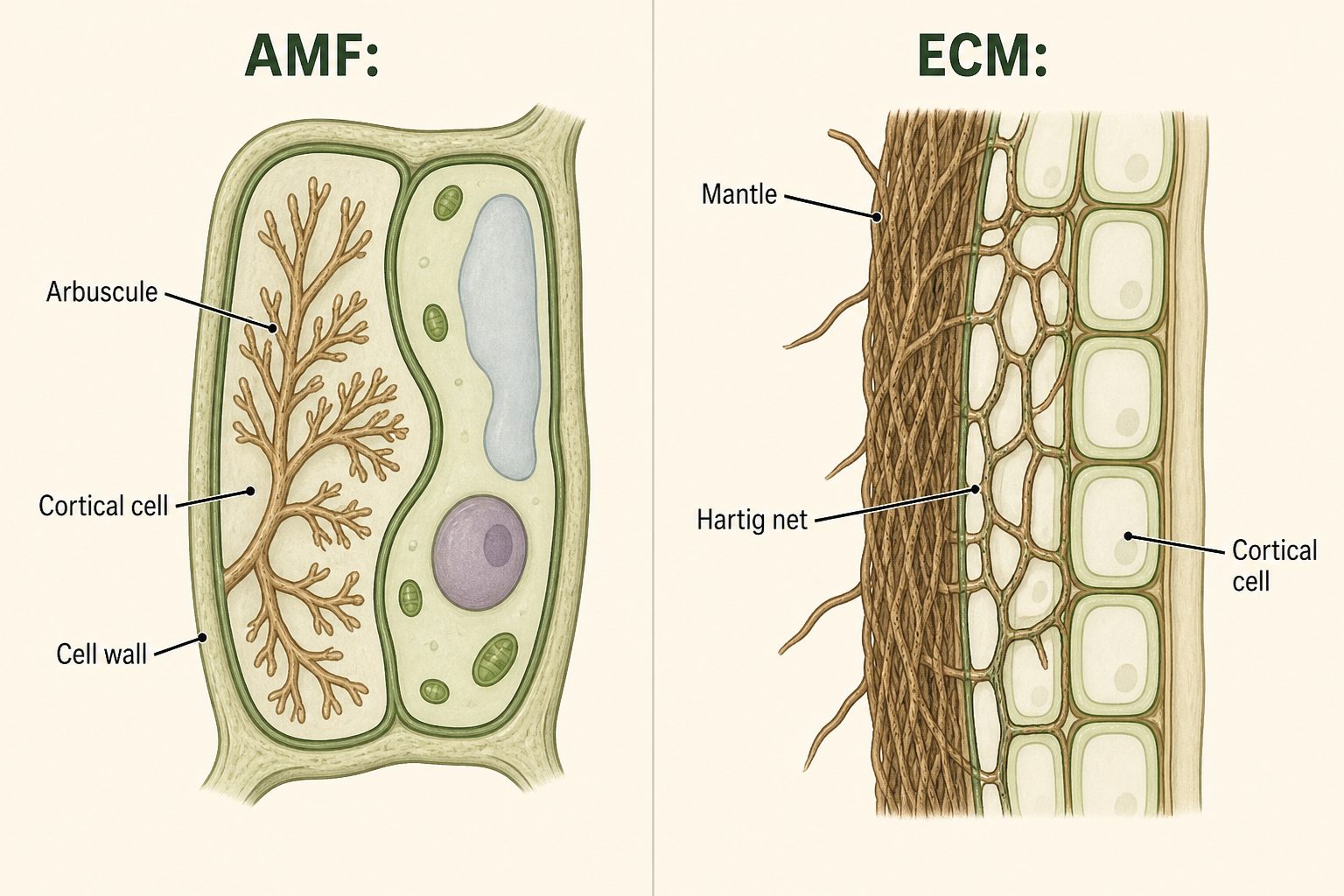
Side by side
AMF: arbuscule inside the cell wall, membrane invaginated around it. ECM: mantle outside, Hartig net in the apoplast.
If you can state that difference from memory, the Briefing’s first spec line is done.
AI generated Comparison plate. Use the Piepenbring figures for anatomy, not this.
Both get called “networks.”
Neither is automatically one.
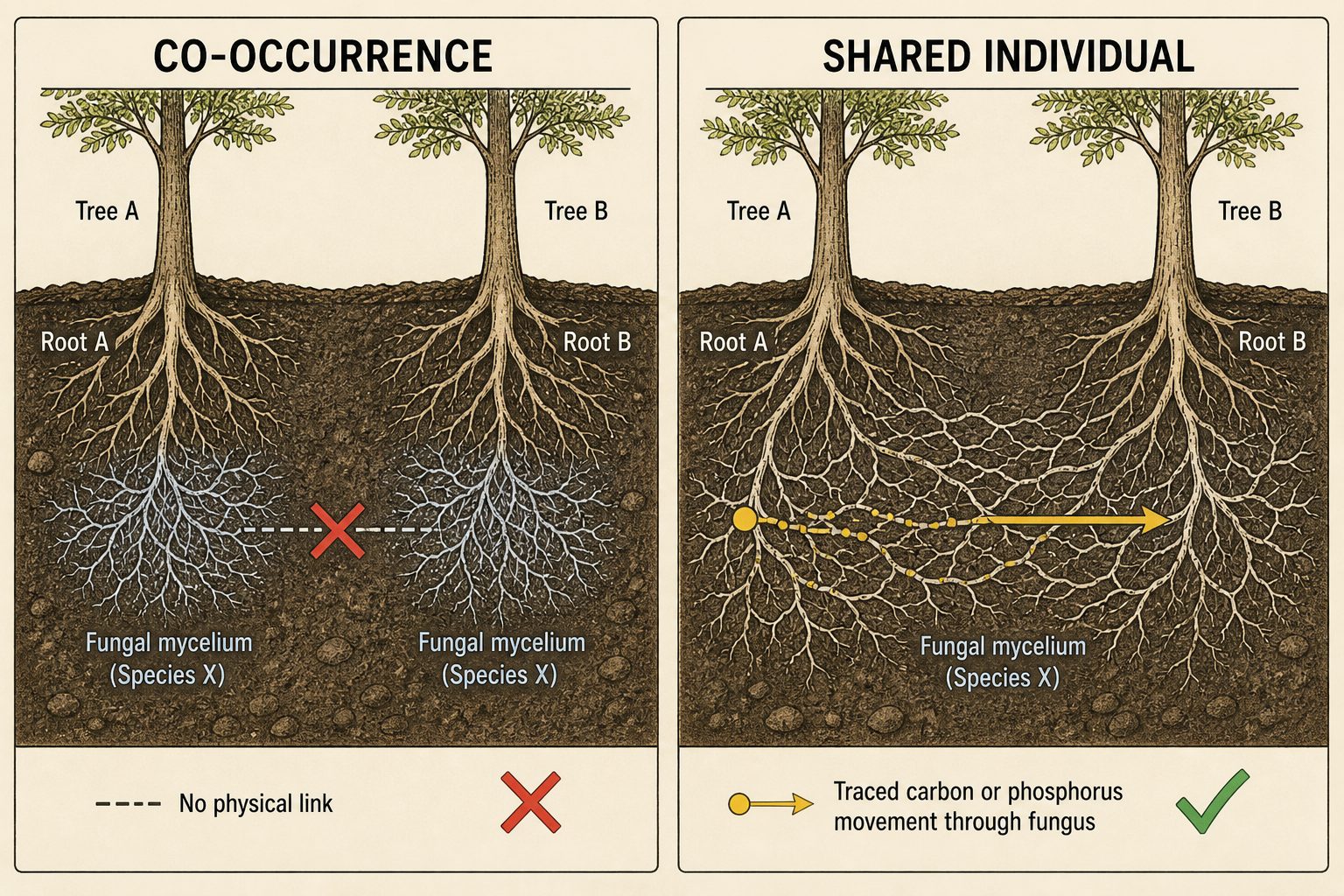
Proximity is not a credential
Two plants in the same soil, even with the same fungal species, can be unconnected. A network here needs a shared fungal individual — a genet — and measured movement of carbon or nutrients between named hosts through it.
AI generated Schema of the distinction, not a map of any forest.
What “connection” has to mean
Not co-occurrence. Not a fruiting body near a trunk. Not a documentary voiceover.
Before this course licenses the word network:
- One fungal individual, spanning more than one host
- Carbon or nutrient flow between those hosts, through that individual, actually measured
- Alternative paths (soil diffusion, overlapping roots) not left as the equally good explanation
Beiler et al. (2010) mapped Rhizopogon genets linking Douglas-fir cohorts. That is architecture. Architecture is not transfer.
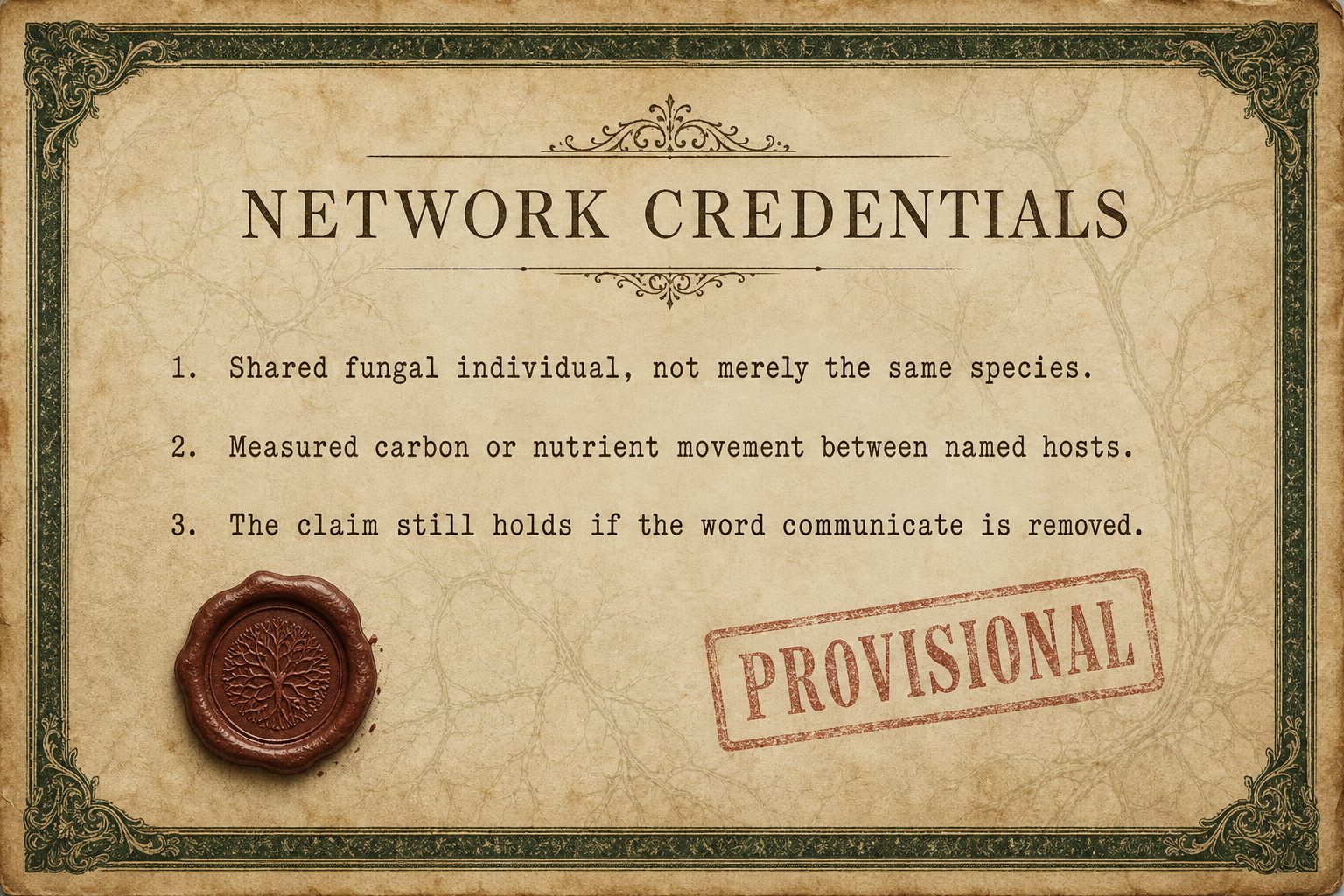
The credentials test
- Shared fungal individual, not just the same species?
- Measured carbon or nutrient movement between hosts through it?
- Does the claim survive without the word “communicate” doing the work?
Hold every later week against this, including the ones the convenor likes.
AI generated Costume. The soil does not issue papers.
“Interesting biology and good diplomacy make the same demand: show your evidence before you use the word for what you’re claiming.”
Where the metaphor already strains
“Credentials” overclaims too
A credential is issued. Someone recognises someone.
The soil does not. A mycorrhiza can exist without a bureau, and a common mycelium can exist without anyone being “admitted” to anything.
Keep the test. Notice the costume. Week 1 is not exempt from the rule it writes.
Three popular claims, one review
Karst, Jones & Hoeksema (2023, Nature Ecology & Evolution) took the headlines to the literature.
- That common mycorrhizal networks are widespread in forests: not settled. Field results vary, and other explanations remain open
- That resources moving through those networks improve seedling performance: not shown well enough to generalise
- That mature trees preferentially send resources and defence signals to their offspring: no peer-reviewed evidence
This is the kind of sentence the credentials test is for. Week 3 will sit with the carbon-transfer papers themselves.
The rest of the dossier
This semester
Trade agreements → aid → espionage → sanctions → double agents → borders → refugees → arms races → cold war → broken treaties → the peace conference, where we audit all of it against this morning.
If a week’s diplomatic label cannot clear the credentials test, it stays a metaphor. It does not become a finding.
Before next week
pnpm dev
pnpm check
Read the trade-agreement brief.
Bring one claim about fungal networks you have heard outside this course — a documentary, a headline, a conversation. You are not defending it. You are putting it on the table.